10% offfor military & first responders
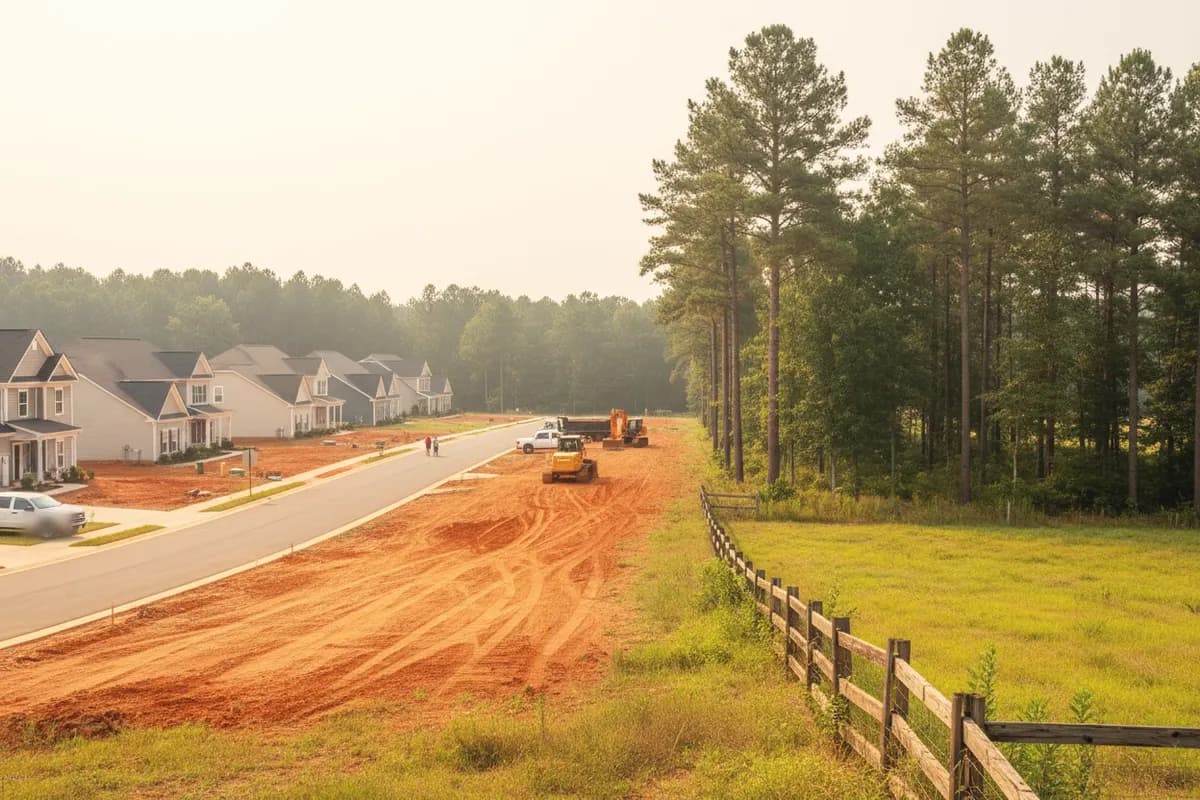
A freshly graded red clay road bed running between new homes and pine woods, a loader and dump truck working down the line beside an old pasture fence.

GRADING & DRIVEWAYS · LAKE OCONEE & LAKE SINCLAIR

Grading and driveway preparation for Lake Oconee and Lake Sinclair homes

Building pads, finished yard grades and driveway subgrades shaped for steep lake lots. Every grade we cut decides where the next storm goes: away from the house, around the drain field and slowed down before it reaches the cove.
  • Lake Oconee & Lake Sinclair
  • Residential & commercial
  • Free estimates

Get a free estimate

or call (678) 863-5620

Property type
What do you need?
Rather talk? (678) 863-5620
Where's the property?
Is it a lake lot? (optional)
Who should we call?

By submitting, you agree we may call or text you about this request. Privacy.

The short answer

What does grading and driveway preparation include on a lake lot?

Grading reshapes the ground so a house pad is level and rainwater runs away from the foundation and the septic drain field. Driveway preparation means cutting and compacting a stable subgrade, adding stone base and building in ditches or culverts. On a Georgia lake lot it also means keeping graded runoff out of the 25-foot shoreline buffer.

Reviewed by A Class Septic Services · Last updated

Who does the work

One crew, raw ground to a working system

  • Homes, lake lots and commercial properties around Lake Oconee & Lake Sinclair
  • Septic systems and the clearing, grading, drainage and lines around them
  • Ask for Brandon Mosley
  • 10% off for military & first responders
(678) 863-5620

Key facts

Grading and driveways in the lake counties: key facts

Each row links to the agency, code or publisher it comes from. Tap a source to check it yourself.

Cost, permit, septic and shoreline facts for grading and driveway work near Lake Oconee and Lake Sinclair, each with its source.
TopicWhat it saysSource
Grading and leveling cost$1 to $2 per square foot; grading contractors $50 to $200 per hour (typical market range, HomeAdvisor 2026).HomeAdvisor: How Much Do Gravel Driveways or Roads Cost? (updated June 17, 2026), 2026
Gravel driveway installed$1.25 to $4.00 per square foot; typical project $500 to $3,500, average about $1,800 (HomeAdvisor 2026).Same source as above
Driveway regrade$1,500 to $9,500; regrading toward a foundation problem $1,000 to $3,000 (HomeAdvisor 2026).HomeAdvisor: How Much Does a Lawn Leveling Service Cost? (updated June 19, 2026), 2026
Driveway onto a state routeResidential driveway permits are applied for at the GDOT District Area Office; GDOT aims to decide within 20 working days of a complete application.Georgia DOT: Regulations for Driveway and Encroachment Control, Chapter 2, Permit Procedures, 2009
Grading counts as diggingGeorgia's 811 law treats mechanized grading below existing grade as excavation, so a locate ticket comes first.Georgia 811: Laws & Policies (Georgia Utility Facility Protection Act, O.C.G.A. 25-9), 2022
Cut and fillGeorgia's erosion law: cut and fill operations must be kept to a minimum and must not endanger adjoining property.O.C.G.A. § 12-7-6, Best management practices; minimum requirements (text via Onecle)
Over a septic systemGrading or filling after final inspection that may harm the system voids the county's approval.Ga. Comp. R. & Regs. R. 511-3-1-.03, Permits and Inspections (LII)
Drains at Lake OconeeDrainage pipes may not run across Georgia Power property; they must end at the project boundary and transition to swales, French drains or dry creek beds.Georgia Power: Lake Oconee Shoreline Guidelines, 2026

Plain definitions

Grading and driveway terms

Rough grading
Cutting and filling the lot to approximate final elevations and building a level, compacted pad for the house or garage.
Finish grading
Shaping the last few inches of soil around the finished house so surface water drains away and the ground is ready for seed, sod or landscaping.
Subgrade
The compacted native soil or fill a driveway's stone base sits on; if it is soft, wet or full of roots, no amount of gravel on top fixes it.
Crown
The slight hump down a driveway's center line that sheds rain to both sides instead of letting it run down the wheel tracks.
Crusher run
Crushed stone mixed with stone dust that packs hard, commonly used as driveway base; HomeAdvisor lists crush and run at $20 to $40 per ton.↗
Cut and fill
Moving soil from high ground to low ground on the same site; HomeAdvisor prices cut-and-fill grading at $1 to $12 per cubic yard.↗

The whole story

Lake lots fall toward the water, and so does every driveway

On most Lake Oconee and Lake Sinclair lots the road is at the top and the shoreline is at the bottom. The house goes somewhere in between, and the driveway has to connect them without becoming a gully. A straight-down driveway on clay collects every drop of roof and road runoff and delivers it, with sediment, to the cove. A driveway that follows the contour, with a crown, ditches on the uphill side and culverts or turnouts that let water leave in small amounts, lasts and keeps the lake cleaner.

Georgia Power's shoreline rules shape the bottom of that system. At Lake Oconee, drainage pipes cannot run across its property; they must stop at the project boundary and hand off to a swale, French drain or dry creek bed (Georgia Power). Mechanical grading or leveling is not allowed on Georgia Power land, even for a sitting area. On Lake Sinclair leased lots, Georgia Power's review of a new home asks for a plan showing the trees 4 inches and up to be removed within the building perimeter, driveway included (Georgia Power, Lake Sinclair). So the driveway line is part of the permit, not an afterthought.

The septic system is the other fixed point. EPA's advice is plain: do not park or drive on a drainfield, and keep roof drains and other rainwater away from it (EPA). On lake lots that are often tight and sloped, we route the driveway and turnaround around the tank and field and grade the yard so water sheds to either side of them. Georgia's septic rules back this up: grading or filling over a permitted system after final inspection that may harm it voids the county's approval.

Then there's the clay itself. Davidson and similar red clays are 40 to 75 percent clay in the subsoil (NRCS), while Helena soils carry a perched water table 18 to 30 inches down from January to April and have high shrink-swell potential (NRCS). Graded in summer, clay looks solid; graded wet, it pumps and ruts under a loaded truck. We compact fill in lifts at workable moisture and get stone on a driveway subgrade before winter rain softens it.
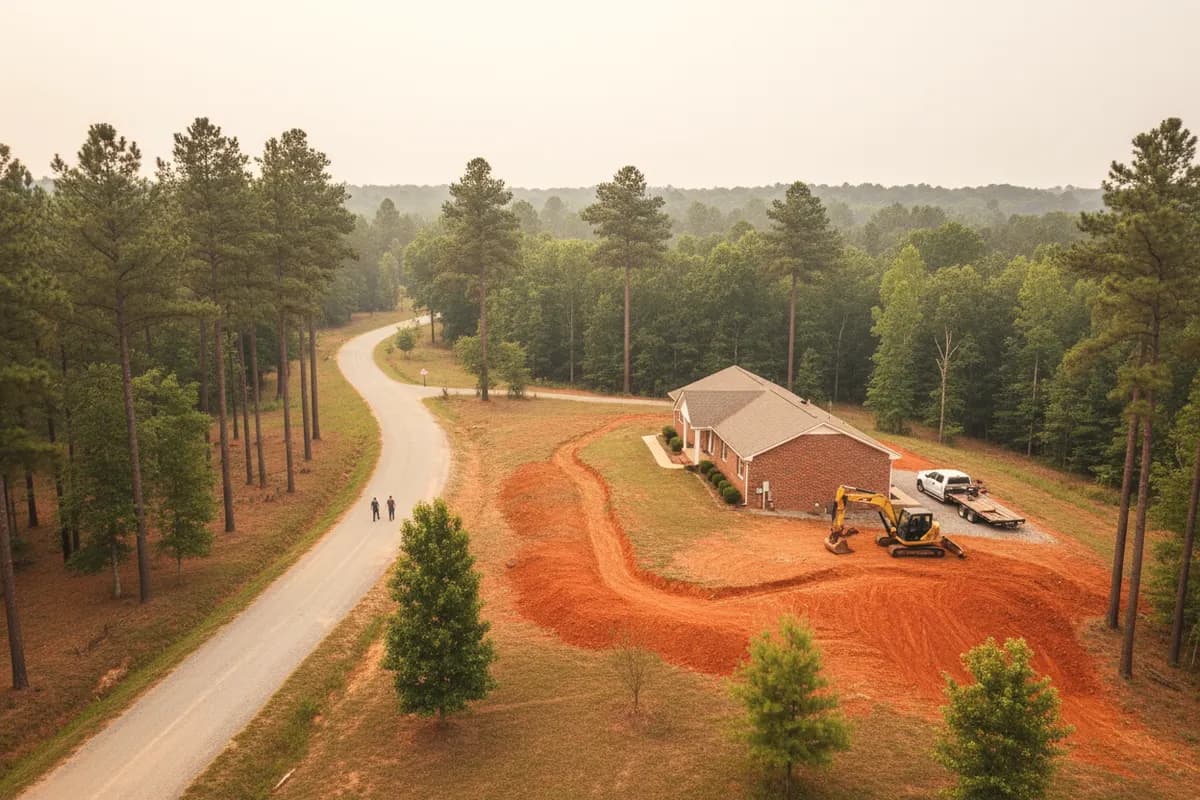
Aerial view of a brick house on a freshly graded red clay lot cut out of pine woods, a compact excavator working beside a curving gravel drive.
Illustrative photo.

How the job runs

How we grade a lot and prepare a driveway

  1. 1

    Lay out grades and the driveway line

    Finished floor elevation, pad size, driveway route and turnaround, and where the water will go, staked on the ground. The septic tank, field and repair area are fenced off so equipment stays off them.

    US EPA: How to Care for Your Septic System

  2. 2

    Locate tickets and permits

    Georgia 811 ticket before any machine work. A GDOT Area Office permit if the driveway meets a state route; county land disturbance permit if the job disturbs an acre or more or sits within 200 feet of the lake's bank.

    O.C.G.A. § 12-7-17, Exemptions, Georgia Erosion and Sedimentation Act (text via Onecle)

  3. 3

    Erosion controls

    Silt fence on the lake side and at the low points; a stone entrance where trucks will come and go. Georgia law wants disturbed soil stabilized as quickly as practicable.

    O.C.G.A. § 12-7-6, Best management practices; minimum requirements (text via Onecle)

  4. 4

    Strip and stockpile topsoil

    Topsoil and organic material come off the pad and driveway footprint; they compress and rot under load. Save the topsoil for the finish grade.

  5. 5

    Cut, fill and compact

    High spots are cut, low spots filled in thin lifts and compacted. Cut faces are shaped so surface water doesn't sheet down them.

    O.C.G.A. § 12-7-6, Best management practices; minimum requirements (text via Onecle)

  6. 6

    Build the driveway section

    Shape the subgrade with a crown or cross-slope, cut side ditches, set culverts where the drive crosses a drainage path, add fabric if the soil is soft, then base stone compacted in layers.

  7. 7

    Finish grade and stabilize

    Ground around the house slopes away from the foundation, swales carry water around the drain field, topsoil goes back, and seed and straw go down.

What it costs

Typical grading and driveway costs (third-party ranges)

Published national ranges, dated, for planning. Steep lake lots, long drives and imported fill push numbers toward the high end.

What moves the price

Third-party national ranges with publication year, for planning only; our own quote depends on your slope, soil and driveway length. Call (678) 863-5620 for a free estimate on your lot.

Free estimate: (678) 863-5620
  1. 01Slope and lengthA long switchback drive down a lake lot moves far more dirt and needs more drainage than a short flat apron.
  2. 02Import or export of dirtBalancing cut and fill on site is the cheapest; trucking fill in at $5 to $30 per cubic yard plus delivery adds up fast.
  3. 03Soft or wet claySoils that pump under load need undercutting, fabric or extra stone before the base goes on.
  4. 04Culverts and ditchesEvery drainage crossing needs pipe sized for the flow; see storm drain installation.
  5. 05PermitsA state-route driveway permit, county land disturbance permit and Georgia Power review each add steps.

Your options

Gravel, asphalt or concrete on top of the grade

We prepare the grade and base. The surface you choose changes how much base and drainage it needs.

OPTION 01

Gravel driveway

When it fits: Long rural and lake-lot drives, steep drives that need traction, and budgets that put money into drainage instead of paving.

  • Cheapest per foot; Fixr lists $1,000 to $3,000 typical
  • Easy to repair and regrade
  • Water can soak in along the edges
  • Needs new stone every 2 to 4 years
  • Washes on steep grades without a good crown and turnouts

OPTION 02

Asphalt

When it fits: Moderate slopes where a smooth surface is wanted and a paver can get in.

  • Smooth and quiet
  • Sheds water well when crowned
  • Fixr lists $3,000 to $10,000 for a driveway
  • Concentrates runoff that must be managed at the bottom

OPTION 03

Concrete

When it fits: Short, steep sections, garage aprons and turnarounds near the house.

  • Long-lived, good traction when broomed
  • Fixr lists $3,460 to $6,910 for a driveway
  • Least forgiving of a poor subgrade
  • Impervious, so runoff has to be planned

Whatever the surface, the subgrade and drainage underneath decide how long it lasts.

Warning signs

Signs your yard or driveway needs regrading

Water running the wrong way? Call (678) 863-5620

  • 1. Ruts and washouts down the wheel tracksThe driveway has lost its crown and water is running down it instead of off it.
  • 2. Water standing against the foundationThe ground slopes toward the house. HomeAdvisor lists regrading for this at $1,000 to $3,000.
  • 3. Red clay washing onto the road or into the coveBare or poorly shaped ground is eroding. On a lake lot that sediment ends up in the water.
  • 4. A soggy strip over the septic field after rainRunoff from the drive or roof is crossing the field. Compare with the signs of a failing drain field.
  • 5. Potholes that come back every springThe subgrade under the stone is soft, wet or full of rotting roots, and needs to be rebuilt, not topped.

Where we do this

Where we do grading & driveway preparation

Every county runs its own permits, and the lakes add Georgia Power's rules. Start with your lake or county, or jump to your town.

FAQ

Grading and driveway questions

Straight answers, with the rule or record behind them. Still unsure? Call and ask the crew that digs.

(678) 863-5620

How much does it cost to grade a yard in Georgia?

HomeAdvisor's 2026 national figures put grading and leveling at $1 to $2 per square foot, a typical lawn leveling job at $1,021 to $3,331, and regrading to fix water at the foundation at $1,000 to $3,000. Steep lake lots and imported fill push costs up. These are typical ranges, not quotes.

Source: HomeAdvisor: How Much Does a Lawn Leveling Service Cost? (updated June 19, 2026)

How much does a gravel driveway cost?

HomeAdvisor's 2026 guide lists $1.25 to $4.00 per square foot installed, with most projects $500 to $3,500 and an average near $1,800. Fixr adds that excavation can add $200 to $5,600 on difficult sites. Long, steep lake-lot drives are at the high end.

Source: HomeAdvisor: How Much Do Gravel Driveways or Roads Cost? (updated June 17, 2026)

Do I need a permit for a driveway in Georgia?

If the driveway connects to a state route, yes: residential driveway permits come from the GDOT District Area Office, and GDOT aims to decide within 20 working days of a complete application. Driveways onto county roads go through the county. A big grading job may also need a land disturbance permit.

Source: Georgia DOT: Regulations for Driveway and Encroachment Control, Chapter 2, Permit Procedures

Can I drive or park over my septic drain field?

No. EPA says not to park or drive on a drainfield, because it isn't built for vehicle weight and compaction harms it. Plan driveways and turnarounds around the tank and field from the start; moving a field later is far harder than moving a driveway.

Source: US EPA: How to Care for Your Septic System

Can I regrade down to the water on Lake Oconee?

Not on Georgia Power land or in the 25-foot buffer without its written approval. Its guidelines bar mechanical clearing or contour changes there and say drainage pipes must stop at the project boundary and transition to swales, French drains or dry creek beds.

Source: Georgia Power: Lake Oconee Shoreline Guidelines

When is the best time to grade red clay?

When it is moist but not wet. Clay graded wet pumps and ruts under equipment; Helena soils, for example, hold a perched water table 18 to 30 inches down from January to April. Drier months make compaction easier, but bare ground then needs stabilizing before storms.

Source: USDA NRCS Official Series Description: Helena series

Does grading need a Georgia 811 ticket?

Yes. Georgia's utility protection law defines excavation as any mechanized movement of earth below existing grade, which includes grading. Shallow lines such as cable and irrigation are often within a few inches of the surface.

Source: Georgia 811: Laws & Policies (Georgia Utility Facility Protection Act, O.C.G.A. 25-9)

Is there a military or first responder discount?

Yes, 10% off for military members and first responders on our work. Mention it when you call (678) 863-5620 for an estimate.

A small creek with eroded red clay banks and rock ledges in pine and hardwood woods, a weathered wooden shed on the bank.

Ready when you are

Need grading & driveways? Call the crew that digs.

Building pads, finished yard grades and driveway subgrades shaped for steep lake lots. Every grade we cut decides where the next storm goes: away from the house, around the drain field and slowed down before it reaches the cove.

(678) 863-5620

Property type
What do you need?
Rather talk? (678) 863-5620
Where's the property?
Is it a lake lot? (optional)
Who should we call?

By submitting, you agree we may call or text you about this request. Privacy.

Call nowFree Estimate
