10% offfor military & first responders
A compact excavator digging red clay beside two green septic riser lids in the lawn of a two-story house, a dump truck at the drive.

UNDERGROUND TANK REMOVAL · LAKE OCONEE & SINCLAIR

Underground tank removal and old septic tank abandonment in the Lake Oconee and Lake Sinclair region

Buried heating oil tanks, farm fuel tanks and retired septic tanks are liabilities you can't see. We dig them out, haul them off and backfill the hole, and we start by finding out which rules apply to your tank.
  • Lake Oconee & Lake Sinclair
  • Residential & commercial
  • Free estimates

Get a free estimate

or call (678) 863-5620

Property type
What do you need?
Rather talk? (678) 863-5620
Where's the property?
Is it a lake lot? (optional)
Who should we call?

By submitting, you agree we may call or text you about this request. Privacy.

The short answer

How is an underground tank removed in Georgia?

Underground tank removal means emptying a buried tank, excavating it, hauling it away and backfilling the hole. Which rules apply depends on the tank. Georgia EPD regulates commercial fuel USTs and wants 30 days' notice before closure; home heating oil tanks are exempt from its rules; retired septic tanks must be pumped and filled or removed.

Reviewed by A Class Septic Services · Last updated

Who does the work

One crew, raw ground to a working system

  • Homes, lake lots and commercial properties around Lake Oconee & Lake Sinclair
  • Septic systems and the clearing, grading, drainage and lines around them
  • Ask for Brandon Mosley
  • 10% off for military & first responders
(678) 863-5620

Key facts

Underground tanks in Georgia: the key facts

Each row links to the agency, code or publisher it comes from. Tap a source to check it yourself.

Which buried tanks are regulated, what closure requires, and typical market ranges for removal, each with its source.
TopicWhat it saysSource
What counts as a federal USTA tank and its connected underground piping with at least 10 percent of their combined volume underground, storing petroleum or certain hazardous substances.US EPA — Learn About Underground Storage Tanks (USTs)
Home heating oil tanksExempt from the Georgia UST rules; EPD sends questions on heating tanks to the local fire department, city or county, or US EPA.Georgia EPD — Underground Storage Tanks (UST Management Program, GUST Rule 391-3-15)
Farm and residential fuel tanksFederal UST rules exclude farm and residential motor fuel tanks of 1,100 gallons or less used for noncommercial purposes.US EPA — Learn About Underground Storage Tanks (USTs)
Regulated tank closure noticeGeorgia's Closure Activity Form (GUST-29) is due at least 30 days before closure.Georgia EPD — UST Tank Closures (GUST-29 Closure Activity Form, Closure Report Template)
Removal or closure in placeGeorgia's UST program recommends closing tanks by removing them from the ground.Georgia EPD — UST Facility Owners
Retired septic tanksMust be pumped and filled with sand, soil or rock, or removed (511-3-1-.17(5)).Ga. Comp. R. & Regs. R. 511-3-1-.17, Maintenance and Operation (LII)
Underground oil tank removal cost$1,000 to $3,500 (typical market range, Bob Vila, 2023).Bob Vila — Oil Tank Removal Cost (updated May 31, 2023), 2023
Active petroleum USTs nationwideAbout 534,000.US EPA — Learn About Underground Storage Tanks (USTs)

Plain definitions

Tank terms you will run into

UST (underground storage tank)
A tank system with 10 percent or more of its volume, including piping, below ground, storing petroleum or regulated hazardous substances.↗
Heating oil tank
A tank holding fuel oil burned on the property to heat it; excluded from federal and Georgia UST rules, though local authorities may still regulate it.↗
Closure in place
Cleaning a tank and filling it with inert material instead of digging it up; Georgia EPD warns such tanks can delay or add cost to a future sale.↗
Release
Any leak or spill of a tank's contents into soil or groundwater; Georgia EPD runs a reporting page and corrective action program for regulated tanks.↗
Septic tank abandonment
Taking a septic tank out of service under Georgia's on-site sewage rules by pumping it and either filling or removing it.↗

The whole story

Where buried tanks turn up around the lakes

Most buried tanks we are asked about in this region fall into three groups. The first is fuel: oil tanks that once fed a furnace in an older farmhouse or early lake cabin, and gasoline or diesel tanks that fueled tractors and trucks on a farm. Federal rules exclude residential and farm motor fuel tanks of 1,100 gallons or less used for noncommercial purposes, and both federal and Georgia rules exclude heating oil tanks, but excluded does not mean harmless. A rusted tank still holds whatever fuel is left in it.

The second is septic tanks left behind. When a house connects to sewer, gets a new system in a different spot, or is torn down for a new build, the old tank stays in the ground unless someone deals with it. Georgia's on-site sewage rule requires a discontinued tank to be pumped and filled or removed, because an empty tank with a failing lid is a collapse hazard.

The third is commercial: tanks at former country stores, marinas, shops and fleet yards. Those are the ones Georgia EPD's UST Management Program regulates, and they come with notice, sampling and reporting requirements that a homeowner's heating oil tank does not. Near Lake Oconee and Lake Sinclair any leaking tank is a bigger worry than inland, because fuel that reaches groundwater can travel toward the lake.

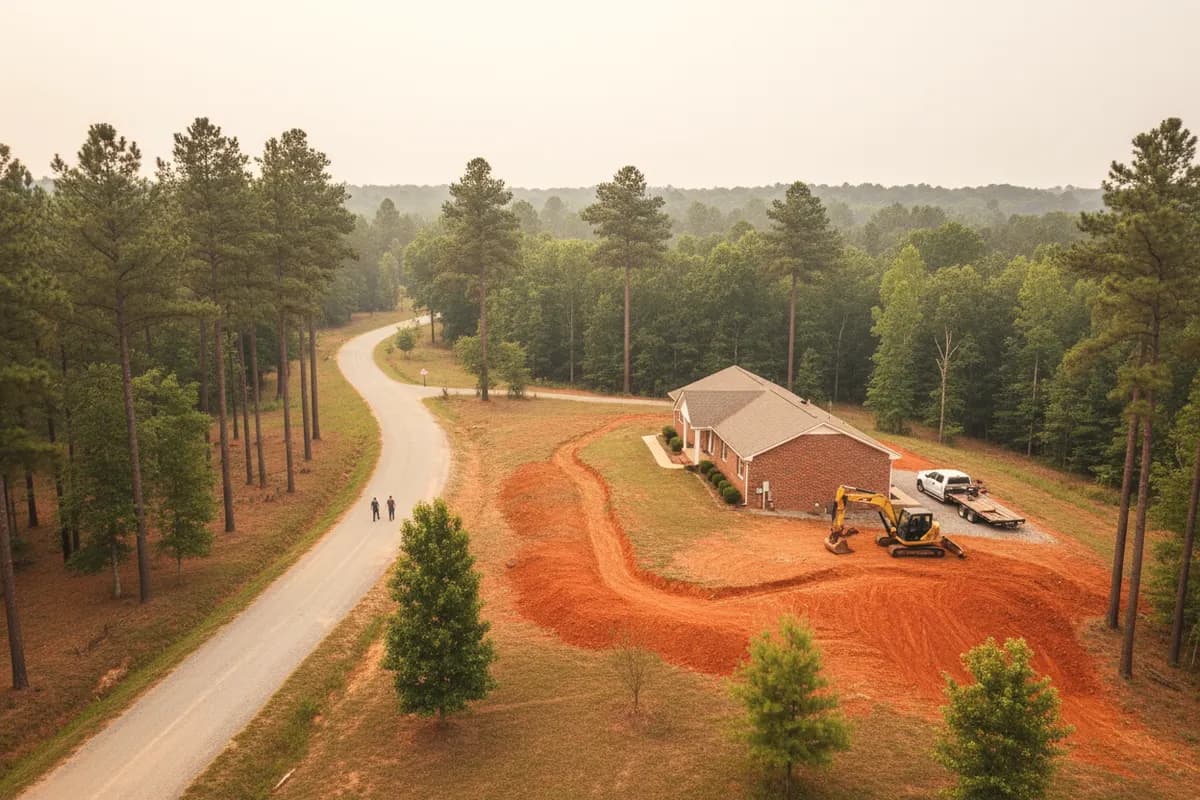
Aerial view of a brick house on a freshly graded red clay lot cut out of pine woods, a compact excavator working beside a curving gravel drive.
Illustrative photo.

How the job runs

How a buried tank comes out

The steps change with the tank type. A regulated commercial UST adds notice and reporting steps; a heating oil tank or old septic tank does not.
  1. 1

    Identify the tank and its owner of record

    Fill pipes, vent pipes, old fuel lines in a basement wall, or a probe that hits steel are the usual clues. What the tank held and how it was used decides whether EPD's UST rules apply.

    US EPA — Learn About Underground Storage Tanks (USTs)

  2. 2

    Line up the paperwork for regulated tanks

    For a regulated UST, the GUST-29 Closure Activity Form goes to EPD at least 30 days ahead, and closure follows EPD's guidance and report template. For heating oil tanks, check with the local fire department or county, which EPD names as the contacts.

    Georgia EPD — UST Tank Closures (GUST-29 Closure Activity Form, Closure Report Template)

  3. 3

    Call Georgia 811

    Tank excavation is mechanized digging, so the locate request goes in first. Old fuel and electric lines near a tank are common.

    Georgia 811 — Georgia Utility Facility Protection Act (O.C.G.A. 25-9) summary

  4. 4

    Empty the tank

    Remaining fuel or septage is pumped out by a qualified hauler before excavation. Bob Vila lists leftover oil disposal at $10 to $70 per pound in its cost breakdown.

    Bob Vila — Oil Tank Removal Cost (updated May 31, 2023)

  5. 5

    Excavate and lift

    We dig around the tank, cut and cap lines, and lift it out with the excavator. In Piedmont clay the hole is benched or sloped so the walls stay put.

  6. 6

    Look at the soil

    Stained or fuel-smelling soil is a sign of a release. Soil testing, typically $500 to $1,800, tells you whether cleanup is needed; regulated releases are reported to EPD.

    Bob Vila — Oil Tank Removal Cost (updated May 31, 2023)

  7. 7

    Backfill, compact and grade

    Clean fill goes in lifts and is compacted so the spot will not settle, then the surface is graded and stabilized.

Permits & the Georgia rules

Rules that apply, by tank type

  1. 01

    Commercial petroleum UST (store, marina, fleet): follow GUST Rule 391-3-15; file GUST-29 at least 30 days before closure and complete the closure report.↗

  2. 02

    Residential heating oil tank: exempt from the Georgia UST rules; ask the local fire department, city or county about any local requirement.↗

  3. 03

    Farm or residential motor fuel tank of 1,100 gallons or less, noncommercial: excluded from federal UST rules; state and local authorities may still regulate it.↗

  4. 04

    Retired septic tank: pump it, then fill it with sand, soil or rock or remove it, per 511-3-1-.17(5).↗

  5. 05

    Any tank: request a Georgia 811 locate before excavating.↗

Georgia rule GA EPD, UST Tank Closures

“You must submit the Closure Activity Form at least 30 days in advance.”
Read the rule

Georgia rule GA EPD, UST Facility Owners

“The Georgia UST Management Program recommends closing tanks and other UST components by removing them from the ground.”
Read the rule

Georgia rule 511-3-1-.17(5)

“If the use of a septic tank is discontinued,”
Read the rule

What it costs

What underground tank removal typically costs

Removal cost depends on tank size, how deep and accessible it is, and above all whether the soil around it is contaminated. These residential figures come from a national cost guide.

What moves the price

These are typical third-party market ranges, not A Class Septic Services prices. We provide free estimates.

Free estimate: (678) 863-5620
  1. 01ContaminationA tank that leaked can cost several times more than a clean one, because the soil becomes the project.
  2. 02Tank size and depthBigger, deeper tanks need a larger excavation and more backfill.
  3. 03AccessTanks under drives, decks or close to the house take more care to dig out.
  4. 04Leftover contentsFuel still in the tank has to be pumped and disposed of first.
  5. 05Regulated statusCommercial USTs add notice, sampling and reporting work that residential tanks do not.

Your options

Remove it or close it in place?

OPTION 01

Remove the tank

When it fits: You plan to sell, build over the spot, or want the question closed for good. Georgia's UST program recommends this route.

  • Nothing left to disclose or inspect later
  • Lets you see and test the soil directly
  • Frees the space for a new septic system or addition
  • Bigger excavation
  • Surface restoration needed

OPTION 02

Close in place

When it fits: The tank sits under a structure or where digging would endanger the foundation.

  • Less digging
  • EPD warns it can delay and add cost to a future sale
  • Soil under the tank is harder to assess

OPTION 03

Septic tank fill-in versus removal

When it fits: An old septic tank is being retired after a sewer connection or a new system.

  • Filling is allowed by rule and is quick
  • Removal clears room for new system components
  • A filled tank is still in the ground

Both options are allowed under 511-3-1-.17(5).

Warning signs

Signs a buried tank is on your property

Found a pipe you can't explain? Call (678) 863-5620

  • 1. A pipe sticking out of the yardA capped fill pipe or a thin vent pipe near the house often marks a fuel tank.
  • 2. Copper or steel lines through the foundationOld fuel supply and return lines at the basement wall lead outside to a tank.
  • 3. An oil furnace or its old footprintIf the house once burned oil and no tank is visible, it may be buried.
  • 4. A sunken rectangle in the lawnSettlement over a rusting tank or a collapsing septic lid shows up as a dip.
  • 5. Fuel odor or sheen after rainPetroleum smell in soil or water is a sign of a release that needs attention.

Where we do this

Where we do underground tank removal

Every county runs its own permits, and the lakes add Georgia Power's rules. Start with your lake or county, or jump to your town.

FAQ

Underground tank removal questions

Straight answers, with the rule or record behind them. Still unsure? Call and ask the crew that digs.

(678) 863-5620

Is a residential heating oil tank regulated in Georgia?

Not by Georgia's UST rules. EPD lists tanks used for heating oil and for operating heating equipment, boilers and furnaces among the most common exemptions, and refers questions to the local fire department, city or county government, or US EPA. Federal rules also exclude heating oil used on the premises where it is stored. Local requirements can still apply.

Source: Georgia EPD — Underground Storage Tanks (UST Management Program, GUST Rule 391-3-15)

How much does it cost to remove an underground oil tank?

Bob Vila's 2023 guide puts underground oil tank removal at about $1,000 to $3,500, with soil testing at $500 to $1,800 and contamination cleanup at $500 to $10,000 if needed. Contamination is the swing factor. A clean, accessible tank is a modest dig; a leaking one turns into a soil project.

Source: Bob Vila — Oil Tank Removal Cost (updated May 31, 2023)

Should I remove the tank or fill it in place?

Removal is usually better. Georgia's UST program recommends closing tanks by removing them, and warns that tanks left in the ground, even if closed in place, can cause delays and added expense when selling a property. Closing in place makes sense mainly when the tank sits under a structure that digging would put at risk.

Source: Georgia EPD — UST Tank Closures (GUST-29 Closure Activity Form, Closure Report Template)

What do I do with my old septic tank after connecting to sewer?

Georgia's on-site sewage rule gives two choices for a tank that is no longer used: have it pumped out and filled with sand, soil or rock so nobody can fall in, or have the empty tank removed. Removal makes sense when the space is needed for something else. Either way, the old tank cannot simply be left empty.

Source: Ga. Comp. R. & Regs. R. 511-3-1-.17, Maintenance and Operation (LII)

What notice does Georgia EPD require before closing a regulated UST?

For tanks under Georgia's UST program, such as those at stores, marinas and fleet yards, the Closure Activity Form GUST-29 must be submitted at least 30 days before closure. Closure then follows EPD's closure report guidance and template. Residential heating oil tanks are exempt from this process.

Source: Georgia EPD — UST Tank Closures (GUST-29 Closure Activity Form, Closure Report Template)

Are farm fuel tanks regulated?

Federal UST rules exclude farm and residential tanks of 1,100 gallons or less that store motor fuel for noncommercial purposes. Larger farm tanks, or tanks used commercially, may fall under the rules. EPA notes that state and local authorities may still regulate excluded tanks, so check before closing one.

Source: US EPA — Learn About Underground Storage Tanks (USTs)

Can a new septic system go where an old tank was removed?

Often, yes. Georgia's abandonment rule specifically allows an empty septic tank to be removed to make room for a new system component. Any new drain field still has to meet the state setbacks, such as 100 feet from wells and 50 feet from the normal water level of a lake or stream, and be permitted through county Environmental Health.

Source: Ga. Comp. R. & Regs. R. 511-3-1-.07, Absorption Fields (LII)

A small creek with eroded red clay banks and rock ledges in pine and hardwood woods, a weathered wooden shed on the bank.

Ready when you are

Need underground tank removal? Call the crew that digs.

Buried heating oil tanks, farm fuel tanks and retired septic tanks are liabilities you can't see. We dig them out, haul them off and backfill the hole, and we start by finding out which rules apply to your tank.

(678) 863-5620

Property type
What do you need?
Rather talk? (678) 863-5620
Where's the property?
Is it a lake lot? (optional)
Who should we call?

By submitting, you agree we may call or text you about this request. Privacy.

Call nowFree Estimate
