10% offfor military & first responders
A sloping pasture split by a raw red clay gully running down to a wooded creek bottom, an excavator and a dump truck working at the far edge.

DUMP TRUCK & HAULING · LAKE OCONEE & LAKE SINCLAIR

Dump truck and hauling services for Lake Oconee and Lake Sinclair

Fill dirt, topsoil, gravel and stone delivered where the job needs it; spoil, stumps and clearing debris hauled off to where Georgia's rules say they can go. Every load is planned around lake roads, steep drives and the septic system you can't drive over.
  • Lake Oconee & Lake Sinclair
  • Residential & commercial
  • Free estimates

Get a free estimate

or call (678) 863-5620

Property type
What do you need?
Rather talk? (678) 863-5620
Where's the property?
Is it a lake lot? (optional)
Who should we call?

By submitting, you agree we may call or text you about this request. Privacy.

The short answer

What does a dump truck service haul on a lake-country job?

A dump truck service delivers fill dirt, topsoil, gravel and stone, and hauls away excavated soil, rock, stumps and land-clearing debris. A typical load is up to about 15 cubic yards. Around Lake Oconee and Lake Sinclair, loads are planned around narrow lake roads, steep drives, septic drain fields trucks must avoid, and inert-landfill rules for debris.

Reviewed by A Class Septic Services · Last updated

Who does the work

One crew, raw ground to a working system

  • Homes, lake lots and commercial properties around Lake Oconee & Lake Sinclair
  • Septic systems and the clearing, grading, drainage and lines around them
  • Ask for Brandon Mosley
  • 10% off for military & first responders
(678) 863-5620

Key facts

Hauling and delivery: key facts

Each row links to the agency, code or publisher it comes from. Tap a source to check it yourself.

Load sizes, typical prices and disposal rules for dump truck hauling near Lake Oconee and Lake Sinclair, each with its source.
TopicWhat it saysSource
Load sizeStandard delivery loads up to 15 cubic yards; sand truckloads typically 10 to 14 cubic yards.HomeAdvisor: What Does Fill Dirt Cost? (updated June 20, 2026), 2026
Fill dirt truckloadAbout $842 on average, normal range $344 to $1,339 (typical market range, HomeAdvisor 2026).Same source as above
Hourly deliverySuppliers without set delivery fees may charge $65 to $100 per hour (HomeAdvisor 2026).Same source as above
Dirt hauling and removal$8 to $25 per cubic yard (HomeAdvisor 2026); Bob Vila lists $140 to $230 per cubic yard, or $1,400 to $2,300 per load, where disposal is costly (2023).HomeAdvisor: How Much Does Excavation Cost in 2026? (updated June 20, 2026), 2026
What inert landfills acceptEarth, concrete, cured asphalt, rock, bricks, yard trimmings and land-clearing debris such as stumps, limbs and leaves.Ga. Comp. R. & Regs. R. 391-3-4-.06, Permit by Rule (inert waste landfills) (LII)
Septic fieldsEPA: do not park or drive on your drainfield.US EPA: How to Care for Your Septic System
Lake Oconee shorelineMan-made beaches are not allowed and no sand may be added to a natural beach on the shoreline or Georgia Power property.Georgia Power: Lake Oconee Shoreline Guidelines, 2026
Basement spoilA 1,000-square-foot basement produces about 300 cubic yards of excavation.This Old House: Cost to Dig Out a Basement (2026 Guide, updated 04/01/2026), 2026

Plain definitions

Materials we move, defined

Fill dirt
Subsoil without much organic matter, used to raise grade, fill holes and build pads because it compacts and doesn't decompose; HomeAdvisor lists it at $5 to $30 per cubic yard.↗
Topsoil
The dark, organic top layer used for lawns and planting beds, not under structures; HomeAdvisor lists $12 to $55 per cubic yard.↗
Crusher run
Crushed stone mixed with fines that packs hard, used as driveway and pad base; HomeAdvisor lists crush and run at $20 to $40 per ton.↗
Spoil
Excavated soil and rock from a dig that is either reused on site or hauled away.
Land-clearing debris
Stumps, limbs, logs and brush from clearing a lot, which Georgia's inert landfill rule accepts for disposal.↗
Cubic yard
A cube 3 feet on each side, 27 cubic feet, the usual unit for selling and hauling dirt, gravel and topsoil.

Start here

What we haul

Dump truck work usually rides along with our excavation, land clearing and grading jobs, and we also run loads on their own.
  • 01

    Fill dirt for pads and low spots

    Clean fill for building pads, regrading, filling stump holes and backfilling trenches and basement walls.

  • 02

    Topsoil for finish grade

    Topsoil spread over a finished grade so seed or sod can take, kept off areas that will carry a slab or driveway.

  • 03

    Gravel and stone

    Driveway base, drainage stone, stone for erosion control entrances, and stone for septic and French drain work.

  • 04

    Excavated spoil

    Surplus soil and rock from foundations, basements and trenches when it can't stay on the lot.

  • 05

    Stumps, logs and clearing debris

    Land-clearing debris hauled to an inert landfill when it can't or shouldn't be burned.

    Stump removal
  • 06

    Concrete and brick

    Broken concrete, old pads and brick from demolition, which inert landfills accept along with rock and earth.

The whole story

Getting a loaded truck down a lake lot

The hard part of hauling at the lakes is rarely the drive from the pit. It's the last 300 feet. Many lake roads are narrow and winding, a lot of homes sit in gated communities, and the driveway to a lakefront building site often drops steeply toward the water on soft, freshly graded clay. A loaded truck that can't turn around at the bottom has to back down, and a truck that sinks in wet clay is a day lost for everyone.

So each hauling job starts with the route: where the truck can get in, where it can dump or spread, and where it can turn. Overhead power and dock lines, low limbs, culverts and soft shoulders are all checked. When the ground is wet we stage loads at the top and move material down with smaller equipment rather than tear up the lot.

The septic system decides where trucks can't go. EPA's advice is simply not to drive or park on a drainfield (EPA), and a loaded dump truck weighs many times what a car does. Georgia's rules also say construction activity after final inspection that may adversely affect a system voids the county's approval (511-3-1-.03). We flag the tank, the field and the repair area before the first load and keep every truck off them.

At the shoreline, Georgia Power's Lake Oconee guidelines rule out man-made beaches and adding sand to an existing natural beach on the shoreline or its property, and no part of a downed tree may be left on its land or in the lake (Georgia Power). We won't dump sand at the water's edge, and clearing debris near the shore leaves on the truck.

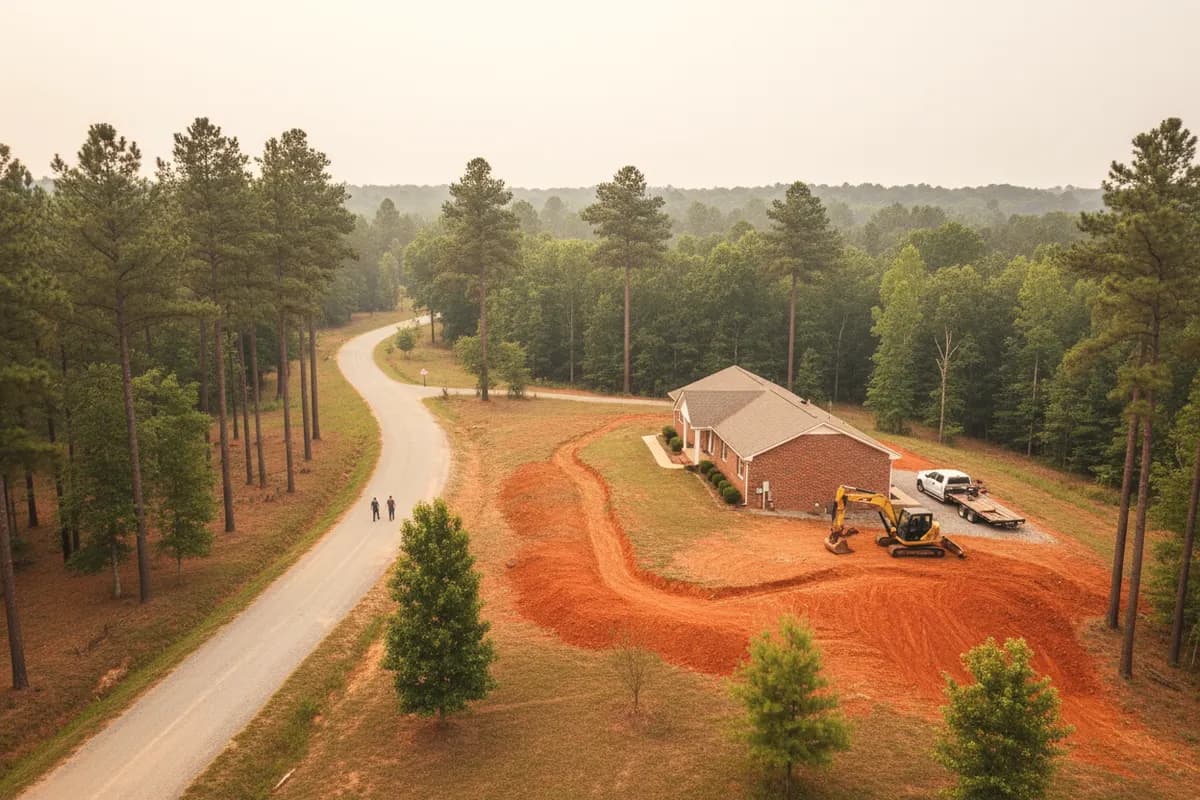
Aerial view of a brick house on a freshly graded red clay lot cut out of pine woods, a compact excavator working beside a curving gravel drive.
Illustrative photo.

How the job runs

How a hauling job is set up

  1. 1

    Material and quantity

    What's going in or out and how much. For deliveries we work from the plan's volumes; for haul-off we estimate from the dig. A 1,000-square-foot basement, for example, is about 300 cubic yards.

    This Old House: Cost to Dig Out a Basement (2026 Guide, updated 04/01/2026)

  2. 2

    Route and access check

    Road width, gates, overhead lines, the driveway's grade and surface, and a turnaround at the bottom.

  3. 3

    Mark no-drive areas

    Septic tank, drain field and repair area, wells, fresh trench lines and the shoreline buffer are flagged so no truck crosses them.

    US EPA: How to Care for Your Septic System

  4. 4

    Dump or spread location

    Material is placed where it will be used, not where it is easiest to dump, so it isn't handled twice. Stockpiles stay away from the lake side.

  5. 5

    Keep mud off the road

    A stone construction entrance and tire cleanup keep clay off lake roads. Georgia's erosion law asks that disturbed areas be stabilized quickly and sediment kept on site.

    O.C.G.A. § 12-7-6, Best management practices; minimum requirements (text via Onecle)

  6. 6

    Disposal to the right place

    Spoil, rock, concrete and clearing debris go to sites that accept them, such as inert landfills. Household trash and other wastes are not mixed into those loads.

    Ga. Comp. R. & Regs. R. 391-3-4-.06, Permit by Rule (inert waste landfills) (LII)

What it costs

Typical hauling and delivery costs (third-party ranges)

Published national ranges, each with its year, for budgeting a haul. Hauling is priced by the load, by the hour or by the cubic yard, and distance to the pit or landfill matters most.

What moves the price

Independent cost-guide ranges with their year, offered as a yardstick; A Class Septic Services prices hauling per job. Call (678) 863-5620 for a free estimate on your loads.

Free estimate: (678) 863-5620
  1. 01DistanceRound trips to the pit, quarry or landfill drive the price. HomeAdvisor notes some suppliers charge about $5 per mile for delivery.
  2. 02Access and turnaroundLots where a truck can't turn add time; staging at the top and moving material down with smaller equipment adds steps.
  3. 03MaterialTopsoil and stone cost more per yard than common fill. Clean structural fill costs more than mixed dirt.
  4. 04Disposal feesLandfill tipping fees vary by site and material; mixed loads can be refused.
  5. 05Wet weatherSoft clay can stop trucks entirely until it dries or stone goes down.

Your options

By the load, by the hour or by the yard?

How hauling is priced changes who carries the risk of waiting, weather and access.

OPTION 01

Per load

When it fits: Simple deliveries or haul-off where loading and dumping are quick and predictable.

  • Easy to budget
  • Good for a set number of fill or gravel loads
  • Slow loading or long waits can make it a poor fit
  • Partial loads cost the same as full ones

OPTION 02

Per hour

When it fits: Jobs where the truck runs with an excavator, many short trips, or uncertain access.

  • Fair when the job is hard to predict
  • HomeAdvisor lists $65 to $100 per hour for hourly delivery
  • Total depends on how smoothly the job runs

OPTION 03

Per cubic yard

When it fits: Material sales (fill, topsoil, stone) and large haul-off volumes measured from plans.

  • Ties cost to the actual quantity
  • Easy to compare between suppliers
  • Check whether delivery is included; HomeAdvisor shows some suppliers list it separately

Fixr lists delivered and spread gravel at $50 to $100 per cubic yard for driveway work.

Where we do this

Where we do dump truck & hauling services

Every county runs its own permits, and the lakes add Georgia Power's rules. Start with your lake or county, or jump to your town.

FAQ

Dump truck and hauling questions

Straight answers, with the rule or record behind them. Still unsure? Call and ask the crew that digs.

(678) 863-5620

How much does a dump truck load of fill dirt cost?

HomeAdvisor's 2026 guide puts a delivered truckload of fill dirt at about $842 on average, with a normal range of $344 to $1,339. Fill itself runs $5 to $30 per cubic yard, and suppliers without set delivery fees may charge $65 to $100 per hour. These are national ranges, not our prices.

Source: HomeAdvisor: What Does Fill Dirt Cost? (updated June 20, 2026)

How many cubic yards are in a dump truck load?

HomeAdvisor describes standard delivery loads of up to 15 cubic yards, with sand truckloads usually 10 to 14 cubic yards. Smaller trucks carry less, and heavy, wet material can hit weight limits before the bed is full.

Source: HomeAdvisor: What Does Fill Dirt Cost? (updated June 20, 2026)

How much does it cost to haul dirt away?

Published ranges vary widely. HomeAdvisor's 2026 guide lists dirt hauling and removal at $8 to $25 per cubic yard; Bob Vila's 2023 guide lists $140 to $230 per cubic yard, or $1,400 to $2,300 per load, where disposal is expensive. Keeping soil on site as fill is usually cheapest.

Source: HomeAdvisor: How Much Does Excavation Cost in 2026? (updated June 20, 2026)

Where can stumps and concrete be dumped in Georgia?

Georgia's inert waste landfill rule accepts earth, concrete, cured asphalt, rock, bricks, yard trimmings and land-clearing debris such as stumps, limbs and leaves. Household garbage and materials likely to produce harmful leachate do not belong in those loads.

Source: Ga. Comp. R. & Regs. R. 391-3-4-.06, Permit by Rule (inert waste landfills) (LII)

Can a dump truck drive over my septic system?

It shouldn't. EPA says not to park or drive on a drainfield, and Georgia's septic rules say construction activity that may harm a permitted system after final inspection voids the county's approval. We mark the tank and field and route trucks around them.

Source: US EPA: How to Care for Your Septic System

Can you deliver sand for a beach at my Lake Oconee dock?

Not on the shoreline. Georgia Power's Lake Oconee guidelines say man-made beaches are not allowed and no additional sand may be added to an existing natural beach along the shoreline or on its property. Sand for other uses on your own land is fine.

Source: Georgia Power: Lake Oconee Shoreline Guidelines

Can clearing debris be burned instead of hauled?

Sometimes. Outside the May 1 to September 30 ban in counties like Putnam, Morgan, Jasper and Jones, land-clearing burns need a Georgia Forestry Commission permit. During the ban, or when burning isn't practical, debris is ground or hauled.

Source: Georgia EPD: Summer Open Burning Ban (May 1 to September 30, 54 counties)

Do you give first responders a discount on hauling?

Yes, A Class Septic Services offers 10% off for first responders and military members. Mention it when you call (678) 863-5620.

A small creek with eroded red clay banks and rock ledges in pine and hardwood woods, a weathered wooden shed on the bank.

Ready when you are

Need dump truck & hauling? Call the crew that digs.

Fill dirt, topsoil, gravel and stone delivered where the job needs it; spoil, stumps and clearing debris hauled off to where Georgia's rules say they can go. Every load is planned around lake roads, steep drives and the septic system you can't drive over.

(678) 863-5620

Property type
What do you need?
Rather talk? (678) 863-5620
Where's the property?
Is it a lake lot? (optional)
Who should we call?

By submitting, you agree we may call or text you about this request. Privacy.

Call nowFree Estimate
