
White Plains, GA · Greene County
Septic installation and repair and site work in White Plains, Georgia, a southeast Greene County town with no public sewer.
- Lake Oconee & Lake Sinclair
- Residential & commercial
- 10% off: military & first responders
Get a free estimate
or call (678) 863-5620The short answer
Is White Plains, GA on sewer or septic?
Septic. White Plains runs a small town water system, about 184 connections on groundwater, but EPA lists no municipal wastewater permit there, only two private permits. Homes rely on septic permitted by Greene County Environmental Health in Greensboro, under Greene's lot-size rule. We install and repair those systems and handle the site work around them.↗↗↗
Reviewed by A Class Septic Services · Last updated
The White Plains story
Named for its sand, built on clay
White Plains sits on SR 15, the Old Greensboro Road, twelve miles southeast of Greensboro and fifteen north of Sparta, with its southeast edge running along the Hancock County line. The name, by local tradition, comes from the light, almost white sandy soil around town.↗↗
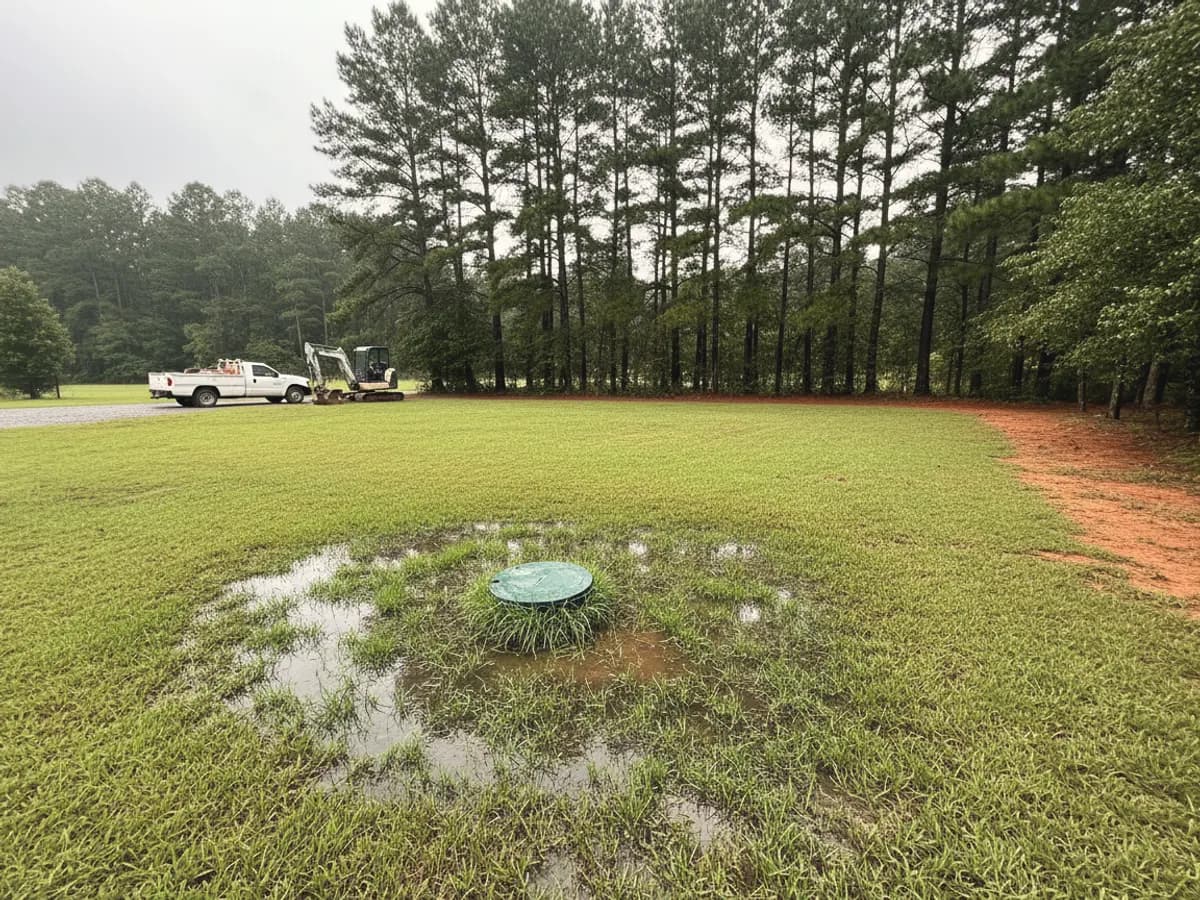
That sand is only the top layer. NRCS maps the ground at the town's center as Helena loamy sand and rates it very limited for septic absorption fields. Helena has a sandy surface over a clay subsoil that moves water slowly, and a perched water table that can sit 18 to 30 inches down from January through April. A field that looks fine in a dry October can be sitting in water by February.↗↗
Georgia's manual requires at least 24 inches between the bottom of a conventional trench and seasonal high water, rock or impervious soil, dropping to 12 inches only with aerobic pretreatment. On Helena ground that separation decides the design: shallow conventional trenches where the soil allows, and aerobic or drip systems where it does not.↗
Sewer or septic?
No town sewer in White Plains
EPA's Clean Water Act records for White Plains show no municipal wastewater plant. The two entries on file are private: one tied to a Lake Oconee lot and one for a land-application system. Every house in town treats its own wastewater.↗
Being on the town's water line counts in Greene County. The Board of Health requires at least 0.75 acre for a septic lot on public water and 1.5 acres on a private well.↗
Local facts
White Plains in numbers
Each row links to the agency, code or publisher it comes from. Tap a source to check it yourself.
| Topic | What it says | Source |
|---|---|---|
| Town water | City of White Plains (GA1330003): about 184 connections, 497 people, groundwater | EPA Envirofacts SDWIS: public water systems in Greene County (PWSID GA133xxxx) |
| Wastewater permits on record | None municipal; one private Lake Oconee lot permit and one private land-application system | EPA ECHO Clean Water Act facility search: White Plains, GA |
| Housing | Median home built 1981; 29 of 94 units are mobile homes, 30 date to 1939 or earlier | Census Reporter: White Plains, GA (ACS 2024 5-year) |
| Incorporated | 1834 per Wikipedia; the New Georgia Encyclopedia says 1856, when the town was first called Fort Nell | Wikipedia: White Plains, Georgia |
| Watershed | Sits on Greene County's basin line: west drains to the Upper Oconee, east to the Upper Ogeechee and the Savannah basin's Little River | Wikipedia: Greene County, Georgia |
Permits · Greene County Environmental Health (Northeast Health District), 1031 Apalachee Ave, Greensboro
Getting a septic permit for White Plains property
- 01
Call the Greene County Environmental Health Manager (706-453-4471) for a septic letter or perc test; the county building office needs that letter with any permit that will use septic.↗
- 02
Meet the Greene lot minimum: 0.75 acre on public water or 1.5 acres on a private well.↗
- 03
Build to the permit and pass the specialist's inspection before backfill; permits last up to 12 months.↗
Services here
Work we do in and around White Plains
- 01Septic System RepairSystems behind 1980s homes and pre-war houses on SR 15.Septic System Repair details
- 02Drain Field Installation & RepairHelena clay and winter water that drown shallow fields.Drain Field Installation & Repair details
- 03Aerobic Septic SystemsPretreatment that halves the soil separation the field needs.Aerobic Septic Systems details
- 04Septic System InstallationNew homes and replacement manufactured homes on rural lots.Septic System Installation details
- 05French DrainsPulling perched winter water away from a field or foundation.French Drains details
- 06Land & Lot ClearingPine and brush on lots out the county roads.Land & Lot Clearing details
Also available:Grading & DrivewaysWaterlines & Mains
FAQ
White Plains septic questions
Straight answers, with the rule or record behind them. Still unsure? Call and ask the crew that digs.
(678) 863-5620Does White Plains have city sewer?
No. EPA's Clean Water Act search shows no municipal wastewater permit for White Plains, only two private permits. The town provides well water only.
Source: EPA ECHO Clean Water Act facility search: White Plains, GA
Why do drain fields fail in White Plains?
The soil at the town center is Helena loamy sand over a slow clay subsoil, with a perched water table that can rise to 18 to 30 inches from January to April. Fields that are too deep or too small saturate in late winter.
Source: USDA NRCS Official Series Description: Helena series
Who issues septic permits for White Plains?
Greene County Environmental Health, at the health department building at 1031 Apalachee Avenue in Greensboro (706-453-4471). Specialists keep in-office hours from 8:30 to 10 a.m. on weekdays.
Source: Northeast Health District: Greene County locations (Environmental Health)
How much land do I need for septic in White Plains?
Greene County's Board of Health requires 0.75 acre on public water or 1.5 acres on a private well, with at least 25,500 square feet usable on the smaller lots.
Source: Greene County Board of Health: Lot Size Ordinance (effective Sept 7, 2018)
What does a septic repair permit cost in Greene County?
$200 for a residential repair permit under the fee schedule effective August 1, 2024; a new residential system inspection is $350, or $400 at five or more bedrooms.
When was White Plains founded?
Sources differ. Wikipedia says the General Assembly incorporated White Plains in 1834; the New Georgia Encyclopedia gives 1856 and says the town was first called Fort Nell. It is also the birthplace of educator William Heard Kilpatrick.

Sources
Where these facts come from
Rules, costs and local facts on this page link to the agency, code or publisher that states them. Cost figures are third-party market ranges, not our prices — estimates are free.
Reviewed by A Class Septic Services · Last updated
- 1EPA Envirofacts SDWIS: public water systems in Greene County (PWSID GA133xxxx)
- 2EPA ECHO Clean Water Act facility search: White Plains, GA
- 3Northeast Health District: Greene County locations (Environmental Health)
- 4Wikipedia: White Plains, Georgia
- 5New Georgia Encyclopedia: Greene County
- 6USDA NRCS Soil Data Access: map unit at White Plains' Census centroid (33.4803, -83.0363)
- 7USDA NRCS Official Series Description: Helena series
- 8GA DPH Manual for On-Site Sewage Management Systems (March 2026), Section F: Dispersal Systems
- 9Greene County Board of Health: Lot Size Ordinance (effective Sept 7, 2018)
- 10Ga. Comp. R. & Regs. r. 511-3-1-.03, General Requirements for On-Site Sewage Management Systems (LII)
- 11Census Reporter: White Plains, GA (ACS 2024 5-year)
- 12Wikipedia: Greene County, Georgia
- 13Greene County, GA: Septic Tank Permits
- 14Greene County EH Fees (effective August 1, 2024)
Ready when you are
Wet yard on SR 15 or a new house on the Hancock line? Call A Class.
We will look at the soil, the slope and the old system, tell you what Greene County will expect, and give you a free estimate for the septic and site work.
(678) 863-5620- Lake Oconee & Lake Sinclair
- Residential & commercial
- 10% off for military & first responders
Free estimate
or call (678) 863-5620