10% offfor military & first responders
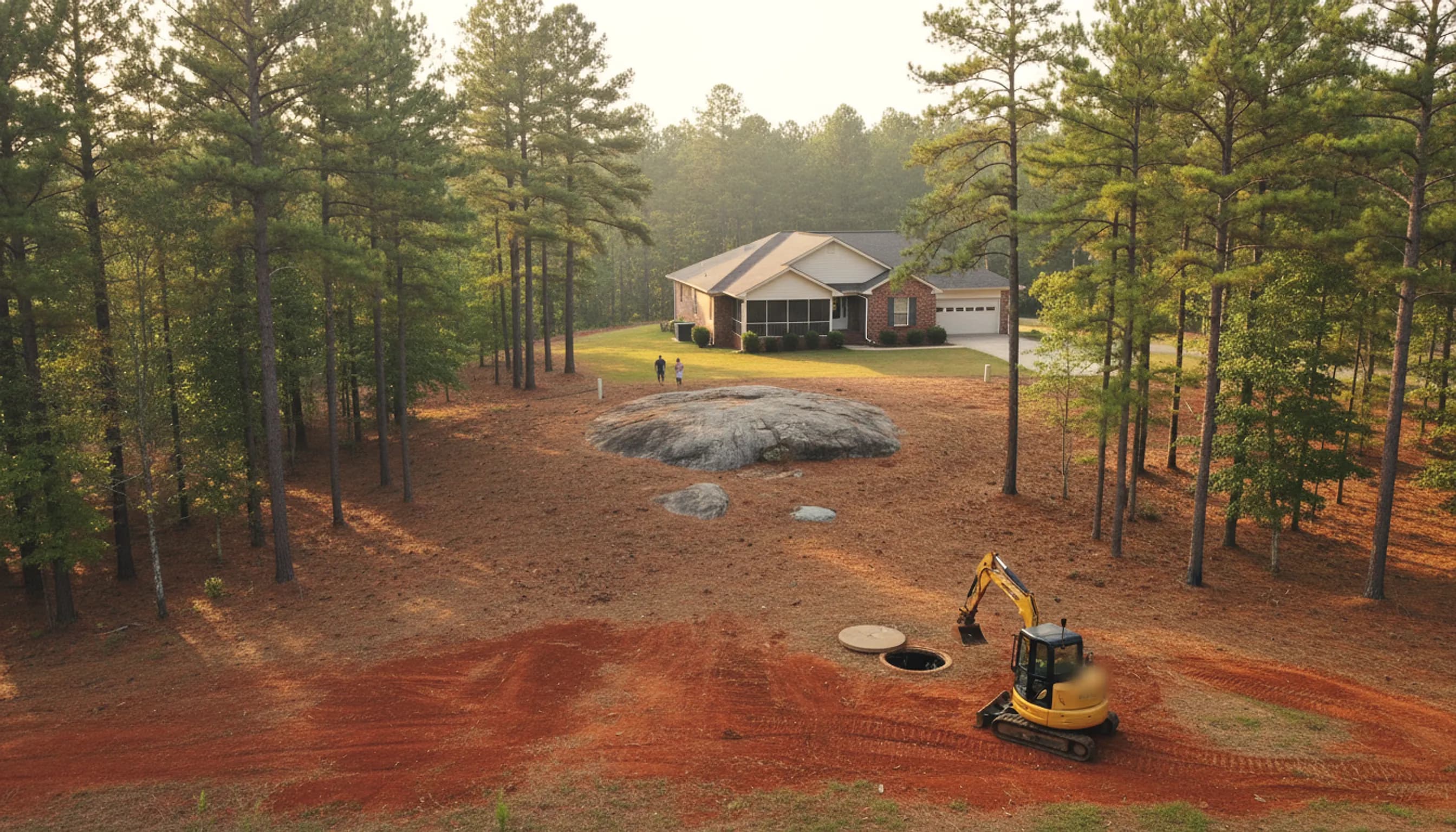
A cleared patch of red clay among loblolly pines, a granite outcrop and an open tank lid in front of a brick ranch, a compact excavator working the clay.

STUMP & TRUNK REMOVAL · LAKE OCONEE & LAKE SINCLAIR

Tree trunk and stump removal around Lake Oconee and Lake Sinclair

Grinding hides a stump; an excavator takes it out with the root ball so a slab, driveway or septic line can go where the tree stood. We fill and compact the hole and send the wood where Georgia's burn and landfill rules allow.
  • Lake Oconee & Lake Sinclair
  • Residential & commercial
  • Free estimates

Get a free estimate

or call (678) 863-5620

Property type
What do you need?
Rather talk? (678) 863-5620
Where's the property?
Is it a lake lot? (optional)
Who should we call?

By submitting, you agree we may call or text you about this request. Privacy.

The short answer

Should a stump be ground or pulled out with an excavator?

Grind a stump when only lawn or planting goes over it. Pull it with an excavator, root ball and all, when a foundation, driveway, septic tank or utility line will go there, because buried wood rots and the ground settles. In Georgia, pulling a stump is mechanized digging, so call Georgia 811 at least 3 business days first.

Reviewed by A Class Septic Services · Last updated

Who does the work

One crew, raw ground to a working system

  • Homes, lake lots and commercial properties around Lake Oconee & Lake Sinclair
  • Septic systems and the clearing, grading, drainage and lines around them
  • Ask for Brandon Mosley
  • 10% off for military & first responders
(678) 863-5620

Key facts

Stump removal: key facts for lake-country owners

Each row links to the agency, code or publisher it comes from. Tap a source to check it yourself.

Costs, legal steps and disposal rules for removing tree stumps in the Lake Oconee and Lake Sinclair area, each with its source.
TopicWhat it saysSource
Typical stump removal cost$195 to $609, average $369; full manual removal with roots $200 to $700 (typical market range, HomeAdvisor 2026).HomeAdvisor: How Much Does Stump Removal Cost? (updated June 19, 2026), 2026
Stump grinding$150 to $500 per stump, or about $3 per inch of diameter (HomeAdvisor 2026).Same source as above
By stump size12-inch stump $85 to $200; 24-inch $200 to $700; 48-inch $540 to $800 (Fixr 2025).Fixr: Stump Removal Cost (updated January 31, 2025), 2025
Before pulling a stumpUprooting with a machine moves earth below grade, which is excavation under O.C.G.A. 25-9: submit a Georgia 811 ticket at least 3 business days ahead.Georgia 811: The 811 Process, 2026
Near marked linesWithin 18 inches of either side of a marked line, the digger must expose it by hand, pot holing or vacuum methods.Georgia 811: Laws & Policies (Georgia Utility Facility Protection Act, O.C.G.A. 25-9), 2022
DisposalStumps, limbs and leaves are acceptable in Georgia inert waste landfills.Ga. Comp. R. & Regs. R. 391-3-4-.06, Permit by Rule (inert waste landfills) (LII)
Burning stumps from machine clearingA land type change under EPD land-clearing burn rules; no burning May 1 to September 30 in Putnam, Morgan, Jasper and Jones.Georgia EPD: Summer Open Burning Ban (May 1 to September 30, 54 counties), 2026
On Georgia Power landNo portion of a downed tree may be disposed of on Georgia Power property or in the lakes.Georgia Power: Lake Oconee Shoreline Guidelines, 2026

Plain definitions

Stump work, defined

Stump grinding
Chewing a stump down below grade with a rotating cutter wheel, leaving the main roots in the ground and a pile of wood chips on top.↗
Stump removal (extraction)
Digging around and prying the whole stump and its root ball out of the ground, usually with an excavator, then filling the hole.↗
Root ball
The mass of large roots and soil that comes out attached to the stump; on big trees it can be several feet across.
Tree trunk removal
Cutting up and hauling away felled trunks and logs that are too big to burn as hand-piled debris or leave on the lot.
Inert waste landfill
A Georgia landfill that may take only earth-like materials, rock, concrete, brick, yard trimmings and land-clearing debris.↗

Your options

Grinding, excavator extraction or leaving it

Each method is right somewhere. The deciding question is what goes on that spot next.

OPTION 01

Excavator extraction

When it fits: Under a future foundation, slab, driveway base, septic tank, drain line or utility trench, or where a big root ball has lifted the ground.

  • Removes the roots that would rot and settle
  • Leaves a hole that can be backfilled and compacted to grade
  • Fixr: removal runs $200 to $700 for a typical stump
  • Disturbs a wide circle of soil
  • Needs a 811 ticket and room for the machine
  • More debris to haul or burn

OPTION 02

Stump grinding

When it fits: Lawns, beds and finished yards where nothing structural will be built and you want minimal disturbance.

  • Small footprint, little soil disturbance
  • Fixr: grinding often $150 to $300
  • Fine near a drain field where digging would do harm
  • Roots stay and decay slowly
  • Chip pile and possible sinking as the wood rots
  • Not a base for concrete or gravel

OPTION 03

Cut flush and leave

When it fits: Wooded areas you are not building on, the shoreline buffer, and Georgia Power land where removal needs approval.

  • No soil disturbance at all
  • Roots keep holding a slope or bank
  • Stump remains visible
  • May sprout depending on species

On lake lots this is often the right answer near the water.

The whole story

Why stumps matter more on a lake lot

Most lake houses around Oconee and Sinclair are built on wooded lots, so almost every new build starts with dozens of stumps. Their fate gets decided in a hurry, and it shows up years later. A stump that was ground instead of pulled under a gravel driveway turns into a soft spot. One buried under fill at the edge of a house pad becomes a sinkhole when it rots out. Roots left along a sewer or water trench find the joints.

The ground makes it trickier. Shallow-rock soils such as the Wilkes series reach weathered rock 10 to 20 inches down, on slopes up to 60 percent (NRCS). Roots on those soils spread wide and wrap around rock, so a stump can bring a slab of rotten rock and a lot of the hillside with it. On a steep lot facing the water we pull stumps only where something will be built, fill and compact each hole the same day, and leave the rest cut flush so their roots keep holding the slope.

Shoreline lots add Georgia Power. Trees on its project lands need a removal permit, and the guidelines say no part of a downed tree may be left on Georgia Power property or put in the lake (Georgia Power). That includes the stump, the trunk and the brush. Everything we take out near the water leaves by truck or is burned on the owner's side of the line where the rules allow.

Septic systems are the other reason to plan. EPA tells owners to keep trees an appropriate distance from a drainfield so roots stay out of the system (EPA). When a tree near an existing field has to go, we usually grind or cut the stump rather than rip a root ball through the drain lines, and we do not drive the machine across the field to get there.
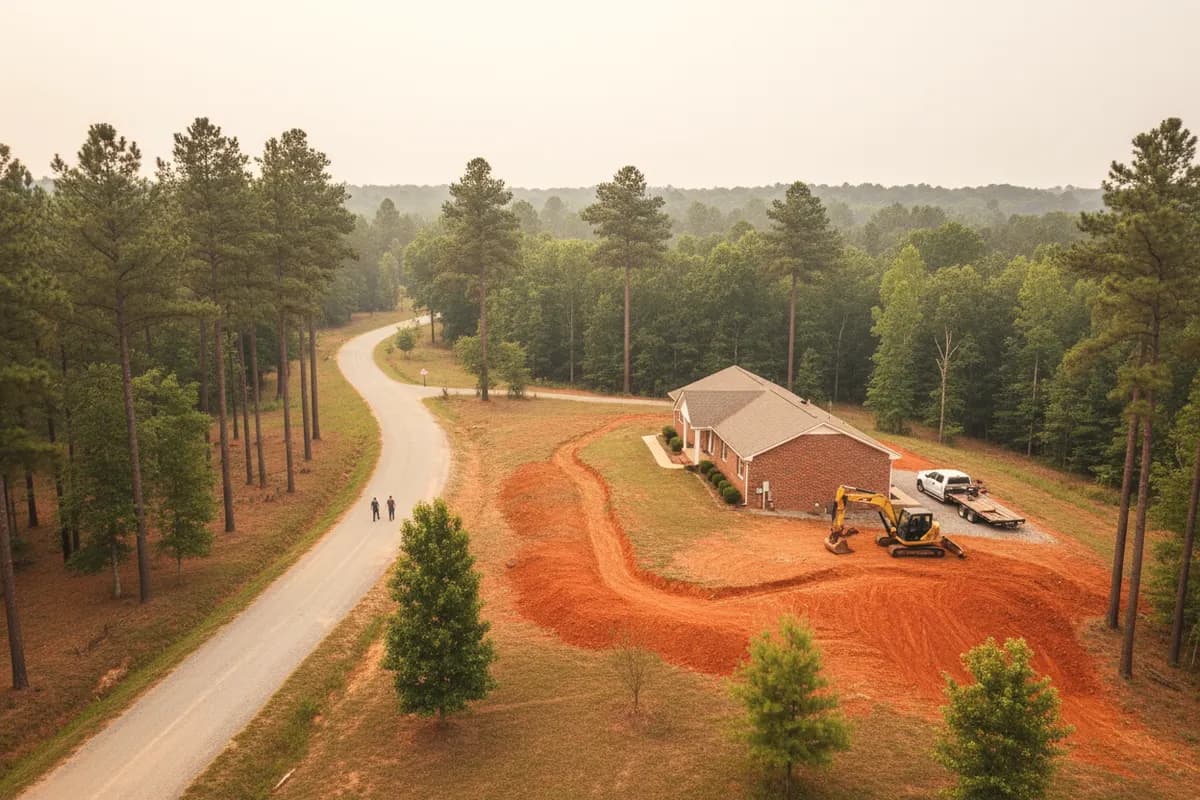
Aerial view of a brick house on a freshly graded red clay lot cut out of pine woods, a compact excavator working beside a curving gravel drive.
Illustrative photo.

How the job runs

How an excavator stump job goes

  1. 1

    Mark what's underground

    Georgia 811 ticket for the public lines, plus a talk with the owner about private ones: septic lines, a pump-tank feed, irrigation, a dock circuit. Within 18 inches of a marked line we expose it by hand.

    O.C.G.A. 25-9-8(b)Georgia 811: Laws & Policies (Georgia Utility Facility Protection Act, O.C.G.A. 25-9)

  2. 2

    Decide pull, grind or leave

    Stumps under anything that will be built get pulled. Stumps in lawn areas or near a drain field are usually ground or cut flush.

  3. 3

    Dig out and lift

    The excavator digs around the stump, cuts or breaks the main lateral roots and lifts the root ball out. Big stumps may be split first.

  4. 4

    Knock off the soil

    Shaking the dirt off the root ball keeps topsoil on the lot and makes the stump lighter to haul.

  5. 5

    Fill and compact the hole

    The hole is filled with clean soil in lifts and compacted, so it won't settle under a driveway or slab. On slopes it gets stabilized right away.

    O.C.G.A. § 12-7-6, Best management practices; minimum requirements (text via Onecle)

  6. 6

    Remove or dispose of the wood

    Haul to an inert landfill that takes stumps, burn under a Forestry Commission permit outside the ban months, or grind on site.

    Ga. Comp. R. & Regs. R. 391-3-4-.06, Permit by Rule (inert waste landfills) (LII)

Warning signs

When a stump has become a problem

Stumps in the way? Call (678) 863-5620

  • 1. A depression is forming where a tree used to beThe stump and roots are rotting and the soil above is dropping. Under a drive or patio, that becomes a pothole or a crack.
  • 2. Shoots keep coming up around an old stumpSome species keep sprouting from living roots. Grinding rarely stops it; extraction does.
  • 3. A stump sits where you want to buildA garage, addition, shop, pool or new septic system can't go over a stump or its root ball.
  • 4. Roots near your sewer or water lineRoots follow moisture to pipe joints. If a line keeps clogging, the tree and stump next to it may need to go along with a sewer line repair.
  • 5. Storm-felled trunks are lying on the lotLarge trunks and root plates from blown-over trees are too big to burn as hand-piled yard debris.

What it costs

Typical stump removal costs (third-party ranges)

What the national cost guides report, with the year of each figure. Excavator removal is usually priced by the job or by the hour when there are many stumps.

What moves the price

Ranges come from outside cost-guide publishers and carry the year they apply to; A Class Septic Services sets its own price per job after seeing the stumps. We give free estimates at (678) 863-5620.

Free estimate: (678) 863-5620
  1. 01DiameterCost climbs with size; Fixr lists a 12-inch stump at $85 to $200 and a 48-inch stump at $540 to $800.
  2. 02CountMany stumps on one lot drop the per-stump price; HomeAdvisor shows $40 to $75 each when several come out in one visit.
  3. 03Rock and slopeRoots wrapped around weathered rock take longer to free and leave bigger holes to fill.
  4. 04DisposalBurn-ban months and landfill distance decide whether the wood is burned, ground or hauled.
  5. 05Fill dirtLarge holes under a driveway or slab need clean fill brought in and compacted.

Where we do this

Where we do tree trunk & stump removal

Every county runs its own permits, and the lakes add Georgia Power's rules. Start with your lake or county, or jump to your town.

FAQ

Stump removal questions

Straight answers, with the rule or record behind them. Still unsure? Call and ask the crew that digs.

(678) 863-5620

Is it better to grind a stump or remove it?

Grinding is cheaper and disturbs less ground, so it suits lawns and beds. Removal takes the roots too, which matters anywhere a slab, driveway, septic tank or pipe will go, because rotting roots leave voids that settle. Fixr's 2025 figures put grinding at $150 to $300 and removal at $200 to $700.

Source: Fixr: Stump Removal Cost (updated January 31, 2025)

Do I need to call 811 to remove a stump?

Yes, if a machine is pulling it. Georgia's law defines excavation as any mechanized movement of earth below grade, and uprooting a stump does that. Submit a ticket at least 3 business days ahead and wait for every utility's response before digging.

Source: Georgia 811: Laws & Policies (Georgia Utility Facility Protection Act, O.C.G.A. 25-9)

How much does it cost to remove a tree stump?

HomeAdvisor's 2026 guide lists a typical range of $195 to $609 with a $369 average, and $200 to $700 to remove a stump with its root system. Extra stumps in the same visit can drop to $40 to $75 each. Those are national ranges, not a quote.

Source: HomeAdvisor: How Much Does Stump Removal Cost? (updated June 19, 2026)

Can I bury stumps on my lot?

We don't recommend it under or near anything you build, since buried wood rots and the ground sinks. Georgia's inert landfill rule accepts stumps, limbs and leaves for disposal, which is the clean way to get them off a building site. Ask your county about any on-site disposal rules.

Source: Ga. Comp. R. & Regs. R. 391-3-4-.06, Permit by Rule (inert waste landfills) (LII)

Can I burn stumps in Putnam County?

Not between May 1 and September 30, when Putnam, Morgan, Jasper and Jones counties are under EPD's summer burn ban. The rest of the year, stumps from machine clearing count as land-clearing debris and need a Georgia Forestry Commission permit for that day.

Source: Georgia EPD: Summer Open Burning Ban (May 1 to September 30, 54 counties)

Can a stump be removed near my septic drain field?

Carefully. Ripping a root ball out can break drain lines, and Georgia's rules say construction activity after final inspection that may harm the system voids its approval. Near a field we usually grind or cut flush and keep machines off the lines.

Source: Ga. Comp. R. & Regs. R. 511-3-1-.03, Permits and Inspections (LII)

Can I remove stumps on Georgia Power land at the lake?

Only with Georgia Power's permission. Tree removal on its land needs a permit application with tree counts, sizes, species, reasons and photos, approved removals are replanted at least one for one, and no part of a downed tree may be left on its property or in the lake.

Source: Georgia Power: Lake Oconee Shoreline Guidelines

Do you discount stump removal for military families?

A Class Septic Services takes 10% off for military members and first responders. Just mention it when you call (678) 863-5620.

A small creek with eroded red clay banks and rock ledges in pine and hardwood woods, a weathered wooden shed on the bank.

Ready when you are

Need stump & trunk removal? Call the crew that digs.

Grinding hides a stump; an excavator takes it out with the root ball so a slab, driveway or septic line can go where the tree stood. We fill and compact the hole and send the wood where Georgia's burn and landfill rules allow.

(678) 863-5620

Property type
What do you need?
Rather talk? (678) 863-5620
Where's the property?
Is it a lake lot? (optional)
Who should we call?

By submitting, you agree we may call or text you about this request. Privacy.

Call nowFree Estimate
