10% offfor military & first responders
An old copper water line joined to a new blue water pipe at the bottom of a narrow red clay trench.

WATERLINES & MAINS · LAKE OCONEE & SINCLAIR

Waterline installation, distribution lines and mains for the Lake Oconee and Lake Sinclair region

A water line is a long, narrow excavation that has to miss your septic system, your sewer and everyone else's buried utilities. We trench it, bed it, lay the pipe and backfill it, from a single service line to a distribution system.
  • Lake Oconee & Lake Sinclair
  • Residential & commercial
  • Free estimates

Get a free estimate

or call (678) 863-5620

Property type
What do you need?
Rather talk? (678) 863-5620
Where's the property?
Is it a lake lot? (optional)
Who should we call?

By submitting, you agree we may call or text you about this request. Privacy.

The short answer

What is involved in installing a water line in Georgia?

Installing a water line means trenching from a meter or well to the house, bedding pipe of at least 3/4 inch, and backfilling. Georgia code keeps the line out of septic tanks and drain fields and 5 feet from a sewer unless sleeved or raised. Public mains need 24 inches of cover and 10 feet from sewers.

Reviewed by A Class Septic Services · Last updated

Who does the work

One crew, raw ground to a working system

  • Homes, lake lots and commercial properties around Lake Oconee & Lake Sinclair
  • Septic systems and the clearing, grading, drainage and lines around them
  • Ask for Brandon Mosley
  • 10% off for military & first responders
(678) 863-5620

Key facts

Water lines in Georgia: the key facts

Each row links to the agency, code or publisher it comes from. Tap a source to check it yourself.

Code minimums, separation rules and published tap fees for water service lines and mains in the lake counties, each with its source.
TopicWhat it saysSource
Minimum service sizeThe water service pipe shall be not less than 3/4 inch in diameter (Georgia plumbing code 603.1).Georgia State Minimum Standard Plumbing Code 2018, Chapter 6 Water Supply and Distribution (UpCodes), 2018
Septic system clearancePotable water service pipes may not run in, under or above septic tanks, drain fields or seepage pits (603.2.1).Same source as above
Drain field setbackAbsorption fields must sit at least 10 feet from water supply lines; a line that must cross goes 12 inches above the aggregate, sleeved in larger pipe.Ga. Comp. R. & Regs. R. 511-3-1-.07, Absorption Fields (LII)
Same trench as a sewerOnly if the sewer is built of approved pressure-rated pipe; otherwise 5 feet of earth between them, or 12 inches of vertical clearance.Georgia State Minimum Standard Plumbing Code 2018, Chapter 6 Water Supply and Distribution (UpCodes), 2018
Public main coverNot less than 24 inches of cover over the top of the pipe (EPD Minimum Standards 12.5.2).Georgia EPD — Minimum Standards for Public Water Systems (revised March 2021), 2021
Public main to sewerAt least 10 feet horizontally, measured edge to edge, and 18 inches vertical at crossings (12.6.1, 12.6.2).Same source as above
Typical installed cost$75 to $225 per linear foot, most paying $100 to $200 (typical market range, Fixr, 2025).Fixr — Main Water Line Installation Cost (updated August 29, 2025), 2025
Baldwin County water connection$900 for a 3/4-inch connection, $1,800 for 1-inch, plus a $75 deposit (published utility fee).Baldwin County Water and Sewer: Schedule of Rates, Fees, and Penalties (rev. February 14, 2020), 2020

Plain definitions

Waterline terms, from the meter to the main

Water service line
The pipe from the meter or well to the house; on a utility system the owner is usually responsible for everything on the house side of the meter.↗
Water main
A larger distribution pipe that serves several connections; Georgia EPD sets 2 inches as the minimum main size and 6 inches where fire hydrants attach.↗
Distribution system
The network of mains, valves and service lines that carries water across a subdivision, farm or commercial site.
Tap
The utility's connection on its main and the fee charged to set it and the meter.↗
Thrust restraint
Concrete blocking or restrained joints at bends, tees and valves that keep water pressure from pushing fittings apart; EPD requires it on mains.↗

The whole story

Wells, county systems and long driveways

Around the two lakes a water line can start in three very different places. In town it starts at a utility meter: Baldwin County's water ordinance has the county install the service line to the road right-of-way and set the meter, typically within 3 feet of it, and everything from there to the house is the owner's. Outside the towns it often starts at a private well. Morgan County's service delivery strategy names Rutledge, Bostwick, Buckhead and Madison as the only water providers, and says all other areas rely on in-ground wells and pump houses.

Lake homes add distance. A house set well back from the road on a deep lot, or a cabin down a long gravel drive, can need hundreds of feet of service line, and that line has to dodge the septic tank, the drain field and its repair area. Georgia's septic rule keeps drain fields 10 feet from water supply lines, and the plumbing code keeps water pipe out from over or under any part of a septic system. On a tight lake lot those two rules decide the route before anything else does.

Older public lines are part of the picture too. Baldwin County's 2023 comprehensive plan says every galvanized water line in the Coopers area needs replacement, and the same plan flags water pressure southeast of Lake Sinclair as needing to rise with development. When a utility replaces its main, owners often find their own aging service line is the next thing to go.

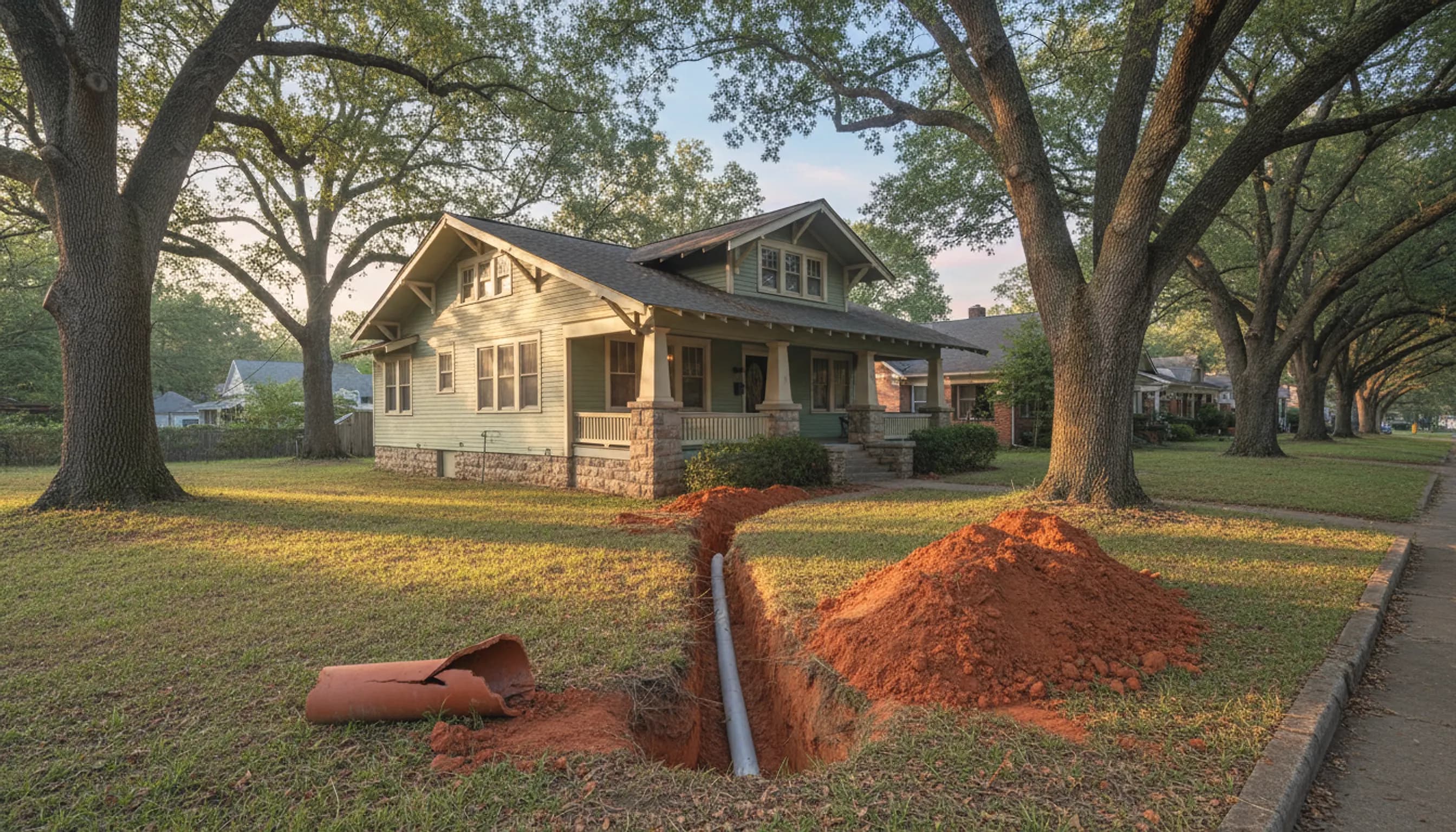
An open trench across a craftsman bungalow's front yard under old oaks, broken terracotta sewer pipe set beside new white PVC.
Illustrative photo.

How the job runs

How a new or replacement water line goes in

  1. 1

    Find the start, the end and everything between

    We locate the meter or well head, the entry point at the house, and the septic tank, drain field and sewer line, then lay out a route that respects the separations in the code.

    Georgia State Minimum Standard Plumbing Code 2018, Chapter 6 Water Supply and Distribution (UpCodes)

  2. 2

    Request locates through Georgia 811

    Any trench dug by machine needs a locate request first. Inside the marked tolerance zone, the facility width plus 18 inches each side, the digging switches to hand or vacuum methods.

    Georgia 811 — Georgia Utility Facility Protection Act (O.C.G.A. 25-9) summary

  3. 3

    Pay the tap or set the well tie-in

    On a utility system the tap and meter are bought from the utility; EPWSA, for example, lists $1,330 for a 3/4-inch water tap plus a separate capacity charge. On a well system the line ties into the pressure tank or pump house.

    EPWSA Schedule of Rates, Fees, and Penalties (effective 5.16.25, corrected)

  4. 4

    Trench and clear rock

    The trench is cut to the planned depth. Where the Piedmont throws up stone, rock is removed for at least 6 inches below the pipe, the same clearance EPD sets for public mains.

    Georgia EPD — Minimum Standards for Public Water Systems (revised March 2021)

  5. 5

    Bed, lay and restrain

    Pipe goes on continuous, uniform bedding. On mains, bends, tees and valves get thrust blocking or restrained joints, and non-metallic pipe gets detection tape so it can be found later.

    Georgia EPD — Minimum Standards for Public Water Systems (revised March 2021)

  6. 6

    Pressure test, then backfill in lifts

    The line is pressurized and checked for leaks before it is buried. Backfill is tamped in layers around and above the pipe so it is supported and protected.

    Georgia EPD — Minimum Standards for Public Water Systems (revised March 2021)

  7. 7

    Flush and restore

    New lines are flushed to clear trench debris, the surface is graded, and bare soil is seeded or mulched so the trench line does not wash.

What it costs

What water line installation typically costs

Water line cost is driven by length and by whether the line goes in by open trench or trenchless boring. Utility tap fees are a separate, fixed charge.

What moves the price

These are typical market ranges and utility fees published by third parties, not A Class Septic Services prices. Our estimates are free.

Free estimate: (678) 863-5620
  1. 01Run lengthEvery foot from meter or well to house is trench, pipe, bedding and backfill. Deep lake lots set far from the road cost more for that reason alone.
  2. 02RockWeathered granite and gneiss are common under Piedmont clay; hitting rock means slower digging and imported bedding.
  3. 03Septic layoutA route that must swing around a drain field and its reserve area adds length; crossing near one adds sleeving.
  4. 04Pipe size and materialA distribution main for several homes costs far more per foot than a 3/4-inch service.
  5. 05Surface restorationLawn is cheap to restore; driveways, walks and landscaping are not.

Your options

Open trench or trenchless?

OPTION 01

Open trench

When it fits: New service lines, new distribution lines on open ground, and any run that has to change depth or direction often.

  • Full view of the pipe and bedding
  • Easy to add valves and tees
  • Shares a trench with conduit when the code allows
  • Disturbs lawn and landscaping
  • Bare soil must be stabilized after

OPTION 02

Trenchless boring

When it fits: Short crossings under a driveway, road or mature landscaping where digging would cost more to repair than to bore.

  • Little surface damage
  • Fast under pavement
  • Hard to steer through rock
  • Less control over grade and bedding

OPTION 03

Replace in the same route

When it fits: The old line follows a clear, legal route and simply failed from age.

  • Known path
  • Least design work
  • Old route may now cross a newer septic repair area or patio

Warning signs

Signs the existing service line is failing

Seeing a wet strip or a high bill? Call (678) 863-5620

  • 1. A water bill rising with no change in useWater lost underground still runs through the meter.
  • 2. One strip of grass greener than the restA slow leak feeds the turf along the line's route.
  • 3. Wet, soft ground with no rainPuddles or a squishy patch over the line usually mean the pipe has opened up.
  • 4. Pressure dropping at every fixtureWhen every tap is weak at once, the problem is often the line feeding the house rather than the plumbing inside.
  • 5. Old galvanized or polybutylene pipeBoth materials fail with age; galvanized also restricts flow as it rusts inside.

Homes & businesses

Service lines for homes, distribution lines for everything else

Residential

Homes, lake houses and outbuildings

Most residential work is a service line from a meter or well to the house, or a branch to a barn, shop, guest house or boathouse. We plan these routes around the septic system first, since that is the code constraint most often missed.

  • Meter-to-house service lines
  • Well-to-house lines
  • Lines to barns, shops and outbuildings
  • Replacement of failed service lines

Commercial

Distribution systems and mains

Waterline distribution systems and mains serve more than one connection and follow Georgia EPD's Minimum Standards when they are part of a public system: 2-inch minimum mains, 6-inch where hydrants attach, 24 inches of cover and 10 feet from sewers. We install to the engineer's plan and the utility's specifications.

  • Subdivision and site distribution lines
  • Farm and pasture water lines
  • Commercial service lines

FAQ

Water line installation questions

Straight answers, with the rule or record behind them. Still unsure? Call and ask the crew that digs.

(678) 863-5620

How much does it cost to run a water line from the meter to a house?

National cost guides put main water line installation at $75 to $225 per linear foot, with most owners paying $100 to $200 per foot, and whole jobs from about $1,500 to $12,000 (Fixr, 2025). Length is the biggest driver. Any utility tap or meter fee is separate; EPWSA's 3/4-inch water tap is $1,330 before its capacity charge.

Source: Fixr — Main Water Line Installation Cost (updated August 29, 2025)

How deep should a water line be buried in Georgia?

For public water mains Georgia EPD requires at least 24 inches of cover over the top of the pipe to protect it from freezing. Private service lines follow the plumbing code and local practice, which generally means burying them below frost and deep enough to protect them from traffic. Lines under driveways need more cover or a sleeve.

Source: Georgia EPD — Minimum Standards for Public Water Systems (revised March 2021)

Can a water line run near my septic tank or drain field?

Not over, under or through it. Georgia's plumbing code bars potable water service pipe in, under or above septic tanks, drain fields and seepage pits, and the septic rule keeps absorption fields 10 feet from water supply lines. If a crossing cannot be avoided, the line goes at least 12 inches above the gravel layer inside a larger sleeve pipe.

Source: Ga. Comp. R. & Regs. R. 511-3-1-.07, Absorption Fields (LII)

Can the water line and sewer line share one trench?

Only when the sewer is made of the pressure-rated materials listed in the plumbing code's Table 702.2. Otherwise the two pipes need 5 feet of undisturbed or compacted earth between them, or the water line must be at least 12 inches above the top of the sewer wherever they are within 5 feet. Public mains need 10 feet.

Source: Georgia State Minimum Standard Plumbing Code 2018, Chapter 6 Water Supply and Distribution (UpCodes)

Who is responsible for the water line between the meter and the house?

Usually the property owner. Under Baldwin County's water ordinance, for example, the county installs the service line to the road right-of-way and sets the meter near it; the pipe from the meter to the house belongs to the owner. Check your own utility's rules, since a few draw the line at the property line instead.

Source: Baldwin County Code, Chapter 58 Article II, Water (December 3, 2019)

Do I need a well permit before a new water line to the house?

If the line comes from a new private well, the well itself needs a permit from county Environmental Health before drilling, and in Greene County a lot on a private well must be at least 1.5 acres for a septic system, not counting land within 75 feet of Lake Oconee's high-water line. The service line from the well follows the plumbing code.

Source: Greene County Board of Health — Lot Size Ordinance (effective Sept 7, 2018)

What size water line does a house need?

Georgia's plumbing code sets 3/4 inch as the minimum water service size and says the line must be sized to deliver the flow and pressure the building needs. Long runs, big houses with many fixtures, and lines that also feed irrigation often justify 1-inch pipe. Utilities price taps by size, so the choice also affects the tap fee.

Source: Georgia State Minimum Standard Plumbing Code 2018, Chapter 6 Water Supply and Distribution (UpCodes)

Can I pump lake water to irrigate my lawn on Lake Oconee?

Georgia Power's Lake Oconee guidelines allow irrigation pumps for single-family homes next to its land, provided the pump sits on land, is centrifugal, does not exceed 2.5 horsepower, and is installed and wired by a qualified electrician. That water is not potable and must never connect to the house's drinking-water plumbing.

Source: Georgia Power — Lake Oconee Shoreline Guidelines (2026)

A small creek with eroded red clay banks and rock ledges in pine and hardwood woods, a weathered wooden shed on the bank.

Ready when you are

Need waterlines & mains? Call the crew that digs.

A water line is a long, narrow excavation that has to miss your septic system, your sewer and everyone else's buried utilities. We trench it, bed it, lay the pipe and backfill it, from a single service line to a distribution system.

(678) 863-5620

Property type
What do you need?
Rather talk? (678) 863-5620
Where's the property?
Is it a lake lot? (optional)
Who should we call?

By submitting, you agree we may call or text you about this request. Privacy.

Call nowFree Estimate
