10% offfor military & first responders
A narrow trench across the lawn of an old porch-front house on an oak- and pine-shaded street, a compact excavator at the curb.

SEWER LINES & TAPS · LAKE OCONEE & SINCLAIR

Sewer taps, sewer line installation and rebuilds around Lake Oconee and Lake Sinclair

Where a city or authority sewer reaches your lot, the line from your house to that tap is yours to build. We dig it, lay it to grade, and backfill it, from a single-home connection to a sewer system build.
  • Lake Oconee & Lake Sinclair
  • Residential & commercial
  • Free estimates

Get a free estimate

or call (678) 863-5620

Property type
What do you need?
Rather talk? (678) 863-5620
Where's the property?
Is it a lake lot? (optional)
Who should we call?

By submitting, you agree we may call or text you about this request. Privacy.

The short answer

What does sewer line installation involve in the Georgia lake country?

Sewer line installation is building the private pipe, the building sewer, from a house to a public sewer tap. In Georgia it must hold a steady downhill slope, have cleanouts no more than 100 feet apart, and pass inspection. Around Lake Oconee and Lake Sinclair, most rural lots have no sewer, so taps cluster in towns and utility service areas.

Reviewed by A Class Septic Services · Last updated

Who does the work

One crew, raw ground to a working system

  • Homes, lake lots and commercial properties around Lake Oconee & Lake Sinclair
  • Septic systems and the clearing, grading, drainage and lines around them
  • Ask for Brandon Mosley
  • 10% off for military & first responders
(678) 863-5620

Key facts

Sewer taps and sewer lines in the lake counties: the key facts

Each row links to the agency, code or publisher it comes from. Tap a source to check it yourself.

Code requirements, connection rules and published utility fees for sewer work in the Lake Oconee and Lake Sinclair counties, each with its source.
TopicWhat it saysSource
When you must connectGeorgia requires connection to public sewer when it is available within 200 feet of the property line or in an abutting right-of-way (511-3-1-.03(1)).Ga. Comp. R. & Regs. 511-3-1, On-Site Sewage Management Systems (Georgia Secretary of State)
Greensboro's stricter lineInside Greensboro, sewer counts as available within 500 feet, and the city may order connection within 90 days.Greensboro Code § 30-89 — Sewer use requirements (Municode)
Minimum slope, 3- to 6-inch pipe1/8 inch per foot; piping 2-1/2 inches or smaller needs 1/4 inch per foot (Table 704.1).Georgia State Minimum Standard Plumbing Code 2018, Chapter 7 Sanitary Drainage (UpCodes), 2018
CleanoutsBuilding sewers need cleanouts no more than 100 feet apart, plus one within 10 feet of the public right-of-way (Section 708.1.2).Same source as above
Water line in the same trenchAllowed only if the sewer is built of approved pressure-rated materials; otherwise keep 5 feet of earth between them (Section 603.2).Georgia State Minimum Standard Plumbing Code 2018, Chapter 6 Water Supply and Distribution (UpCodes), 2018
EPWSA (Eatonton-Putnam) 4-inch sewer tap$2,772 tap fee plus $1,810 system development charge, $4,582 total (published fee, effective May 16, 2025).EPWSA Schedule of Rates, Fees, and Penalties (effective 5.16.25, corrected), 2025
City of Madison 4-inch sewer tap$2,500 tap fee; a separate sewer connection fee of $1,500 applies to a 3/4-inch meter (approved June 24, 2026).City of Madison, GA Schedule of Fees (Exhibit A, approved June 24, 2026), 2026
Before any trenchGeorgia law requires a locate request for mechanized digging; the tolerance zone is the facility width plus 18 inches on each side.Georgia 811 — Georgia Utility Facility Protection Act (O.C.G.A. 25-9) summary

Plain definitions

Sewer terms you will hear on a connection job

Building sewer
The private pipe that runs from just outside your foundation to the public sewer; you own it, pay for it and maintain it.↗
Sewer tap
The physical connection point on the public main, usually set by or under permit from the utility, where your building sewer joins its system.
System development charge
A one-time fee some authorities add to the tap fee to pay for treatment and collection capacity; EPWSA lists it separately from the tap itself.↗
Cleanout
A capped riser on the sewer line that gives a cable or camera a straight shot down the pipe.↗
Sewer system build
Laying the collection piping for more than one building, such as a small subdivision, a commercial site or a cluster of lake cabins, before it is turned over to or tied into a utility.

The whole story

Sewer in lake country is the exception, not the rule

Most of the ground between Lake Oconee and Lake Sinclair has never been sewered. Morgan County's 2022 comprehensive plan says most of the unincorporated county has neither water nor sewer infrastructure, and Jasper County's 2023 plan notes that the county does not own sewer facilities at all. In those places a house runs on a septic system, and a sewer line is something you build only inside a town or a utility's footprint.

Where sewer does exist, the pipes are getting old. Putnam County's 2022 plan says many of Eatonton's water, gas, sewer and stormwater lines are approaching 50-plus years in service, and Baldwin County's 2023 plan records a steering committee finding that every sewer line west of Vinson Highway needs replacing. Old public mains get replaced by the utility; the private building sewer that feeds them is the owner's job, and it is often just as old.

Utilities around the lakes vary. In Putnam County the Eatonton-Putnam Water and Sewer Authority runs the public system and publishes its tap fees. Milledgeville's Water & Sewer Department reports about 6,500 sewer customers and 233 miles of sewer line. Around Reynolds Lake Oconee, Piedmont Water Company is a private water and wastewater utility. Each sets its own tap procedure, so the first call on any connection is to the utility that owns the main.

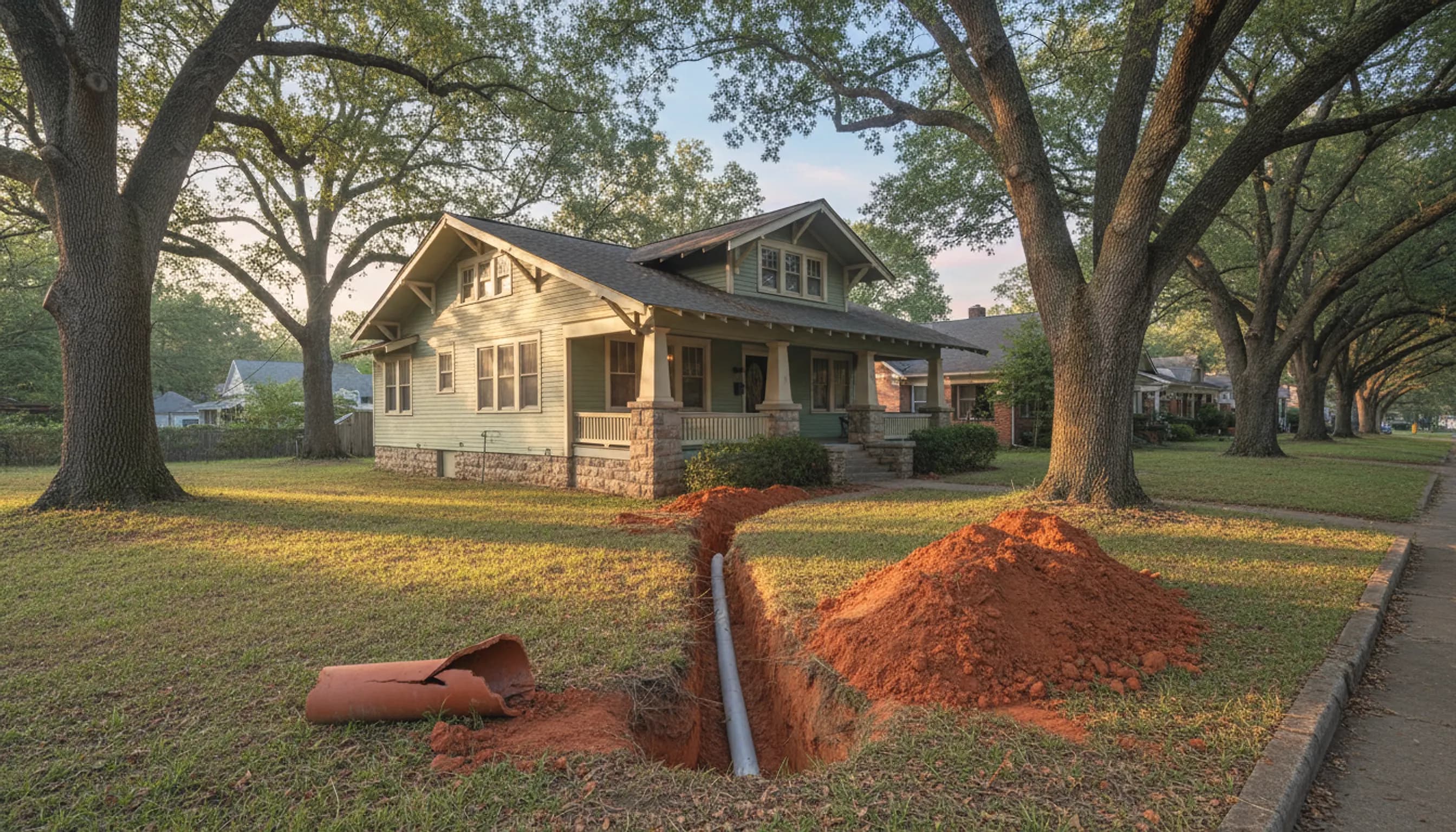
An open trench across a craftsman bungalow's front yard under old oaks, broken terracotta sewer pipe set beside new white PVC.
Illustrative photo.

How the job runs

How a sewer tap and new sewer line go in

The sequence below is the general path for a single-home connection. Utilities differ on who physically makes the tap and who inspects, so step 2 is always settled first.
  1. 1

    Confirm sewer is really available

    We check with the owning utility that a main runs within reach of the lot and at a depth the house can drain to by gravity. A main that sits higher than your lowest drain means a pump, not a gravity line.

    Ga. Comp. R. & Regs. 511-3-1, On-Site Sewage Management Systems (Georgia Secretary of State)

  2. 2

    Pay the tap and capacity fees and get the permit

    The utility issues the connection permit and sets the tap. On EPWSA's published schedule a 4-inch residential sewer tap and its system development charge total $4,582. Greensboro requires a city permit and a Y-branch connection.

    EPWSA Schedule of Rates, Fees, and Penalties (effective 5.16.25, corrected)

  3. 3

    Call Georgia 811 and mark the route

    Before any machine digs, a locate request goes in. Where the trench route is hard to describe, Georgia law calls for white-lining it on the ground so locators know exactly where to mark.

    Georgia 811 — Georgia Utility Facility Protection Act (O.C.G.A. 25-9) summary

  4. 4

    Dig the trench to grade

    The trench is cut so the pipe falls at least 1/8 inch per foot for a 4-inch line, at one even slope. On a lake lot that means laying out the grade with a level before the bucket goes in, because a sag holds solids and a hump starves the pipe of flow.

    Georgia State Minimum Standard Plumbing Code 2018, Chapter 7 Sanitary Drainage (UpCodes)

  5. 5

    Bed, lay and set cleanouts

    Pipe goes onto uniform bedding with cleanouts at the house, at intervals of 100 feet or less, and within 10 feet of the right-of-way. Rock in Piedmont trenches is cleared from under the pipe so nothing point-loads it.

    Georgia State Minimum Standard Plumbing Code 2018, Chapter 7 Sanitary Drainage (UpCodes)

  6. 6

    Inspection, then backfill

    The line stays open until the utility or building inspector signs off. Backfill goes in lifts and is compacted, then the surface is graded and stabilized so the trench does not settle into a ditch.

  7. 7

    Abandon the old septic tank

    When sewer replaces septic, Georgia rules require the old tank to be pumped and filled with sand, soil or rock, or removed. We handle that excavation as part of the conversion.

    Ga. Comp. R. & Regs. R. 511-3-1-.17, Maintenance and Operation (LII)

Permits & the Georgia rules

Permits and rules that apply to a sewer connection

Sewer connections fall under the plumbing code and the owning utility's rules, not the county health department, except where a septic system is being retired.
  1. 01

    Apply to the utility that owns the main for a tap or connection permit and pay its published fees.↗

  2. 02

    Inside a city, pull the plumbing or sewer connection permit that city requires; Greensboro, for example, permits each building sewer connection.↗

  3. 03

    Request a Georgia 811 locate before mechanized digging and wait out the notice period.↗

  4. 04

    Build to the Georgia plumbing code (slope, materials, cleanouts) and hold the trench open for inspection.↗

  5. 05

    Retire the septic tank under 511-3-1-.17(5) if the house is converting from septic.↗

Georgia rule 511-3-1-.03(1)(a)

“Connection shall be made to a public or community sewage treatment system if such system is available within two hundred feet”
Read the rule

Georgia rule GA Plumbing Code 708.1.2

“An additional cleanout shall be provided within 10 feet of the public right of way.”
Read the rule

Georgia rule 511-3-1-.17(5)

“If the use of a septic tank is discontinued,”
Read the rule

How it varies by county

  • Putnam (Eatonton)

    EPWSA publishes a full fee schedule; its 4-inch sewer tap plus capacity charge is $4,582. The county's 2022 plan says more residents are moving to areas EPWSA does not serve.↗

  • Greene (Greensboro)

    The city treats sewer as available within 500 feet and can order connection within 90 days. All costs of the building sewer fall on the owner.↗

  • Morgan (Madison)

    Madison lists a $2,500 tap fee for a 4-inch sewer tap and $3,000 for 6-inch. Most of unincorporated Morgan County has no sewer.↗

  • Jasper (Monticello)

    The county owns no sewer facilities; Monticello runs the only documented municipal sewer.↗

  • Baldwin (Milledgeville)

    Milledgeville's department serves about 6,500 sewer customers over 233 miles of line.↗

What it costs

What sewer taps and sewer lines typically cost

Two kinds of number matter: the utility's fixed tap and capacity fees, which are published, and the trench and pipe work on your side of the tap, which depends on distance, depth and rock. The figures below come from utilities and a national cost guide.

What moves the price

These are third-party typical market ranges and published utility fees, not A Class Septic Services prices. We give free estimates for the work on your side of the tap.

Free estimate: (678) 863-5620
  1. 01Distance from house to mainA lake house set back 300 feet from the road needs three times the pipe and trench of a town lot, plus extra cleanouts every 100 feet.
  2. 02Rock in the trenchPiedmont ground can turn from clay to weathered rock within a few feet; rock slows digging and must be cleared from under the pipe.
  3. 03Gravity versus pumpIf the main sits above the house's lowest drain, a gravity line will not work and a pump station enters the budget. See septic pump systems.
  4. 04Driveways and hardscapeCrossing a paved drive or patio adds cutting and repaving that a lawn crossing does not.
  5. 05Septic tank retirementConverting from septic adds pumping and filling or removing the old tank.

Your options

Gravity line, pumped connection, or stay on septic?

Which way a house connects depends on elevation and distance more than on preference.

OPTION 01

Gravity building sewer

When it fits: The house sits above the public main and the run can hold at least 1/8 inch of fall per foot all the way.

  • No moving parts
  • No electricity needed
  • Lowest lifetime cost
  • Needs a continuous downhill route
  • Deep trenches when the main is far below grade

OPTION 02

Pumped connection

When it fits: Lakefront homes below the street, basements below the main, or long flat runs that cannot hold slope.

  • Works uphill
  • Smaller pipe can follow the ground
  • Pump, float and alarm to maintain
  • Stops during a power outage

We install pump tanks and effluent pumps; see septic pump systems.

OPTION 03

Keep or rebuild the septic system

When it fits: Public sewer is more than 200 feet from the property line, or the utility has no capacity at your location.

  • No tap or monthly sewer bill
  • Independent of utility outages
  • Needs a working drain field and periodic pumping
  • Repair permits through county Environmental Health

Compare septic repair and septic installation.

Warning signs

Signs an existing sewer line needs a rebuild

A building sewer usually fails slowly. These are the patterns that point to the pipe rather than a single clog.

Line backing up again? Call (678) 863-5620

  • 1. Repeat backups at the lowest drainIf the basement floor drain or lowest shower keeps backing up after the line is cleared, the pipe likely has a belly, a break or roots.
  • 2. A soft or sunken strip across the yardSettlement along the line's route can mean soil washing into a cracked pipe.
  • 3. Sewage odor outdoors near the cleanoutGas escaping at the surface points to an open joint or broken cap.
  • 4. Gurgling toilets when other fixtures drainAir being pushed through water seals often means the line is partly blocked downstream.
  • 5. An old clay or Orangeburg lineOlder homes in towns like Eatonton, Madison and Milledgeville may still drain through jointed clay or fiber pipe that roots enter easily.

Homes & businesses

Home connections and sewer system builds

Residential

Homes and lake houses

For a single house the job is a tap, a building sewer and, often, retiring a septic tank. On lake lots the run from house to street can be long and uphill, so we settle grade and route before quoting.

  • New-construction sewer laterals
  • Septic-to-sewer conversions
  • Rebuilding failed or root-filled lines

Commercial

Commercial sites and small developments

Sewer system builds for more than one building, such as a shop with an office, a small subdivision or a marina store, need collection piping laid to an engineer's plan and the utility's standards. Building sewers 8 inches and larger need manholes at each change in direction under the Georgia plumbing code.

  • Multi-building collection lines
  • Taps for restaurants and shops
  • Grease interceptor tie-ins
Grease trap installation

FAQ

Sewer tap and sewer line questions

Straight answers, with the rule or record behind them. Still unsure? Call and ask the crew that digs.

(678) 863-5620

Do I have to connect to city sewer in Georgia if it runs past my house?

Generally yes, if the public sewer is available within 200 feet of your property line or in an abutting right-of-way, Georgia rule 511-3-1-.03(1) requires connection. Some cities go further: Greensboro treats sewer as available within 500 feet and may order connection within 90 days. Your utility can confirm whether a main counts as available at your lot.

Source: Ga. Comp. R. & Regs. 511-3-1, On-Site Sewage Management Systems (Georgia Secretary of State)

How much is a sewer tap in Eatonton or Putnam County?

EPWSA's published schedule, effective May 16, 2025, lists $2,772 for a 4-inch sewer tap plus a $1,810 system development charge, a total of $4,582. That is the authority's fee only. Digging and laying the private line from your house to the tap is billed separately by whoever does the work.

Source: EPWSA Schedule of Rates, Fees, and Penalties (effective 5.16.25, corrected)

Who owns the sewer line between my house and the street?

In most Georgia towns the owner is responsible for the building sewer from the house to the public tap. Greensboro's code says all costs of installing and connecting the building sewer fall on the owner. The utility owns and maintains the main itself. Ask your utility where its responsibility starts, because a few set that line at the property line.

Source: Greensboro Code § 30-91 — Building sewers and connections (Municode)

How deep and how steep does a sewer line need to be?

Georgia's plumbing code sets slope rather than depth: at least 1/8 inch per foot for 3- to 6-inch pipe and 1/4 inch per foot for smaller pipe, at one even grade. Depth follows from that slope and from where the house drain and the public main sit. The pipe also needs enough cover to protect it from traffic and frost.

Source: Georgia State Minimum Standard Plumbing Code 2018, Chapter 7 Sanitary Drainage (UpCodes)

Can a sewer line share a trench with my water line?

Only under conditions. The Georgia plumbing code allows it when the sewer pipe is made of the pressure-rated materials in Table 702.2. Otherwise the two lines need at least 5 feet of undisturbed or compacted earth between them, or the water line must sit at least 12 inches above the sewer where they come within 5 feet.

Source: Georgia State Minimum Standard Plumbing Code 2018, Chapter 6 Water Supply and Distribution (UpCodes)

What happens to my septic tank when I connect to sewer?

Georgia rule 511-3-1-.17(5) says a tank that is no longer used must either be pumped and filled with sand, soil or rock so nobody can fall into it, or be removed. Leaving an empty, unfilled tank in the yard is a collapse hazard. We can dig out or fill the old tank when we lay the new sewer line.

Source: Ga. Comp. R. & Regs. R. 511-3-1-.17, Maintenance and Operation (LII)

Is Lake Oconee on sewer or septic?

Both. Much of the lake's shoreline runs on individual septic systems, while some planned communities are served by private utilities; around Reynolds Lake Oconee, Piedmont Water Company provides water and wastewater service. Check your utility bill or ask the property owners' association. If no sewer bill exists, the house is almost certainly on septic.

Source: Piedmont Water Company — Water Treatment Plant

Do I need to call 811 before digging a sewer trench?

Yes. Georgia's Utility Facility Protection Act applies to anyone digging with mechanized equipment, including homeowners. The locate request must be made ahead of the dig, and the excavator must use careful methods inside the tolerance zone, which is the marked utility's width plus 18 inches on each side.

Source: Georgia 811 — Georgia Utility Facility Protection Act (O.C.G.A. 25-9) summary

Sources

Where these facts come from

Rules, costs and local facts on this page link to the agency, code or publisher that states them. Cost figures are third-party market ranges, not our prices — estimates are free.

Reviewed by A Class Septic Services · Last updated

  1. 1Ga. Comp. R. & Regs. 511-3-1, On-Site Sewage Management Systems (Georgia Secretary of State)
  2. 2Ga. Comp. R. & Regs. R. 511-3-1-.03 (LII)
  3. 3Ga. Comp. R. & Regs. R. 511-3-1-.17, Maintenance and Operation (LII)
  4. 4Georgia State Minimum Standard Plumbing Code 2018, Chapter 7 Sanitary Drainage (UpCodes) (2018)
  5. 5Georgia State Minimum Standard Plumbing Code 2018, Chapter 6 Water Supply and Distribution (UpCodes) (2018)
  6. 6Georgia 811 — Georgia Utility Facility Protection Act (O.C.G.A. 25-9) summary
  7. 7EPWSA Schedule of Rates, Fees, and Penalties (effective 5.16.25, corrected) (2025)
  8. 8City of Madison, GA Schedule of Fees (Exhibit A, approved June 24, 2026) (2026)
  9. 9Bob Vila — How Much Does Sewer Line Replacement Cost? (updated Jan 27, 2023) (2023)
  10. 10Greensboro Code § 30-89 — Sewer use requirements (Municode)
  11. 11Greensboro Code § 30-91 — Building sewers and connections (Municode)
  12. 12Joint Comprehensive Plan, Putnam County and the City of Eatonton (adopted October 2022), GA DCA (2022)
  13. 13Morgan County & Cities of Bostwick, Buckhead and Rutledge 2022-2036 Comprehensive Plan, GA DCA (2022)
  14. 14Jasper County, Monticello & Shady Dale Joint Comprehensive Plan 2023-2028, GA DCA (2023)
  15. 152023 Baldwin County Joint Comprehensive Plan (Baldwin County and City of Milledgeville), GA DCA (2023)
  16. 16City of Milledgeville: Water & Sewer
  17. 17Piedmont Water Company — Water Treatment Plant
A small creek with eroded red clay banks and rock ledges in pine and hardwood woods, a weathered wooden shed on the bank.

Ready when you are

Need sewer lines & taps? Call the crew that digs.

Where a city or authority sewer reaches your lot, the line from your house to that tap is yours to build. We dig it, lay it to grade, and backfill it, from a single-home connection to a sewer system build.

(678) 863-5620

Property type
What do you need?
Rather talk? (678) 863-5620
Where's the property?
Is it a lake lot? (optional)
Who should we call?

By submitting, you agree we may call or text you about this request. Privacy.

By town

Sewer Line Builds, Taps & Rebuilds near you

Local pages with each town's utility, county permit path and ground conditions.

Call nowFree Estimate
