OPTION 01
Float or control replacement
When it fits: The pump is healthy but floats stick, tangle or fail, or the panel has failed.
- Least expensive fix
- Better switches prevent pump burnout
- The tank is usually pumped down to work safely

SEPTIC PUMP SYSTEMS · LAKE OCONEE & LAKE SINCLAIR
Get a free estimate
or call (678) 863-5620The short answer
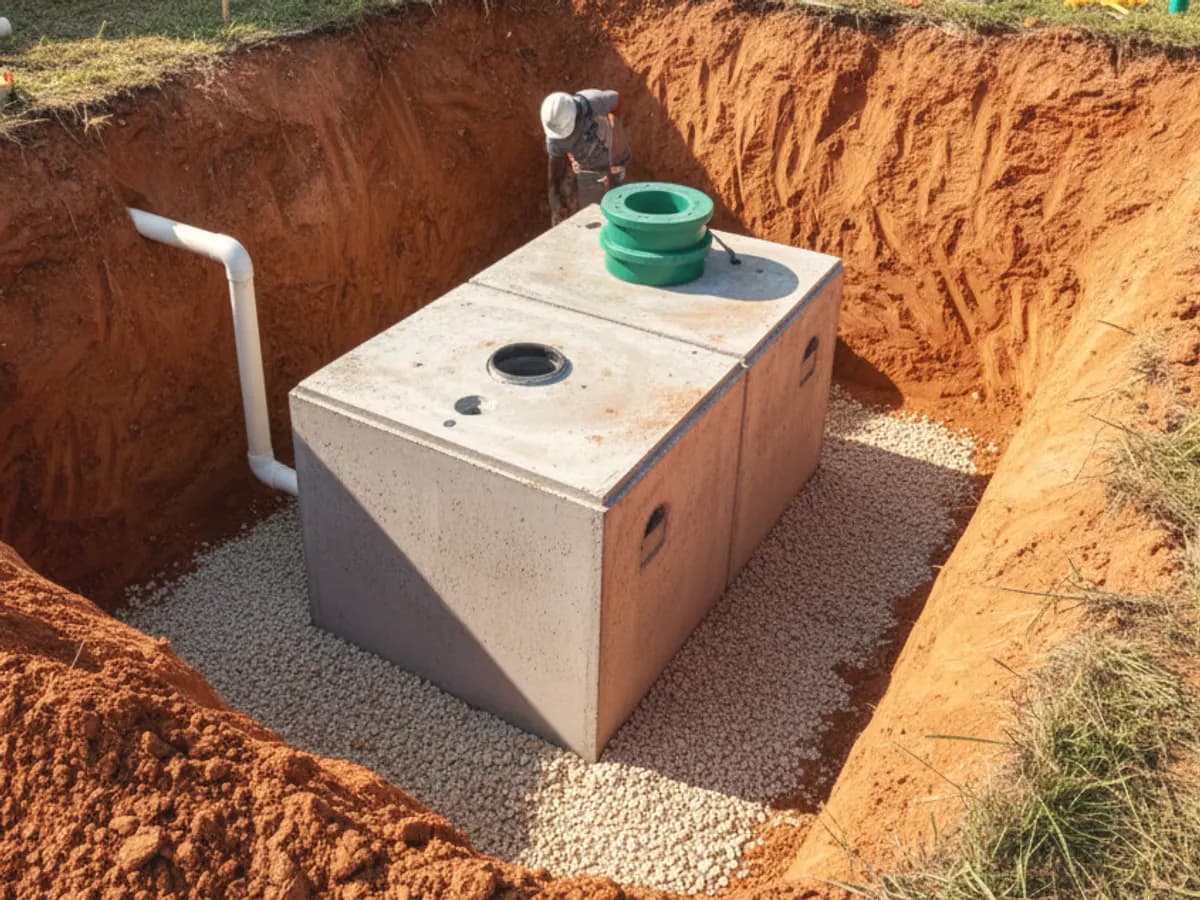
A septic pump system adds a second tank after the septic tank, with a submersible effluent pump, float switches and a high-water alarm, so effluent can be pushed uphill or dosed evenly to a field. Lake Oconee and Lake Sinclair homes often need one because the house sits near the water while the permitted soil sits higher up the lot.
Reviewed by A Class Septic Services · Last updated
Who does the work
One crew, raw ground to a working system
Key facts
Each row links to the agency, code or publisher it comes from. Tap a source to check it yourself.
| Topic | What it says | Source |
|---|---|---|
| When a pump is required | If the dosing tank sits lower than the discharge point, pumps must be used; siphons only work from higher ground with solids removed. | Georgia DPH Manual for On-Site Sewage Management Systems (June 2026), Sections D.4 and E, 2026 |
| Long fields | Fields needing more than 500 linear feet of trench require a dosing tank; over 1,000 feet, alternating pumps or siphons. | Same source as above |
| Reserve capacity | At least one day's flow between the alarm switch and the inlet; for a house, a minimum of 150 gallons per bedroom. | Same source as above |
| Controls | A pump-off switch, a pump-on switch above it, and a high-water alarm switch above that on a separate circuit. | Same source as above |
| Alarm | The high-water alarm must be visual and audible and wired separately from the pump switches. | Same source as above |
| Access | A watertight access at least 24 inches across over the pump, at or within 12 inches of grade, secured against unauthorized opening. | Same source as above |
| Pump specs | Submersible, rated for sewage effluent, corrosion resistant, with performance curves submitted at plan review. | Same source as above |
| Typical market range | Septic pump replacement $800 to $1,400; pump repair $250 to $400 (HomeAdvisor, 2026). Not our prices. | HomeAdvisor: How Much Does a Septic System Cost in 2026? (updated June 20, 2026), 2026 |
Plain definitions
The whole story
The shape of a lake lot works against gravity septic. The house is pushed toward the view, often down a slope, and the deep, well-drained soil the county will permit is frequently on the ridge near the road. On Lake Sinclair lease lots, Georgia Power requires new houses to sit at least 75 feet from the shoreline and the septic system and repair area to stay off its land (Georgia Power), which pushes fields further up the lot. A pump tank and a force main up the hill is the everyday answer.
Getting that right starts with sizing. The pump has to beat the total dynamic head, which is the vertical climb plus the friction in the pipe, at the flow rate the field design calls for. DPH sets minimum pipe sizes so solids keep moving at about two feet per second: 1½-inch pipe at 12 gallons per minute, 2-inch at 21, 2½-inch at 30 and 3-inch at 46 (DPH Manual). A pump that is too small runs constantly and burns out; one that is too big can hammer the lines and flood the first trench.
Reserve space is what protects you during a storm. Georgia requires the volume between the alarm float and the inlet pipe to hold at least a day's flow, 150 gallons per bedroom for a house, so a power outage or a dead pump gives you time before anything backs up. When guests are in the house and the power's out after a summer storm, that reserve is all that stands between you and a backup. Cut water use until the power returns.
The trench for the force main is site work: it may cross a driveway, wind around trees, and climb a slope steep enough to wash out if it isn't stabilized. Because we also do trenching and backfill and erosion control, the pipe run is planned with the grading instead of being an afterthought. Pressure lines should be schedule 40 PVC with pressure fittings and solvent-welded joints.
A note on grinder pumps. Parts of the Lake Oconee shore, including Reynolds Lake Oconee, Great Waters and Cuscowilla, are on Piedmont Water's sewer, and most of its systems are low-pressure sewers where every building has a grinder pump (Piedmont Water). Piedmont says the grinder pump is the homeowner's property and responsibility, and warns that installing a different pump than the model its system was built around may cause sewage back-ups (Piedmont Water). If your home is on one of those systems, check with Piedmont before anyone swaps a pump.
Warning signs
Pump alarm going off? Call (678) 863-5620
Your options
OPTION 01
When it fits: The pump is healthy but floats stick, tangle or fail, or the panel has failed.
OPTION 02
When it fits: The pump is seized, worn out or tripping its breaker.
OPTION 03
When it fits: The pressure line is broken, separated or crushed.
OPTION 04
When it fits: The tank lacks reserve space, leaks, or has no 24-inch access.
How the job runs
Call (678) 863-5620. Tell us what the panel shows and whether the breaker has tripped. We'll set up a free on-site estimate; military members and first responders get 10% off.
Breaker, panel and floats are checked before anyone condemns the pump.
With the quick disconnect and lift rope, the pump comes out without entering the tank; the screen, check valve and discharge line are inspected.
Georgia DPH Manual for On-Site Sewage Management Systems (June 2026), Sections D.4 and E
For new systems or upsizing, the pump is chosen from its curve for the flow and total dynamic head, and the pipe sized to keep solids moving.
Georgia DPH Manual for On-Site Sewage Management Systems (June 2026), Sections D.4 and E
Pump tanks, force mains and system changes go through the county repair or construction permit and inspection.
511-3-1-.03(2)(c)Georgia DPH Rules Chapter 511-3-1, On-Site Sewage Management Systems (Jan 2016)
Off, on and alarm floats are set for the designed dose, the alarm tested on its own circuit, and the lid secured.
Permits & the Georgia rules
For a new pumped system, submit pump performance curves and specification sheets with the plan review.↗
Place the pump tank to meet the same setbacks as a septic tank.↗
Have the work inspected before cover; North Central Health District inspects and permits new, upgraded and repaired systems in its counties.↗
Georgia rule 511-3-1-.06(2)
“Where required, dosing tanks shall be designed, constructed, and installed in accordance with the Manual”
Georgia rule 511-3-1-.03(2)(c)
“Repairs, replacement, or additions to existing systems must be permitted and inspected.”
Greene charges $200 for a home repair permit and $175 to inspect an addition or modification such as a new pump tank (effective August 1, 2024).↗
Pump-related repair permits are $200 for homes; a septic site plan review is $75 (effective August 1, 2024).↗
Pump tank and force-main changes go through Environmental Health at 117 Putnam Drive, Eatonton; the office lists (706) 485-8591.↗
What it costs
Septic pump replacement
$800–$1,400
per pump
Typical market range per HomeAdvisor, 2026
Typical market range — HomeAdvisor: How Much Does a Septic System Cost in 2026? (updated June 20, 2026), 2026
Septic pump repair
$250–$400
per job
Typical market range per HomeAdvisor, 2026
Typical market range — HomeAdvisor: How Much Do Septic Tank Repairs Cost? (updated June 19, 2026), 2026
Pump alarm
$500
per alarm
Typical figure per Today's Homeowner, 2025
Typical market range — Today's Homeowner: Septic Tank Installation Cost (updated April 11, 2025), 2025
New ejector pump
$850–$5,500
per pump
Typical market range per Today's Homeowner, 2025
Typical market range — Today's Homeowner: Septic Tank Installation Cost (updated April 11, 2025), 2025
Typical market ranges from third parties (HomeAdvisor, 2026; Today's Homeowner, 2025); they are not our prices, and we estimate pump work free.
Free estimate: (678) 863-5620Where we do this
FAQ
Straight answers, with the rule or record behind them. Still unsure? Call and ask the crew that digs.
(678) 863-5620The alarm float has risen, meaning effluent is above the level where the pump should have started. Check whether the breaker tripped. If the power is on, the pump, a float, or the discharge line has likely failed. Use as little water as possible; the tank's reserve space buys time but not much. Then call.
Source: Georgia DPH Manual for On-Site Sewage Management Systems (June 2026), Sections D.4 and E
Georgia requires reserve space above the alarm equal to roughly a day's flow, at least 150 gallons per bedroom for a house. With normal use that's about a day, less with a full house. Cut back to essentials, skip laundry and long showers, and get the pump checked promptly.
Source: Georgia DPH Manual for On-Site Sewage Management Systems (June 2026), Sections D.4 and E
It depends on the pump, the switches and how hard it works. DPH notes pump failures can usually be traced to switch failures that burn out the pump, and recommends high-quality switches. A pump sized properly to its head and flow, with floats set correctly, runs fewer, longer cycles and lasts longer.
Source: Georgia DPH Manual for On-Site Sewage Management Systems (June 2026), Sections D.4 and E
Pump tanks hold sewage gases and are confined spaces; Georgia requires pumps to be removable without entering the tank, using a quick disconnect and a lift cable. Wiring must meet the National Electrical Code. Any change to the system's tanks or lines needs a county permit. It's a job for a septic contractor and, for wiring, an electrician.
Source: Georgia DPH Manual for On-Site Sewage Management Systems (June 2026), Sections D.4 and E
Piedmont Water says the grinder pump is the homeowner's property and responsibility, and that installing a different pump than the model its system was built around may cause sewage back-ups. Piedmont offers repair on pumps it installs. Check with Piedmont before replacing one.
Leave power on to the pump and alarm so the system can handle any flow and warn you. For grinder pumps, Piedmont relays the manufacturer's advice for absences over two weeks: run clean water until the pump starts and let it shut off on its own, and don't disconnect power.
No. If the field can sit downhill of the house with enough soil depth, gravity works. Pumps come in when the field is uphill, when the field is long enough that Georgia requires dosing (over 500 feet of trench), or when the design calls for pressure distribution or drip lines.
Source: Georgia DPH Manual for On-Site Sewage Management Systems (June 2026), Sections D.4 and E
Keep going
Septic Systems
Sources
Rules, costs and local facts on this page link to the agency, code or publisher that states them. Cost figures are third-party market ranges, not our prices — estimates are free.
Reviewed by A Class Septic Services · Last updated

Ready when you are
Lake houses sit low and their best soil often sits high, so many systems around Lake Oconee and Lake Sinclair push effluent uphill. We install pump tanks, effluent pumps, floats, control panels and alarms, and we replace and repair them when they fail.
(678) 863-5620Free estimate
or call (678) 863-5620By town
Local pages with each town's utility, county permit path and ground conditions.