10% offfor military & first responders
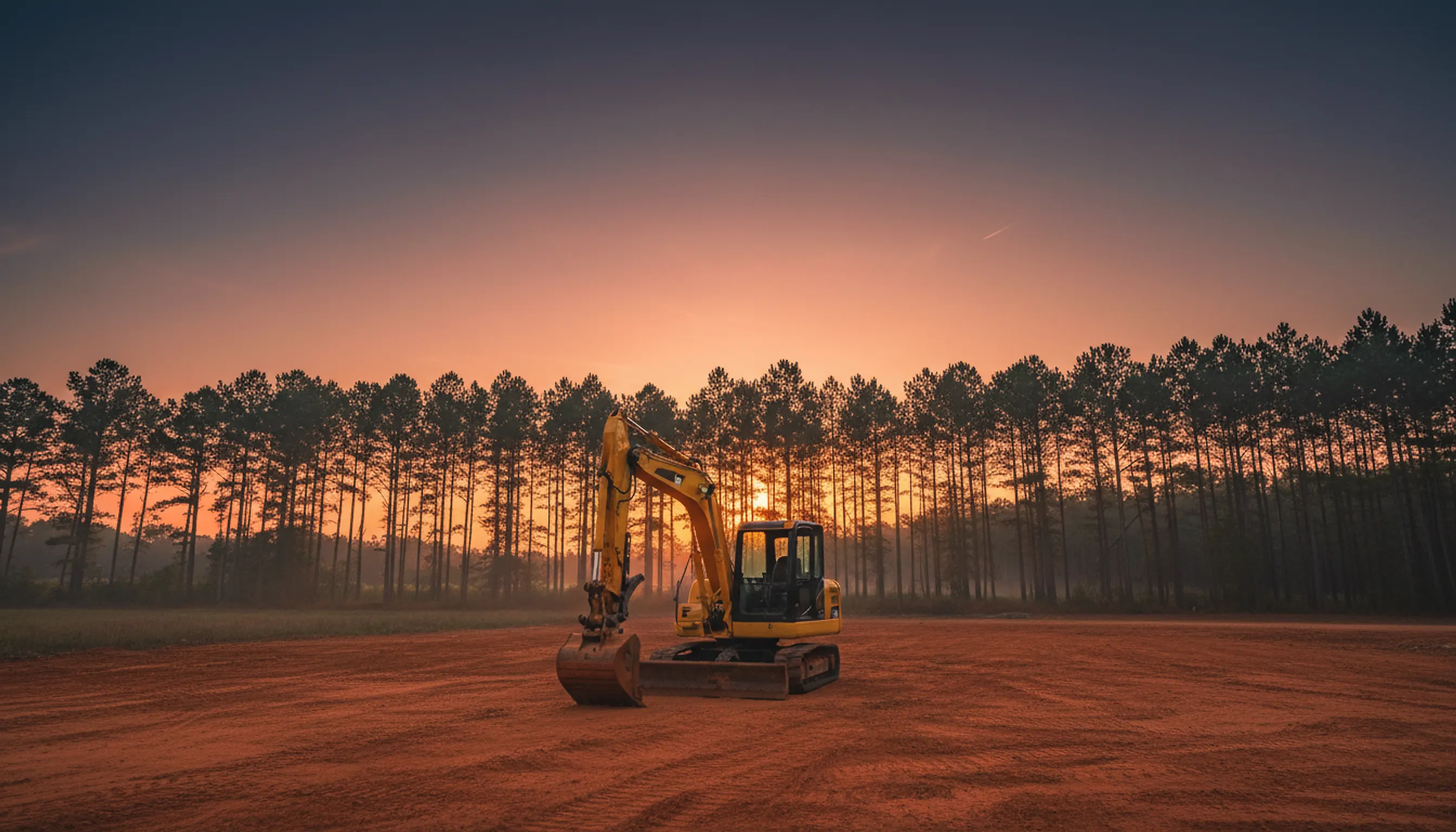
A compact excavator parked on red clay at dusk with loblolly pines silhouetted against an orange sky.

STORM SHELTERS & SAFE ROOMS · MIDDLE GEORGIA

Storm shelter and safe room installation in the Lake Oconee and Lake Sinclair region

An in-ground shelter is an excavation job first: the hole, the base, the anchoring and the drainage decide whether it stays dry and stays put. We dig, set and backfill shelters and prepare sites for safe rooms built to FEMA and ICC 500 criteria.
  • Lake Oconee & Lake Sinclair
  • Residential & commercial
  • Free estimates

Get a free estimate

or call (678) 863-5620

Property type
What do you need?
Rather talk? (678) 863-5620
Where's the property?
Is it a lake lot? (optional)
Who should we call?

By submitting, you agree we may call or text you about this request. Privacy.

The short answer

What should you know before installing a storm shelter in Georgia?

A residential storm shelter or safe room should meet ICC 500, and FEMA recommends designing for 250 mph tornado winds anywhere. In-ground units must be anchored against groundwater uplift, graded so runoff flows away from the door, and kept out of floodways. In Middle Georgia, tornadoes cluster from March through May, so installs are best finished before spring.

Reviewed by A Class Septic Services · Last updated

Who does the work

One crew, raw ground to a working system

  • Homes, lake lots and commercial properties around Lake Oconee & Lake Sinclair
  • Septic systems and the clearing, grading, drainage and lines around them
  • Ask for Brandon Mosley
  • 10% off for military & first responders
(678) 863-5620

Key facts

Storm shelters and safe rooms: the key facts

Each row links to the agency, code or publisher it comes from. Tap a source to check it yourself.

Design criteria, siting rules, Georgia tornado climate and typical market ranges for residential storm shelters, each with its source.
TopicWhat it saysSource
Design wind speedFEMA recommends residential safe rooms be designed for 250 mph tornado winds regardless of location.FEMA P-320, Taking Shelter from the Storm: Building or Installing a Safe Room for Your Home (Sixth Edition, December 2024), 2024
Debris testA 15-pound 2x4 board traveling horizontally at 100 mph, striking end-on.Same source as above
Space per person (tornado)At least 3 square feet of floor area per person; 7 square feet for a hurricane safe room.Same source as above
FloodwaysStorm shelters and safe rooms are not allowed in floodways under any circumstance.Same source as above
In-ground anchoringAnchored so rising groundwater cannot push the unit out of the ground; FEMA also recommends an interior sump pump.Same source as above
Exterior shelter distanceICC 500 limits a residential shelter's access opening to 150 feet of travel from the nearest house entrance.Same source as above
Middle Georgia tornado climateAbout 6 tornado days per year in the Peachtree City forecast area; most tornadoes occur March through May.NWS Peachtree City — Severe Weather Climatology
Underground shelter cost$4,300 to $17,000 (typical market range, Fixr, 2022).Fixr — Cost to Build a Storm Shelter (updated August 18, 2022), 2022

Plain definitions

Shelter and safe room terms

Safe room
A hardened structure built to FEMA's criteria in FEMA P-361 and P-320, intended to give near-absolute protection in tornadoes and hurricanes.↗
Storm shelter
A structure that meets the ICC 500 standard; a safe room meets ICC 500 and FEMA's more conservative funding criteria on top of it.↗
ICC 500
The ICC/NSSA Standard for the Design and Construction of Storm Shelters; FEMA P-320's guidance is based on the 2023 edition.↗
In-ground safe room
A shelter surrounded by soil on all four sides, usually a prefabricated unit set in an excavation, as opposed to a basement safe room.↗
Listed and labeled
Third-party marking showing a prefabricated shelter or door assembly was tested to ICC 500; FEMA does not certify products itself.↗

The whole story

Tornado country, clay ground and lake setbacks

Middle Georgia sees real tornadoes. The National Weather Service office in Peachtree City, which covers the lake counties, reports an average of 6 tornado days a year in its area, with F2 or stronger tornadoes involved in 37 percent of events on a county-by-county basis. Tornadoes have been reported in every month, but most arrive in March, April and May. FEMA P-320 itself cites the April 2011 outbreak that hit Alabama, Mississippi and Georgia among the events that shaped its current guidance.

The ground decides how an in-ground shelter behaves. Most lake-region lots sit on Piedmont clay; the Davidson series that dominates the Baldwin, Jones and Putnam survey has a subsoil that runs 40 to 75 percent clay, and soils like Helena are only moderately well drained. A shelter set in a clay hole is set in a basin that can fill with water after heavy rain. FEMA warns that in-ground safe rooms must be anchored so rising groundwater cannot float them out of the ground, recommends a sump pump inside, and asks that the surface be graded to shed water away from the entrance.

Lake lots add siting rules. On a Georgia Power lease lot at Lake Sinclair, all construction has to sit outside the project boundary and at least 75 feet from the shoreline, and the septic system and its repair area have to fit on the lot too. Add the state setbacks that keep drain fields 5 to 10 feet from buildings and 10 feet from water supply lines, and the open spot for a shelter on a lake lot is often smaller than it looks.
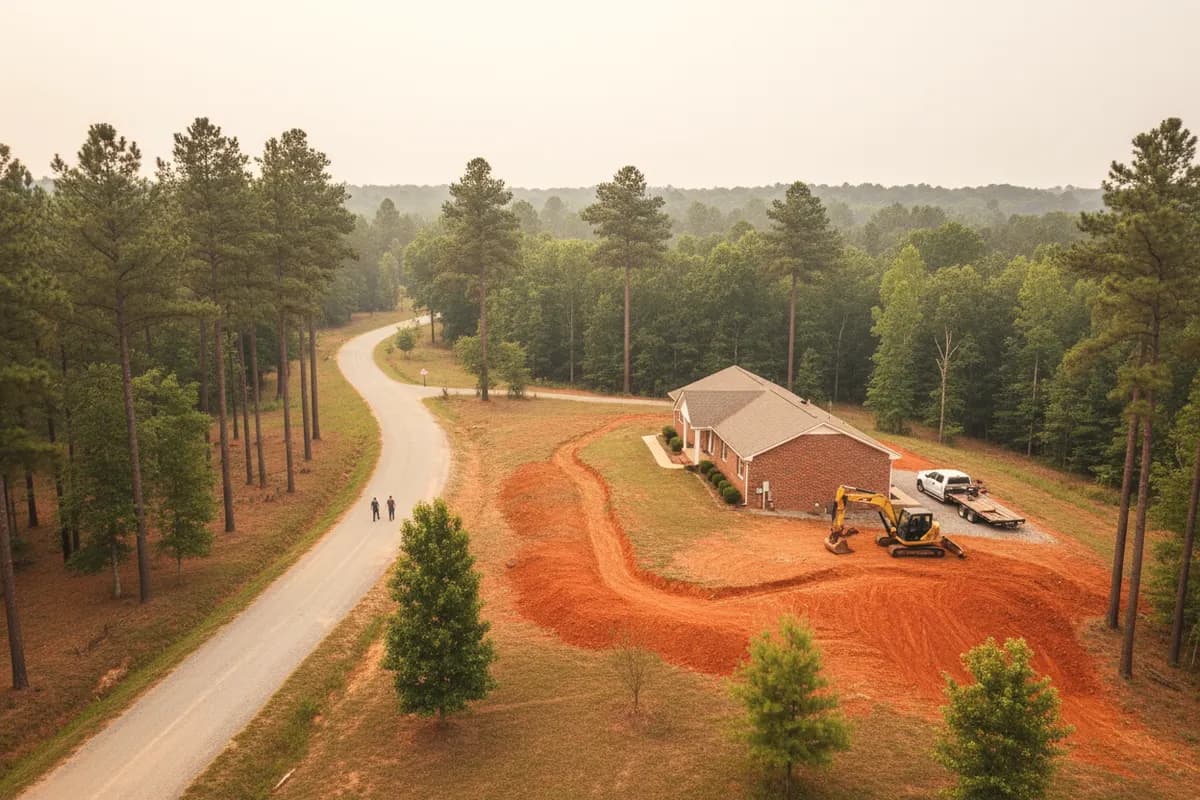
Aerial view of a brick house on a freshly graded red clay lot cut out of pine woods, a compact excavator working beside a curving gravel drive.
Illustrative photo.

How the job runs

How an in-ground shelter goes in

We handle the excavation, base, setting, anchoring and backfill. The shelter unit itself should be a listed and labeled ICC 500 product, or a site-built design with sealed plans.
  1. 1

    Pick the site

    Within 150 feet of travel from a house entrance, out of any floodway or flood hazard area, clear of the septic tank, drain field and repair area, and with ground that can be graded away from the door.

    FEMA P-320, Taking Shelter from the Storm: Building or Installing a Safe Room for Your Home (Sixth Edition, December 2024)

  2. 2

    Confirm the building permit

    The 2021 and 2024 International Residential Code require signed and sealed construction documents for residential storm shelters unless the unit is prefabricated and listed and labeled to ICC 500. Your county or city building department confirms what it needs.

    FEMA P-320, Taking Shelter from the Storm: Building or Installing a Safe Room for Your Home (Sixth Edition, December 2024)

  3. 3

    Call Georgia 811

    The excavation is mechanized digging, so a locate request goes in first and marked lines are respected.

    Georgia 811 — Georgia Utility Facility Protection Act (O.C.G.A. 25-9) summary

  4. 4

    Excavate and prepare the base

    The hole is dug to the depth and footprint the manufacturer or engineer specifies, with a level, compacted base. Where clay or rock is wet, a drainage layer under and around the unit helps keep water from collecting.

  5. 5

    Set and anchor

    The shelter is lowered in and anchored per its design so it resists buoyant uplift from groundwater, as FEMA requires for in-ground units.

    FEMA P-320, Taking Shelter from the Storm: Building or Installing a Safe Room for Your Home (Sixth Edition, December 2024)

  6. 6

    Backfill and grade

    Backfill goes in lifts. The finished surface slopes away from the entrance so stormwater cannot run into the door, within the slope limits the design allows where soil cover is part of the debris protection.

    FEMA P-320, Taking Shelter from the Storm: Building or Installing a Safe Room for Your Home (Sixth Edition, December 2024)

  7. 7

    Stabilize the disturbed ground

    Bare soil around the install is seeded or mulched so the new slope does not wash into the shelter entrance or downhill toward the lake.

What it costs

What storm shelters typically cost

Shelter cost is mostly the unit itself plus the excavation and setting. The figures below are national ranges from a 2022 cost guide; current prices may be higher.

What moves the price

Shelter figures here are national market ranges published by a third party, not A Class Septic Services prices; we estimate free.

Free estimate: (678) 863-5620
  1. 01Unit size and typeCapacity drives price; FEMA's minimum is 3 square feet per person for tornado use.
  2. 02RockHitting weathered rock in a Piedmont dig slows excavation and can force a shallower, larger footprint.
  3. 03WaterWet clay sites need drainage stone, a sump and careful anchoring.
  4. 04AccessSetting a heavy prefabricated unit needs room for delivery and a machine to lift it.
  5. 05FinishLighting, ventilation and power add cost to the base install.

Your options

In-ground, above-ground, or in the garage?

FEMA says an above-ground safe room that meets FEMA P-361 is just as safe as one below ground. The right choice depends on your site and the people who will use it.

OPTION 01

In-ground shelter in the yard

When it fits: There is a dry, accessible spot within 150 feet of the house, outside flood hazard areas and clear of the septic system.

  • Soil provides natural debris protection
  • Takes no space inside the house
  • Must be anchored against groundwater
  • Occupants go outdoors to reach it
  • Steps can be hard for some users

OPTION 02

Above-ground safe room

When it fits: High groundwater, flood hazard areas, rock close to the surface, or occupants who cannot manage stairs.

  • No buoyancy or flooding concerns
  • Walk-in access
  • Uses floor or slab space
  • Must be rigorously tested for debris impact

OPTION 03

Garage floor shelter

When it fits: Homes with a slab garage where a unit can be set below the floor.

  • Reach it without going outside
  • Slab cutting and patching
  • Garage use is limited around the hatch

Warning signs

Signs a site is wrong for an in-ground shelter

Some lots are better served by an above-ground safe room. These are the conditions that push us that way.

Want a site checked for a shelter? Call (678) 863-5620

  • 1. Standing water after rainGround that ponds will surround a buried shelter with water.
  • 2. A mapped floodway or flood zoneShelters are not allowed in floodways, and below-ground siting is not permitted in special flood hazard areas.
  • 3. Rock at shallow depthIf the excavator hits rock a few feet down, the cost of going deeper climbs quickly.
  • 4. Septic system in the only open spotThe drain field and its repair area cannot be dug up for a shelter.
  • 5. Users who can't manage stepsFEMA points to above-ground safe rooms when occupants have physical limits.

Where we do this

Where we do storm shelters & safe rooms

Every county runs its own permits, and the lakes add Georgia Power's rules. Start with your lake or county, or jump to your town.

FAQ

Storm shelter and safe room questions

Straight answers, with the rule or record behind them. Still unsure? Call and ask the crew that digs.

(678) 863-5620

How much does an underground storm shelter cost in Georgia?

A 2022 national cost guide from Fixr puts underground storm shelters at about $4,300 to $17,000 and the typical shelter of any type at $3,900 to $9,000, averaging about $5,800. Prices have likely risen since. Size, unit material, rock in the excavation and whether the site needs drainage work drive the final number.

Source: Fixr — Cost to Build a Storm Shelter (updated August 18, 2022)

What is the difference between a safe room and a storm shelter?

Both must meet the ICC 500 standard. A safe room also meets FEMA's funding criteria from FEMA P-361, which are more conservative; the biggest difference is that a residential safe room must be designed for 250 mph tornado winds wherever it is built. FEMA recommends applying safe room guidance to every storm shelter, even without grant money.

Source: FEMA P-320, Taking Shelter from the Storm: Building or Installing a Safe Room for Your Home (Sixth Edition, December 2024)

Is an underground shelter safer than an above-ground safe room?

Not inherently. FEMA P-320 says an above-ground safe room that meets FEMA P-361 is just as safe as a below-ground one. In-ground units get natural debris protection from the surrounding soil; above-ground units must pass impact testing instead. Above-ground is the better choice where groundwater is high, flooding is possible, or occupants struggle with stairs.

Source: FEMA P-320, Taking Shelter from the Storm: Building or Installing a Safe Room for Your Home (Sixth Edition, December 2024)

Do I need a permit for a storm shelter?

Expect to need a building permit from your county or city. FEMA notes that the 2021 and 2024 International Residential Code require signed and sealed construction documents with each residential storm shelter permit application unless the shelter is a prefabricated unit listed and labeled to ICC 500. Check with your local building official before ordering a unit.

Source: FEMA P-320, Taking Shelter from the Storm: Building or Installing a Safe Room for Your Home (Sixth Edition, December 2024)

How big should a family storm shelter be?

FEMA says a tornado safe room for a one- or two-family home should provide at least 3 square feet of floor area per person, which also meets ICC 500's minimum for residential tornado shelters. A hurricane safe room, where people may stay 24 hours or more, needs at least 7 square feet per person. Plan for guests and pets.

Source: FEMA P-320, Taking Shelter from the Storm: Building or Installing a Safe Room for Your Home (Sixth Edition, December 2024)

Will an in-ground shelter flood?

It can if it is badly sited or built. FEMA requires in-ground safe rooms to be anchored against groundwater uplift, recommends an interior sump pump, and wants the ground graded to slope away from the entrance. It also bars shelters from floodways. FEMA records a 2015 case in Oklahoma where a woman drowned in a flooded storm cellar.

Source: FEMA P-320, Taking Shelter from the Storm: Building or Installing a Safe Room for Your Home (Sixth Edition, December 2024)

When is tornado season in Middle Georgia?

The National Weather Service office in Peachtree City says tornadoes have been reported in its area in every month, but most occur from March through May. Its climatology shows about 6 tornado days a year across the forecast area. Fall and winter outbreaks happen too, so a shelter installed in winter is ready before the spring peak.

Source: NWS Peachtree City — Severe Weather Climatology

Can I put a storm shelter on my Lake Sinclair lease lot?

Possibly, if it fits within Georgia Power's rules. Its Lake Sinclair guidelines require all construction to be outside the project boundary and at least 75 feet from the shoreline, and the septic system and its repair area must also fit on the lot without disturbing the boundary. Talk to Georgia Power's lake resources office and your county before choosing a spot.

Source: Georgia Power — Lake Sinclair Dwellings and Additions guidelines

A small creek with eroded red clay banks and rock ledges in pine and hardwood woods, a weathered wooden shed on the bank.

Ready when you are

Need storm shelters & safe rooms? Call the crew that digs.

An in-ground shelter is an excavation job first: the hole, the base, the anchoring and the drainage decide whether it stays dry and stays put. We dig, set and backfill shelters and prepare sites for safe rooms built to FEMA and ICC 500 criteria.

(678) 863-5620

Property type
What do you need?
Rather talk? (678) 863-5620
Where's the property?
Is it a lake lot? (optional)
Who should we call?

By submitting, you agree we may call or text you about this request. Privacy.

Call nowFree Estimate
