OPTION 01
Curtain drain
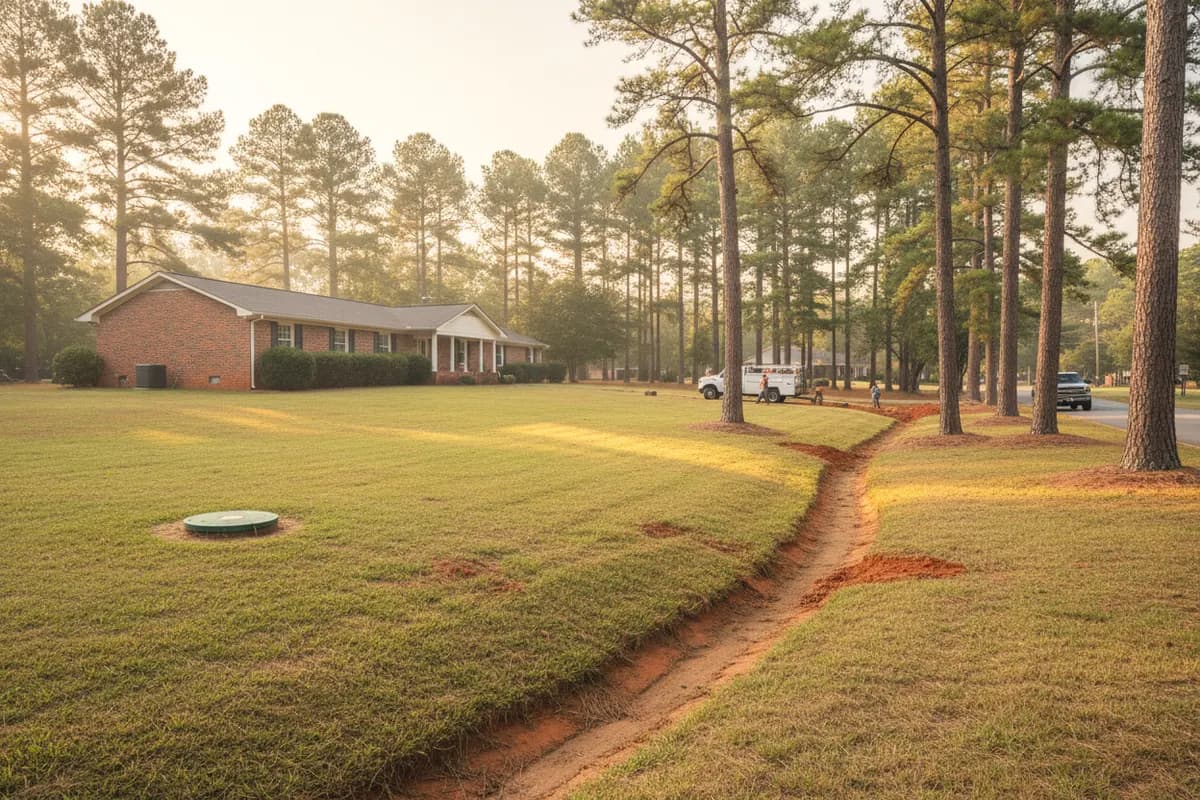
When it fits: Water is moving downhill through the topsoil onto a lawn, patio, drive or drain field.
- Shallow, so it costs less per foot
- Protects everything downhill of it
- Does nothing for water already below it
FRENCH DRAINS · LAKE OCONEE & SINCLAIR
Get a free estimate
or call (678) 863-5620The short answer
A French drain is a gravel-filled trench around a perforated pipe that collects water from saturated soil and carries it away. It suits yards that stay soggy, seepage at foundations, and wet slopes. In Georgia's Piedmont clay it needs a real outlet, and on Lake Oconee lots it often serves as the legal end point for runoff pipes.
Reviewed by A Class Septic Services · Last updated
Who does the work
One crew, raw ground to a working system
Key facts
Each row links to the agency, code or publisher it comes from. Tap a source to check it yourself.
| Topic | What it says | Source |
|---|---|---|
| Pipe size (subsoil drains at buildings) | Not less than 4 inches; open-jointed, split or perforated pipe (Georgia plumbing code 1111.1). | Georgia State Minimum Standard Plumbing Code 2018, Chapter 11 Storm Drainage (UpCodes), 2018 |
| Where a foundation drain may discharge | To a trapped area drain, a sump, a dry well or an approved location above ground (1111.1). | Same source as above |
| Role on Lake Oconee lots | Drainage pipes may not cross Georgia Power land; they must end at the boundary and transition to swales, French drains or dry creek beds. | Georgia Power — Lake Oconee Shoreline Guidelines (2026), 2026 |
| Keep away from the drain field | EPA advises keeping rainwater drainage away from drain fields; Georgia keeps absorption fields 15 feet from drainage ditches. | Ga. Comp. R. & Regs. R. 511-3-1-.07, Absorption Fields (LII) |
| Davidson clay subsoil | 40 to 75 percent clay in the subsoil, the largest soil component in the Baldwin-Jones-Putnam survey. | USDA NRCS Official Series Description — Davidson series |
| Exterior French drain cost | $10 to $100 per linear foot, averaging about $25 (typical market range, Fixr, 2025). | Fixr — French Drain Installation Cost (updated January 31, 2025), 2025 |
| Curtain drain cost | $10 to $25 per linear foot (typical market range, Fixr, 2025). | Same source as above |
| Typical whole project | $1,650 to $12,250, about $5,000 on average (typical market range, LawnStarter, 2026). | LawnStarter — How Much Does a French Drain Cost in 2026? (updated October 5, 2026), 2026 |
Plain definitions
Soil & terrain
Clay soils move water slowly. The Davidson series, the largest soil in the Baldwin, Jones and Putnam survey area, has a dark red subsoil that runs 40 to 75 percent clay. Rain that falls faster than clay can take it either runs off the surface or perches in the looser topsoil above the clay, and that perched water is what keeps a lawn spongy for days after a storm.
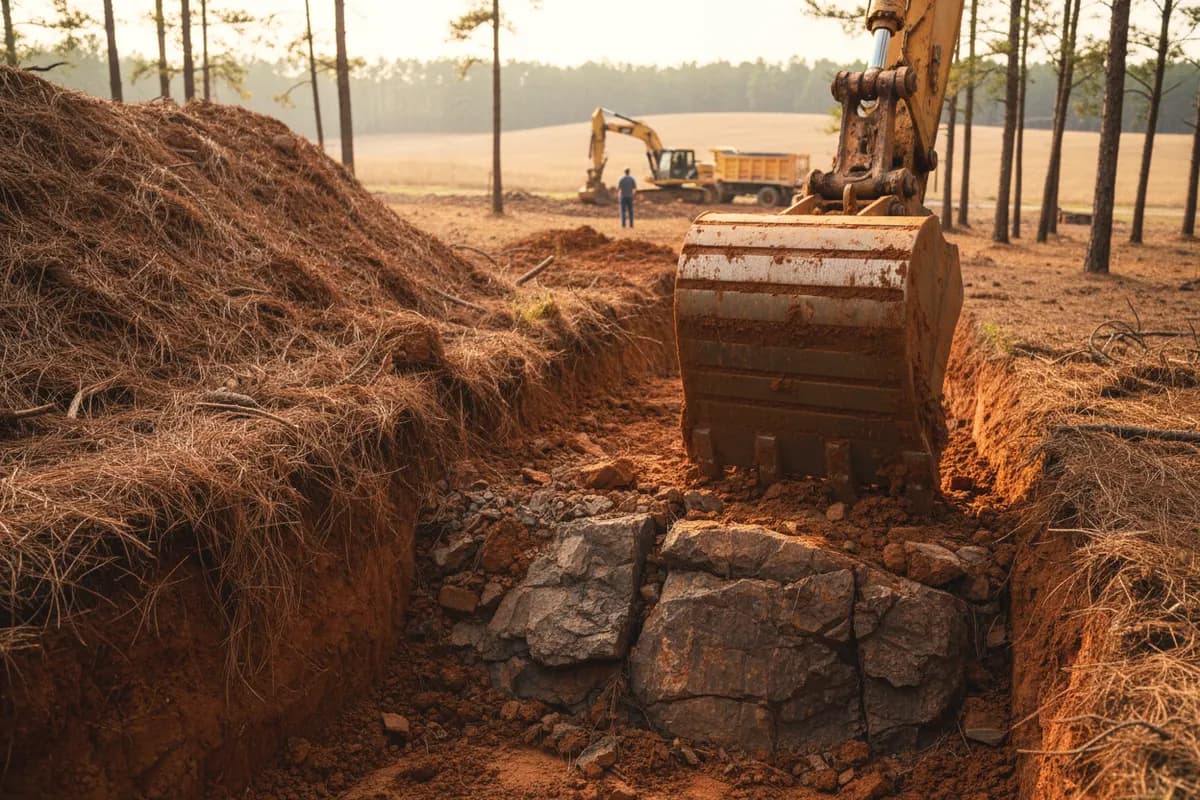
A French drain works by giving that perched water an easier path than the clay does. The gravel trench sits below the wet layer, the perforated pipe inside carries what collects, and the outlet sends it downhill. Because clay hands water over slowly, a French drain here has to be long enough to intercept a meaningful band of slope, and wrapped in fabric so fine clay particles do not plug the gravel.
Some lake-region soils are wetter still. In Greene County, NRCS maps Cataula, Helena and Hard Labor soils across about 35,000 acres, all with subsoils that slow water movement. Helena, mapped at the Putnam County centroid, is moderately well drained and in hydrologic group D, the group that sheds the most runoff. Lots on soils like these are where curtain drains earn their keep.
The whole story
Georgia Power gave French drains a specific job on Lake Oconee. Its shoreline guidelines say no drainage pipe, whatever its origin, may run across Georgia Power property or the project boundary. A pipe has to stop at the boundary and transition to a swale, a French drain or a dry creek bed. So the downspout line or yard drain on a lakefront lot often ends in a short, wide French drain that spreads its water into the soil before the protected strip along the shore.
The other common job is protecting a septic system. A drain field cannot treat wastewater if it is already soaked with rain, and the U.S. EPA's septic care advice is to route roof drains, sump pumps and other rainwater systems away from the field. A curtain drain dug across the slope above a drain field catches water moving downhill through the topsoil before it reaches the trenches. Georgia's septic rule keeps absorption fields at least 15 feet from drainage ditches, so the curtain drain is placed with that distance in mind.
Lake houses with walkout basements are the third. A house cut into a hillside has a wall holding back wet clay on the uphill side, and a footing drain along that wall relieves the pressure that pushes water through block joints.

How the job runs
We work out whether the problem is surface runoff, perched water or a spring, and where the drain can legally and physically discharge: daylight on a downhill slope, a dry well, a swale, or the end of a pipe short of Georgia Power land.
A French drain trench is a long mechanized dig, so a Georgia 811 request goes in first. Irrigation lines and low-voltage wiring are not marked by 811, so we ask about those too.
Georgia 811 — Georgia Utility Facility Protection Act (O.C.G.A. 25-9) summary
The trench drops continuously toward the outlet. Depth follows the wet layer: a few inches below the topsoil for a yard drain, down to the footing for a foundation drain.
Fixr — French Drain Installation Cost (updated January 31, 2025)
Filter fabric lines the trench so clay fines stay out, then a gravel bed goes down under the pipe.
Fixr — French Drain Installation Cost (updated January 31, 2025)
Perforated pipe, 4 inches where it serves a building, goes in holes-down on the gravel, then more gravel, then the fabric is folded over. A cleanout at the high end lets the line be flushed later.
Georgia State Minimum Standard Plumbing Code 2018, Chapter 11 Storm Drainage (UpCodes)
The outlet gets a pop-up emitter, a rock splash pad or a dry creek bed so released water does not cut a new gully.
GSWCC Field Manual for Erosion & Sediment Control in Georgia (2016 edition)
The top is finished in gravel, sod or topsoil and seed, and any bare ground is stabilized.
What it costs
Exterior French drain
$10–$100
per linear foot
Average about $25 per foot.
Typical market range — Fixr — French Drain Installation Cost (updated January 31, 2025), 2025
Curtain drain
$10–$25
per linear foot
Typical market range — Fixr — French Drain Installation Cost (updated January 31, 2025), 2025
Deep footing drain around a foundation
$80–$100
per linear foot
Typical market range — Fixr — French Drain Installation Cost (updated January 31, 2025), 2025
Interior (basement) French drain
$40–$100
per linear foot
Typical market range — LawnStarter — How Much Does a French Drain Cost in 2026? (updated October 5, 2026), 2026
Whole French drain project
$1,650–$12,250
per project
Average about $5,000.
Typical market range — LawnStarter — How Much Does a French Drain Cost in 2026? (updated October 5, 2026), 2026
These ranges are typical third-party market figures, not A Class Septic Services prices. We estimate French drain jobs free of charge.
Free estimate: (678) 863-5620Your options
OPTION 01
When it fits: Water is moving downhill through the topsoil onto a lawn, patio, drive or drain field.
OPTION 02
When it fits: Water is seeping through a basement wall or pooling at the footing.
OPTION 03
When it fits: Water is ponding on the surface and the soil underneath is fine.
See storm drain installation and grading.
Warning signs
Yard still soggy after the rain? Call (678) 863-5620
Where we do this
FAQ
Straight answers, with the rule or record behind them. Still unsure? Call and ask the crew that digs.
(678) 863-5620National guides put exterior French drains at about $10 to $100 per linear foot, averaging around $25 (Fixr, 2025), curtain drains at $10 to $25 per foot, and whole projects from roughly $1,650 to $12,250 (LawnStarter, 2026). Depth, length and the distance to a usable outlet drive the price more than anything else on a lake-country lot.
Source: Fixr — French Drain Installation Cost (updated January 31, 2025)
Yes, if they are built for it. Clay releases water slowly, so the drain needs filter fabric to keep fines out of the gravel, enough length to intercept the wet band, and a dependable outlet. A short drain ending in a small gravel pit will fill and stay full in clay; one that daylights downhill keeps working.
Source: USDA NRCS Official Series Description — Davidson series
Not across Georgia Power land. Its Lake Oconee guidelines say drainage pipes must terminate at the project boundary and transition to swales, French drains or dry creek beds. In practice that means ending pipes short of the boundary and spreading water through a French drain or rock swale that lets it soak in and slow down.
Source: Georgia Power — Lake Oconee Shoreline Guidelines (2026)
It can protect one, but it must not drain one. A curtain drain uphill of the field intercepts rainwater before it reaches the trenches, which the U.S. EPA recommends. Georgia keeps absorption fields at least 15 feet from drainage ditches, so the drain is set back from the trenches, and it should never collect effluent.
Anywhere from a few inches to several feet, depending on what it is draining. A yard drain sits just below the wet topsoil; a footing drain goes down to the base of the foundation. Fixr notes that a drain at the wrong depth for the water table stops working and may need to be reset.
Source: Fixr — French Drain Installation Cost (updated January 31, 2025)
Fixr reports that French drains last from about 3 to 40 years with maintenance, and lists iron ochre in the soil, poor installation and uncleared clogs as the things that shorten their life. Filter fabric, clean washed stone and a cleanout at the upper end all push a drain toward the long end of that range.
Source: Fixr — French Drain Installation Cost (updated January 31, 2025)
A curtain drain is a type of French drain. The name describes its position: a shallow drain dug across a slope like a curtain, above the area it protects, to intercept water flowing downhill through the topsoil. A general French drain can run in any direction, at any depth, wherever water collects.
Source: Fixr — French Drain Installation Cost (updated January 31, 2025)
Four-inch perforated pipe is the common choice. Georgia's plumbing code sets 4 inches as the minimum for subsoil drains serving a building and says they must discharge to a trapped area drain, a sump, a dry well or an approved location above ground. Long yard drains carrying a lot of water may step up to 6 inches.
Source: Georgia State Minimum Standard Plumbing Code 2018, Chapter 11 Storm Drainage (UpCodes)
Keep going
Sources
Rules, costs and local facts on this page link to the agency, code or publisher that states them. Cost figures are third-party market ranges, not our prices — estimates are free.
Reviewed by A Class Septic Services · Last updated
Ready when you are
Red clay holds water like a bowl, and a lake lot slopes all of it toward the house or the cove. A French drain intercepts water below the surface and carries it somewhere it can do no harm.
(678) 863-5620Free estimate
or call (678) 863-5620By town
Local pages with each town's utility, county permit path and ground conditions.