10% offfor military & first responders
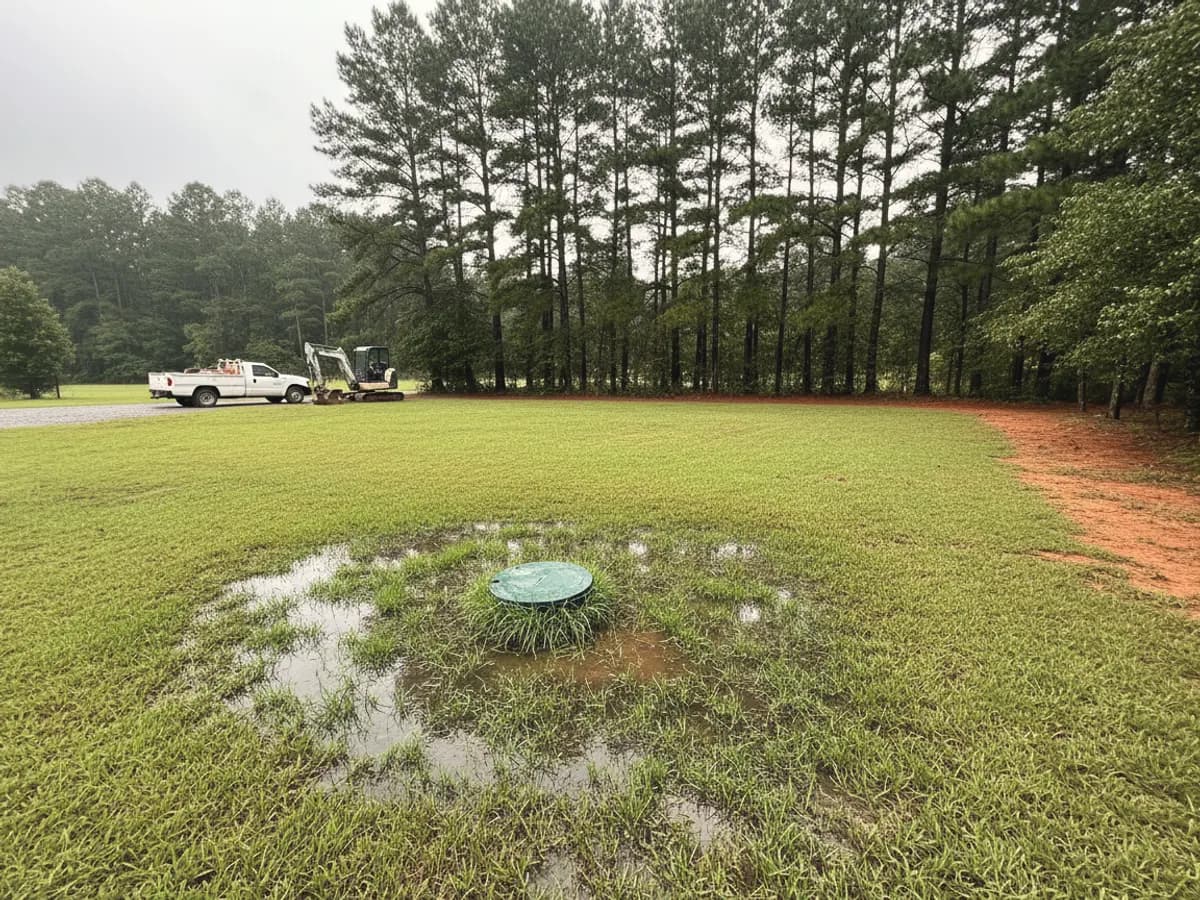
Standing water and an overly green, soggy patch of lawn around a green septic riser lid at the edge of pine woods.

GUIDE · DRAIN FIELD WARNING SIGNS

Signs your drain field is failing, and what to do next in Georgia

A failing drain field usually announces itself in the lawn before it backs up into the house. Here is what each sign means, why lake-country clay and slopes make some worse, and what Georgia requires once a field has quit.
  • Lake Oconee & Lake Sinclair
  • Homes & lake lots
  • Free estimates

Get a free estimate

or call (678) 863-5620

Property type
What do you need?
Rather talk? (678) 863-5620
Where's the property?
Is it a lake lot? (optional)
Who should we call?

By submitting, you agree we may call or text you about this request. Privacy.

The short answer

How do you know a drain field is failing?

A drain field is failing when effluent cannot soak into the soil fast enough. The EPA lists the signs: drains that are slow or back up, gurgling plumbing, standing water or damp spots over the field, sewage odor outside, and bright green, spongy grass over the lines even in dry weather. Near a lake, algae blooms are another warning.

Reviewed by A Class Septic Services · Last updated

Who does the work

One crew, raw ground to a working system

(678) 863-5620

Key facts

Drain field failure at a glance

Each row links to the agency, code or publisher it comes from. Tap a source to check it yourself.

Sourced facts on why drain fields fail, how Georgia handles a failed system and what replacement typically costs.
TopicWhat it saysSource
Most common causeInadequate maintenance, per Georgia DPH; solids carried out of the tank clog the fieldGA DPH Manual for On-Site Sewage Management Systems (March 2026), Section L: Operation and Maintenance, 2026
Other causesPoor design and soil-based systems in unsuitable soils, slopes or high water tablesUS EPA SepticSmart: Resolving Septic System Malfunctions
Repairs in GeorgiaRepairs, replacements and additions must be permitted and inspectedGa. Comp. R. & Regs. r. 511-3-1-.03, General Requirements for On-Site Sewage Management Systems (LII)
Replacement trenches near a lakeStill at least 50 feet from normal water level and 100 feet from wellsGa. Comp. R. & Regs. r. 511-3-1-.07, Absorption Fields (LII)
If sewer is closeA failing system must connect when sewer is available; homes under 2,000 gpd may be exempted if a code repair fitsGa. Comp. R. & Regs. r. 511-3-1-.03, General Requirements for On-Site Sewage Management Systems (LII)
Drain field replacement (national)About $7,000; new field installation $5,000-$12,000 (HomeAdvisor, June 2026)HomeAdvisor: Septic System Installation Cost (updated Jun 20, 2026), 2026
Septic repair (national)Average $1,828; normal range $627-$3,041 (HomeAdvisor, June 2026)HomeAdvisor: Septic Tank Repair Cost (updated Jun 19, 2026), 2026
Greene County repair permit$200 residential (fees effective Aug. 1, 2024)Greene County EH Fees (effective August 1, 2024), Northeast Health District, 2024

Warning signs

The signs, and what each one usually means

One sign alone can have a simple cause. Two or more together, especially outdoors over the field, point to the soil no longer accepting effluent.

Seeing two or more? Call (678) 863-5620

  • 1. Bright green, spongy grass over the lines in dry weatherEffluent is reaching the root zone instead of soaking in below the trench. On a Georgia summer lawn the stripes often show the exact layout of the field.
  • 2. Standing water or soggy ground over the fieldThe trenches are full. In Piedmont clay this often shows first at the low end of the field, where the slope runs toward a creek or cove.
  • 3. Sewage odor outsideSmell near the tank or over the field, not just at the roof vent, suggests effluent is surfacing.
  • 4. Slow drains and gurgling throughout the houseWhen every fixture is slow, the problem is downstream of the house: a full tank, a blocked outlet or a field that cannot take more water.
  • 5. Backups after heavy use or heavy rainA field that only fails when the lake house is full or after a soaking rain is at its limit, and will fail more often.
  • 6. Algae blooms in a nearby cove or pondEPA lists algae blooms in nearby lakes as a sign of septic failure, because effluent carries nutrients.
  • 7. Pump alarm sounding on a pump-to-field systemIf the pump runs but the alarm keeps coming back, the field may be refusing water rather than the pump failing.

Plain definitions

Drain field terms

Hydraulic overload
Hydraulic overload is more water than the soil can absorb, from heavy use, leaking fixtures or roof and yard runoff aimed at the field.↗
Replacement area
The replacement area is the unobstructed land Georgia requires for a complete second field; with trenches on 16-foot centers, the new trenches can go between the old ones.↗
Surfacing effluent
Surfacing effluent is partly treated wastewater that rises to the ground surface over or below a field, the clearest sign a field has failed.↗

The whole story

Why lake-country fields fail the way they do

Clay is the first reason. The red Piedmont clay around Lake Oconee and Lake Sinclair holds water, and Georgia's manual warns that digging absorption trenches in wet clay causes irreversible smearing and compaction. A field built in a wet week can start life with half its capacity, and those fields tend to fail early.

Water from the wrong places is the second. Georgia requires fields to be protected from stormwater and gutter discharge, and the EPA says to keep roof drains and sump pumps away from them. On a lake lot, downspouts and driveway runoff often head downhill, which is exactly where the field was put. On Lake Oconee, Georgia Power also bars drainage pipes from crossing its project boundary, so runoff has to be spread out in swales or French drains before the property line.

Use patterns are the third. A lake house that sits empty for weeks and then runs laundry, dishwashers and showers for a crowd hits the field with days of water at once. Jones County's own comprehensive plan describes rural homes with poor septic function, including backups in houses and yards, so this is not only a lake problem.

Age matters everywhere. Georgia DPH estimates about 1.5 million on-site systems in the state, many more than 30 years old.

Three parallel drain field trenches of washed gravel and white pipe cut into red clay in a pine woods lot, a compact track loader behind.
Illustrative photo.

How the job runs

What to do when you see the signs

  1. 1

    Cut the water load immediately

    Spread out laundry, fix running toilets and leaky fixtures, and redirect any downspout aimed at the field. This buys time; it does not fix a failed field.

    US EPA SepticSmart: How to Care for Your Septic System

  2. 2

    Keep people and vehicles off wet ground

    Surfacing effluent is a health hazard. Do not drive or park over the field, and keep kids and pets away from soggy areas.

    US EPA SepticSmart: How to Care for Your Septic System

  3. 3

    Find out what is actually failing

    A full tank, a crushed line, a failed pump or distribution box, and a sealed field look similar from the house. Georgia's county offices can also evaluate an existing system on request.

    GA DPH Manual for On-Site Sewage Management Systems (March 2026), Section L: Operation and Maintenance

  4. 4

    Get the repair permit

    Any repair, replacement or addition needs a county permit and inspection. In Greene and Morgan the residential repair permit is $200.

    511-3-1-.03Ga. Comp. R. & Regs. r. 511-3-1-.03, General Requirements for On-Site Sewage Management Systems (LII)

  5. 5

    Rebuild in the right place

    New trenches go in the reserved replacement area or new suitable soil, still 50 feet from normal lake level. If sewer is available within 200 feet, Georgia may require a hookup instead.

    511-3-1-.07Ga. Comp. R. & Regs. r. 511-3-1-.07, Absorption Fields (LII)

Your options

Repair or replace?

OPTION 01

Repair a component

When it fits: The field soil is still accepting water, and the problem is a broken pipe, a failed distribution box, a pump or float, or roots in a line.

  • Lower cost
  • Keeps the existing permitted layout
  • Does nothing for a sealed or overloaded field
  • Still needs a permit in Georgia

HomeAdvisor's June 2026 average for septic repair is $1,828; distribution boxes run $500 to $1,500.

OPTION 02

Replace the drain field

When it fits: Effluent is surfacing, the soil is saturated or sealed, or the field was undersized for the house.

  • Restores capacity
  • Can correct an old design, such as adding a pump to reach better soil
  • Needs suitable replacement area
  • Lake lots may need drip or aerobic designs to fit

HomeAdvisor puts drain field replacement at about $7,000 and warns improper repairs can lead to field failure costing up to $20,000.

FAQ

Drain field failure questions

Straight answers, with the rule or record behind them. Still unsure? Call and ask the crew that digs.

(678) 863-5620

What does a failing drain field look like?

Look for standing water or damp spots over the field, bright green and spongy grass over the lines even in dry weather, and a sewage smell outdoors. Inside, slow drains and gurgling across the whole house often accompany it. These are the EPA's listed signs of septic failure.

Source: US EPA SepticSmart: Resolving Septic System Malfunctions

Can a failed drain field be repaired?

Sometimes the cause is a fixable component, such as a broken line, distribution box or pump. If the soil itself is saturated or sealed, the field usually has to be replaced in the reserved repair area. Either way, Georgia requires a county permit and inspection for the work.

Source: Ga. Comp. R. & Regs. r. 511-3-1-.03, General Requirements for On-Site Sewage Management Systems (LII)

How much does it cost to replace a drain field?

HomeAdvisor's June 2026 cost guide puts drain field replacement at about $7,000 and new drain field installation at $5,000 to $12,000. Lake lots that need a pump, drip or aerobic design to fit within setbacks usually cost more.

Source: HomeAdvisor: Septic System Installation Cost (updated Jun 20, 2026)

Why is the grass greener over my septic lines?

Occasional green stripes in a wet spring can be normal. Bright green, spongy grass over the field during dry weather is different: the EPA lists it as a sign of failure, because effluent is reaching the surface roots instead of soaking in below the trench.

Source: US EPA SepticSmart: Resolving Septic System Malfunctions

Do septic additives fix a failing drain field?

No. Georgia DPH says chemical or biological additives are not a substitute for pumping, and Putnam County's health department does not recommend them. A field that is failing needs the cause found and fixed.

Source: North Central Health District: Putnam County Environmental Health Department

What causes a drain field to fail?

Georgia DPH names inadequate maintenance as the primary reason most systems malfunction, letting solids migrate into the field. The EPA adds poor design and fields built in unsuitable soils, steep slopes or high water tables. Runoff aimed at the field and heavy surges of use speed it up.

Source: GA DPH Manual for On-Site Sewage Management Systems (March 2026), Section L: Operation and Maintenance

Will heavy rain make my drain field fail?

Rain does not cause failure by itself, but a saturated field has nowhere to put effluent. Georgia requires fields to be protected from excessive surface water, including stormwater and gutter discharge, so redirecting runoff is often part of the fix.

Source: GA DPH Manual for On-Site Sewage Management Systems (March 2026), Section F: Dispersal Systems

Do I have to connect to sewer if my septic fails?

If public sewer is available within 200 feet of the property line, Georgia requires a failing system to connect. Residential systems under 2,000 gallons per day may be exempted when a code-compliant repair fits and the county finds enough area and usable soil.

Source: Ga. Comp. R. & Regs. r. 511-3-1-.03, General Requirements for On-Site Sewage Management Systems (LII)

Worth knowing

Drain field repair in lake country

A Class Septic Services repairs and replaces drain fields, tanks, lines, distribution boxes and septic pumps around Lake Oconee and Lake Sinclair and across Putnam, Greene, Morgan, Baldwin, Hancock, Jasper and Jones counties, and handles the drainage work that keeps runoff off a new field. Call (678) 863-5620.

A small creek with eroded red clay banks and rock ledges in pine and hardwood woods, a weathered wooden shed on the bank.

Ready when you are

Rather have a pro look at it? Call the crew that digs.

A failing drain field usually announces itself in the lawn before it backs up into the house. Here is what each sign means, why lake-country clay and slopes make some worse, and what Georgia requires once a field has quit.

(678) 863-5620

Property type
What do you need?
Rather talk? (678) 863-5620
Where's the property?
Is it a lake lot? (optional)
Who should we call?

By submitting, you agree we may call or text you about this request. Privacy.

Call nowFree Estimate
