10% offfor military & first responders
Two round concrete septic lids beside freshly dug access holes in a big back yard behind an old white frame farmhouse, a shovel and probe rod on the grass.

SEPTIC REPAIR · LAKE OCONEE & LAKE SINCLAIR

Septic system repair around Lake Oconee and Lake Sinclair

Most septic trouble starts at one component: a baffle, a cracked pipe, a tilted distribution box or a pump. We find it, repair it under the county permit Georgia requires, and keep the rest of your system out of it.
  • Lake Oconee & Lake Sinclair
  • Residential & commercial
  • Free estimates

Get a free estimate

or call (678) 863-5620

Property type
What do you need?
Rather talk? (678) 863-5620
Where's the property?
Is it a lake lot? (optional)
Who should we call?

By submitting, you agree we may call or text you about this request. Privacy.

The short answer

What does a septic repair involve in the Georgia lake counties?

A septic repair in Putnam, Greene, Morgan or the other lake counties means finding the failed component (baffle, pipe, distribution box, pump or tank) and fixing it under a county Environmental Health repair permit. Georgia rule 511-3-1-.03(2)(c) says repairs, replacements and additions to existing systems must be permitted and inspected.

Reviewed by A Class Septic Services · Last updated

Who does the work

One crew, raw ground to a working system

  • Homes, lake lots and commercial properties around Lake Oconee & Lake Sinclair
  • Septic systems and the clearing, grading, drainage and lines around them
  • Ask for Brandon Mosley
  • 10% off for military & first responders
(678) 863-5620

Key facts

Septic repair in Georgia: the key facts

Each row links to the agency, code or publisher it comes from. Tap a source to check it yourself.

Permit rules, fees, owner responsibility and typical repair ranges for septic systems in the Lake Oconee and Lake Sinclair counties.
TopicWhat it saysSource
Permit required?Yes. Repairs, replacement or additions to existing systems must be permitted and inspected (511-3-1-.03(2)(c)).Georgia DPH Rules Chapter 511-3-1, On-Site Sewage Management Systems (Jan 2016), 2016
County decision timeThe County Board of Health approves or disapproves a completed application within 20 days (511-3-1-.03(2)(a)).Same source as above
Repair permit fees (Greene, Morgan)$200 residential, $300 commercial, effective August 1, 2024.Greene County EH Fees (effective August 1, 2024), Northeast Health District, 2024
Who is responsibleThe property owner must operate and maintain the system to prevent failure (511-3-1-.17(2)).Georgia DPH Rules Chapter 511-3-1, On-Site Sewage Management Systems (Jan 2016), 2016
Sewer nearbyA failing system must connect to public sewer if it is available within 200 feet; a residential system under 2,000 gallons per day may be exempted if a compliant repair fits (511-3-1-.03(1)).Same source as above
Hardship variancesThe County Board of Health may grant variances in cases of hardship where existing systems are malfunctioning (511-3-1-.17(6)).Same source as above
Most common causeDPH calls inadequate maintenance the primary reason for most system malfunctions.Georgia DPH Manual for On-Site Sewage Management Systems (June 2026), 2026
Typical repair range$627 to $3,041, average about $1,830 (HomeAdvisor, 2026). Not our prices.HomeAdvisor: How Much Do Septic Tank Repairs Cost? (updated June 19, 2026), 2026

Plain definitions

The repairable parts of a septic system

Outlet filter
Georgia requires an approved filter on the outlet end of every new septic tank; when it packs with solids, the tank backs up toward the house.↗
Inlet and outlet tees
Vertical fittings at each end of the tank that keep scum and sludge from leaving; DPH notes inspections often find them deteriorated and lying on the tank floor.↗
Distribution box
A small box after the tank that must sit on a firm foundation so every outlet gets an equal share; if it tilts, one trench takes most of the flow.↗
Pump tank and high-water alarm
On pumped systems, a separate tank holds effluent until a float starts the pump; a separate-circuit alarm signals when the level rises too high.↗
Riser
A collar that brings a tank opening up to within 12 inches of the surface; Georgia requires one where a tank sits under more than 12 inches of soil.↗

Warning signs

Signs your system needs a repair, and where they usually point

Write down which of these you're seeing and when they started before you call. The pattern tells us whether to start at the house side of the tank or the field side.

Two or more of these? Call (678) 863-5620 for a free on-site estimate

  • 1. Every fixture drains slowly at onceA whole-house slowdown usually means the restriction is at or before the tank inlet: a clogged inlet tee, a root mass in the building sewer, or a pipe that has sagged or broken between the house and tank.
  • 2. Trouble starts after a full-house weekendLake houses that sit empty and then host a crowd can push more water through the tank than it can settle. If problems track your guest calendar, the tank, filter and field may all be working near their limit.
  • 3. An alarm panel is beeping or litThat's a high-water warning from a pump tank or an aerobic unit. Cut water use and call; see our septic pump alarm guide for the first checks.
  • 4. Sewage smell at the lids or in the yardCracked lids and unsealed risers vent gas and let rainwater in. Odor plus wet ground downhill of the tank points toward the field.
  • 5. Wet ground or effluent on the surfaceGeorgia prohibits any system from discharging effluent to the ground surface, a ditch or a lake. Surfacing is a repair the county will expect to see permitted.
  • 6. A soft or sunken spot over the tank or pipeSettling can mean a broken pipe washing soil away or a lid starting to fail. Keep vehicles and people off it until it's checked.

The whole story

Repairing septic systems on lake lots and older rural homes

Around the lakes, the system you're repairing was often built for a different house. Fishing cabins became four-bedroom weekend homes; a single-wide was replaced with a double-wide on the same pad; a basement was finished with a bathroom that drains to a tank sized for two. The first step on any repair is finding the original permit and comparing what was permitted with what the house is now asking of it. If the county has a record of the system, it shows where the tank and field are, which saves digging.

Next is the tank. Once a pumper empties it, the walls, tees, filter and inlet and outlet pipes are visible. Concrete tees and baffles break off, outlet filters pack with lint and grease, and older tanks may have no filter at all. If the outlet baffle has been missing for a while, solids have probably reached the field, and that gets checked next instead of assumed.

After the tank comes the distribution box. Georgia's manual says the box has to sit on a firm foundation so it can't rock, and the way to test it is to pour water in and watch every outlet run at the same time (DPH Manual). On sloped lake lots, boxes settle downhill, and one trench quietly takes the whole flow until it fails. Releveling or replacing the box, sometimes with flow-equalizing caps on the outlets, can put the rest of the field back to work.

On a pumped system, the pump, floats, alarm and control panel get checked in place. Lake houses lose power in storms, and a pump tank with too little reserve space can fill and back up before the lights come back. The fix may be the pump itself or the controls; our septic pump systems page covers those repairs in depth.

Only when the tank, pipes, box and pump all check out does the drain field itself get the blame. If it's the field, the same crew that diagnosed it digs it, under the same conversation with Environmental Health. That work has its own page: drain field installation and repair.

Shoreline lots add one more check. Repair work stays off Georgia Power land, and on Lake Oconee any mechanical clearing or regrading inside the 25-foot vegetative buffer or on project lands needs Georgia Power's written approval first (Georgia Power). Georgia Power does consider tree removal requests to make way for septic installation, with 1:1 replanting, so a repair that needs a tree out can usually be planned around.

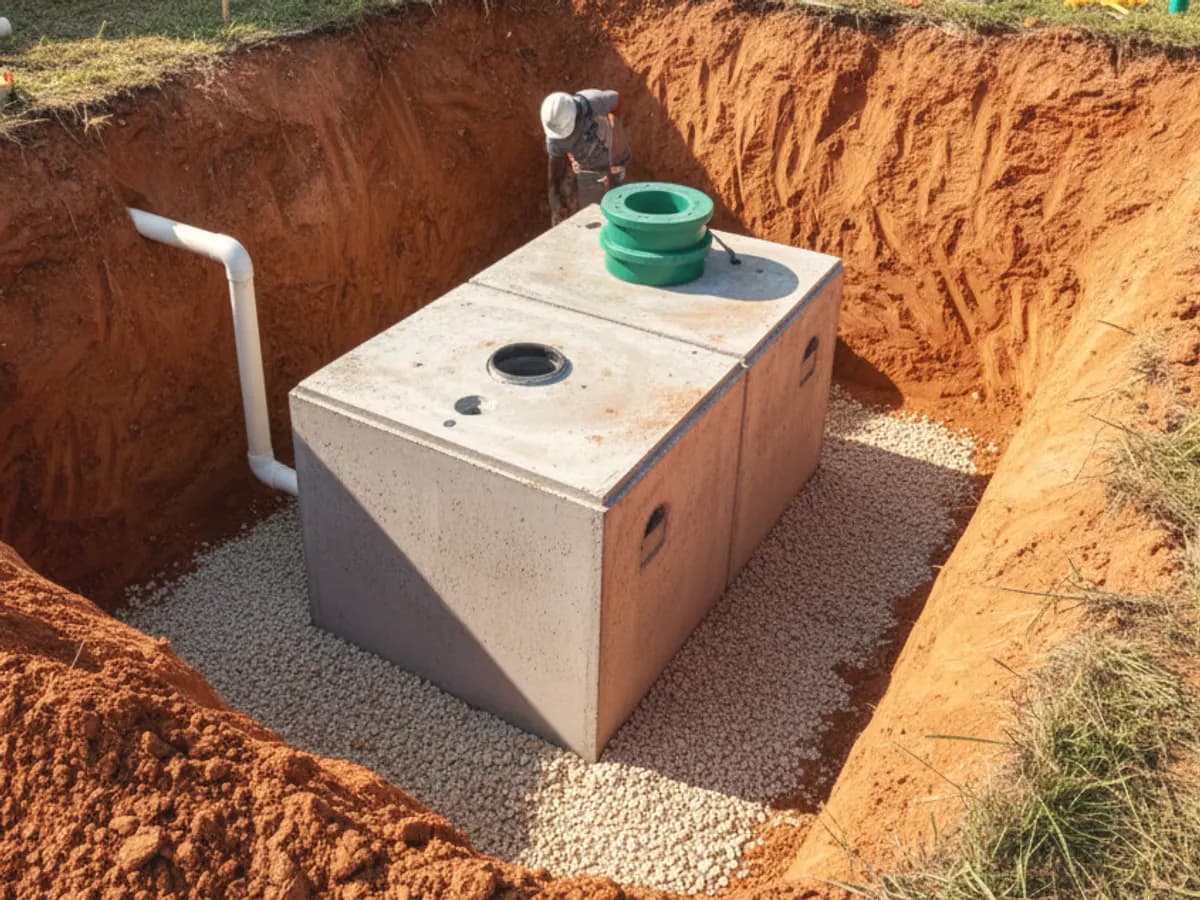
A new concrete septic tank set level on gravel in a red clay pit, a white PVC inlet pipe and a green riser on top.
Illustrative photo.

Your options

Repair options, smallest to largest

What we recommend depends on what's found with the tank open, not on the symptom seen from the yard.

OPTION 01

Outlet filter or tee replacement

When it fits: The filter is packed, or a tee or baffle is broken, clogged or missing.

  • Small excavation at the tank opening
  • Stops solids from reaching the field
  • The tank must be pumped first
  • Field may still need checking if solids already escaped

OPTION 02

Pipe repair or replacement

When it fits: A pipe between the house, tank and box is broken, separated, crushed or full of roots.

  • Fixes the backup at its source
  • New schedule 40 PVC with sealed joints resists roots
  • Trenching along the failed run
  • Driveway and walkway crossings add restoration

OPTION 03

Distribution box relevel or replacement

When it fits: One trench is overloaded or the box has cracked, settled or clogged.

  • Restores even flow to every line
  • Can save a field that looked like it was failing
  • A trench that took years of extra flow may still need work

OPTION 04

Risers and new lids

When it fits: Lids are buried more than a foot deep, cracked or leaking rainwater in.

  • Every future service starts at the surface
  • Sealed risers keep stormwater out of the tank
  • Buried tanks must be dug to fit them

OPTION 05

Tank replacement

When it fits: The tank is collapsed, badly cracked, or far undersized for the house.

  • Current two-compartment tank with an outlet filter
  • Correct size for today's bedroom count
  • Largest tank-side job
  • The old tank must be pumped and filled or removed under 511-3-1-.17(5)

How the job runs

How a septic repair runs

  1. 1

    Call with the symptoms

    Call (678) 863-5620 and tell us what's happening, whether you have a pump or alarm, and whether the house is lived in full time or used on weekends. We set up a free on-site estimate.

  2. 2

    Find and open the tank

    County permit records often show the layout. We locate the lids, dig to them if there are no risers, and open the tank.

  3. 3

    Pump and look

    Septage can only be removed by a hauler holding a county septage removal permit. With the tank empty, the walls, tees, filter and pipes can be inspected.

    511-3-1-.11Georgia DPH Rules Chapter 511-3-1, On-Site Sewage Management Systems (Jan 2016)

  4. 4

    Trace downstream

    We expose the distribution box and water-test it, then check the pump tank, floats and alarm if there is one.

    Georgia DPH Manual for On-Site Sewage Management Systems (June 2026)

  5. 5

    Permit the repair

    We coordinate the county repair application and inspection. The county must answer a completed application within 20 days.

    511-3-1-.03(2)Georgia DPH Rules Chapter 511-3-1, On-Site Sewage Management Systems (Jan 2016)

  6. 6

    Repair, inspect, cover

    The failed part is replaced, set level on firm bearing and sealed. Environmental Health inspects before backfill, then we add risers and grade so water runs away from the lids.

Permits & the Georgia rules

Repair permits in the lake counties

Every repair goes through the county Environmental Health office for the property. Here is what's published for each.
  1. 01

    Check for public sewer within 200 feet of the property line or in an abutting right-of-way; if it's there, connection comes first unless the residential exemption applies.↗

  2. 02

    File the repair application with the county Environmental Health office; the North Central Health District investigates failures and inspects and permits all repairs.↗

  3. 03

    Make the repair within the permit's 12-month life and call for inspection before anything is covered.↗

  4. 04

    Where a repair needs a new or relocated trench, keep it 50 feet from the lake's normal water level and 100 feet from any well.↗

Georgia rule 511-3-1-.03(2)(c)

“Repairs, replacement, or additions to existing systems must be permitted and inspected.”
Read the rule

Georgia rule 511-3-1-.17(1)

“No person shall allow the unapproved discharge or spillage of sewage”
Read the rule

Georgia rule 511-3-1-.17(3)

“No strong bases, acids, or organic solvents shall be used in the operation of an onsite sewage management system.”
Read the rule

How it varies by county

  • Putnam County

    Repair applications go to Environmental Health at the Putnam County Health Department in Eatonton, (706) 485-8591. No fee schedule is posted online. EPWSA sewers Eatonton and some growth areas; most lake shoreline homes are on septic.↗

  • Greene County

    Residential repair permit $200, commercial $300; an existing-system evaluation is $175 (effective August 1, 2024).↗

  • Morgan County

    Residential repair permit $200, commercial $300, existing-system evaluation $175. The county plan says most of unincorporated Morgan has no water or sewer infrastructure.↗

  • Jasper County

    Jasper County Environmental Health, 825 Eatonton Street, Monticello; (706) 468-6850. Its comprehensive plan states most of the county is not served by sewer.↗

  • Baldwin, Hancock and Jones counties

    North Central Health District counties; repair permits go through each county health department's Environmental Health office.↗

What it costs

What septic repairs typically cost

We price each repair after we've seen it, and the estimate is free. These published ranges give you the size of the numbers first.

What moves the price

These are third-party typical market ranges (HomeAdvisor, 2026; Today's Homeowner, 2025) and county fee schedules, not our prices. Estimates are free, and military members and first responders get 10% off.

Free estimate: (678) 863-5620
  1. 01Buried lidsNo risers means digging before anyone can pump, inspect or repair, every time.
  2. 02Where the failure isTank-side fixes are small digs; a failure that has already damaged the field adds trench work.
  3. 03Slope and accessA steep lake lot with the tank below a deck or retaining wall takes longer to reach than an open side yard.
  4. 04County feesGreene and Morgan list $200 residential repair permits; commercial permits are $300.

FAQ

Septic repair questions

Straight answers, with the rule or record behind them. Still unsure? Call and ask the crew that digs.

(678) 863-5620

Do I need a permit to repair a septic system in Georgia?

Yes. Georgia rule 511-3-1-.03(2)(c) requires repairs, replacements and additions to existing systems to be permitted and inspected by the county health department. In Greene and Morgan the residential repair permit is $200. We coordinate the permit and the inspection as part of the job.

Source: Georgia DPH Rules Chapter 511-3-1, On-Site Sewage Management Systems (Jan 2016)

Who pays to fix a failing septic system, the owner or the county?

The owner. Georgia rule 511-3-1-.17(2) makes the property owner responsible for operating and maintaining the system to prevent failure. The county's role is to investigate failures, permit the repair and inspect it before it's covered.

Source: Georgia DPH Rules Chapter 511-3-1, On-Site Sewage Management Systems (Jan 2016)

Can I repair my septic system if city sewer is nearby?

If public sewer is within 200 feet of your property line or in an abutting right-of-way, a failing system is supposed to connect. A home system under 2,000 gallons per day can be exempted if a repair meets the state manual and the lot has enough area and usable soil, as the County Board of Health decides.

Source: Georgia DPH Rules Chapter 511-3-1, On-Site Sewage Management Systems (Jan 2016)

My lake house only backs up on holiday weekends. Why?

A tank sized for a family's daily flow is being asked to settle a crowd's worth of showers, laundry and dishes in a day or two. Solids get pushed out before they settle, and the field gets more water than it can take. A full tank, packed filter or weak field shows up first under that load.

Will a septic additive fix the problem?

No. Georgia's manual says chemical or biological additives are not a substitute for pumping and can cause sludge bulking and damage the soil, even if there's brief relief. The rules also ban strong acids, bases and solvents in a system. A backup has a physical cause that needs a repair.

Source: Georgia DPH Manual for On-Site Sewage Management Systems (June 2026)

Can a septic system be repaired close to the lake?

Yes, as long as the repair meets the setbacks: trenches 50 feet from the lake's normal water level and tanks 25 feet. On Georgia Power lease lots, work stays outside the project boundary. If an old system was built closer than today's rules allow, the county decides what the repair must look like.

Source: Ga. Comp. R. & Regs. R. 511-3-1-.07, Absorption Fields (LII)

What happens to my old septic tank if it's replaced?

Under rule 511-3-1-.17(5), an abandoned tank must be pumped by a permitted pumper and filled with sand, soil or rock so nobody can fall in, or removed to make room for the new component. Removal is excavation work we do as part of the job.

Source: Georgia DPH Rules Chapter 511-3-1, On-Site Sewage Management Systems (Jan 2016)

A small creek with eroded red clay banks and rock ledges in pine and hardwood woods, a weathered wooden shed on the bank.

Ready when you are

Need septic repair? Call the crew that digs.

Most septic trouble starts at one component: a baffle, a cracked pipe, a tilted distribution box or a pump. We find it, repair it under the county permit Georgia requires, and keep the rest of your system out of it.

(678) 863-5620

Property type
What do you need?
Rather talk? (678) 863-5620
Where's the property?
Is it a lake lot? (optional)
Who should we call?

By submitting, you agree we may call or text you about this request. Privacy.

Call nowFree Estimate
