10% offfor military & first responders
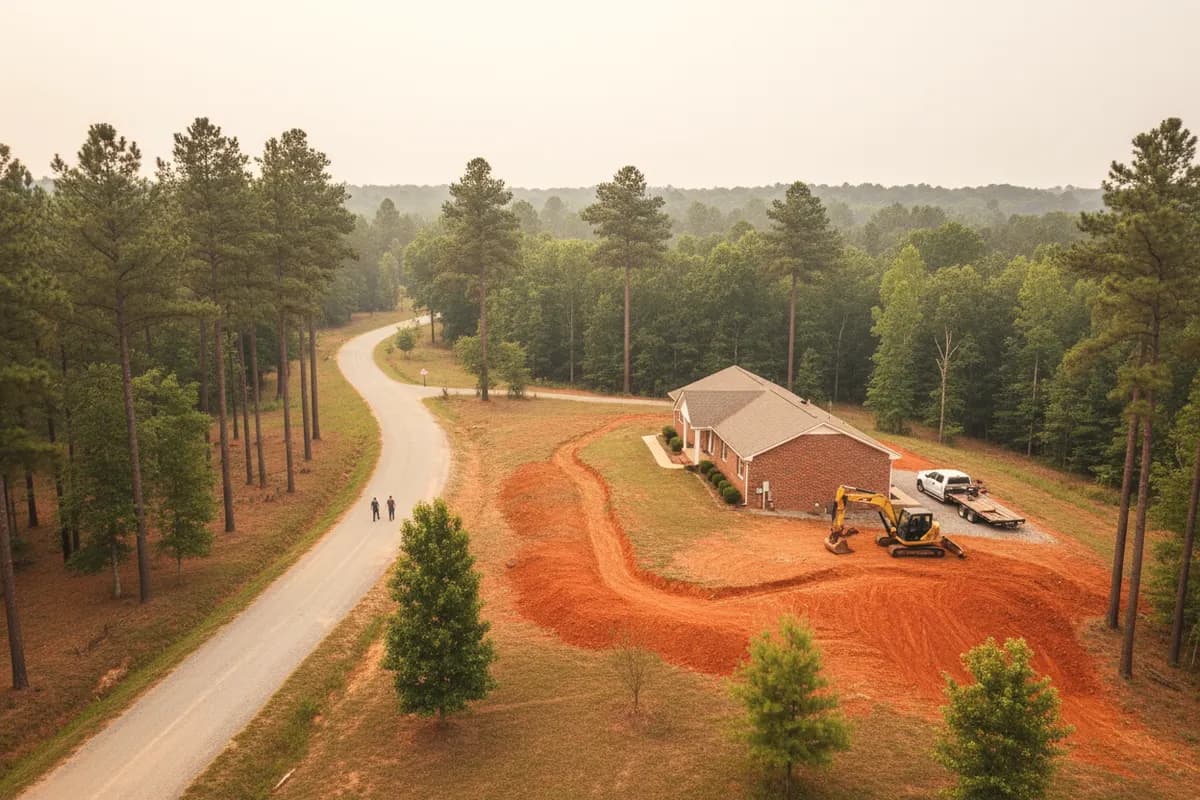
Aerial view of a brick house on a freshly graded red clay lot cut out of pine woods, a compact excavator working beside a curving gravel drive.

GUIDE · LAND CLEARING & DEBRIS BURNING

Land clearing cost per acre in Georgia, and the burn rules that come with it

Per-acre prices are the easy part. On a lake lot the real questions are what you may cut, how close to the water, and whether the brush pile can be burned in your county this month.
  • Lake Oconee & Lake Sinclair
  • Residential & commercial
  • Free estimates

Get a free estimate

or call (678) 863-5620

Property type
What do you need?
Rather talk? (678) 863-5620
Where's the property?
Is it a lake lot? (optional)
Who should we call?

By submitting, you agree we may call or text you about this request. Privacy.

The short answer

How much does land clearing cost in Georgia?

Land clearing typically runs $500 to $2,000 an acre for lightly wooded ground and $3,600 to $5,600 for heavy forest, per HomeAdvisor's 2026 figures. Burning the debris needs a Georgia Forestry Commission permit, and from May 1 to September 30 EPD bans open burning in Putnam, Morgan, Jasper and Jones counties.

Reviewed by A Class Septic Services · Last updated

Who does the work

One crew, raw ground to a working system

  • Homes, lake lots and commercial properties around Lake Oconee & Lake Sinclair
  • Septic systems and the clearing, grading, drainage and lines around them
  • Ask for Brandon Mosley
  • 10% off for military & first responders
(678) 863-5620

Key facts

Clearing and burning facts for the lake counties

Each row links to the agency, code or publisher it comes from. Tap a source to check it yourself.

Published clearing costs and the burn, buffer and permit rules that apply around Lake Oconee and Lake Sinclair.
TopicWhat it saysSource
Average clearing job (national)$3,780; normal range $1,397 to $6,176HomeAdvisor: Land Clearing Cost (updated Jun 17, 2026), 2026
Per acre, lightly wooded$500 to $2,000Same source as above
Per acre, heavily forested$3,600 to $5,600Same source as above
Grading after clearing$1,000 to $3,300 extraSame source as above
2026 summer burn banMay 1 to September 30 in 54 counties, including Putnam, Morgan, Jasper and Jones; Baldwin, Greene and Hancock are not on the listGA EPD press release, Apr. 29, 2026: Annual Ban on Open Burning, 2026
Land-clearing burnsStill need a Georgia Forestry Commission permit, even outside the banSame source as above
Lake Oconee shorelineNo mechanical clearing or grubbing in the 25-foot buffer or on Georgia Power land without its written approvalGeorgia Power: Lake Oconee Shoreline Guidelines (PDF)
Greene County permit triggerErosion plan, land disturbance permit and EPD notice when work disturbs over 1 acre or is within 200 feet of state watersGreene County, GA: Erosion Control Permit Requirements

Plain definitions

Clearing terms, defined

Land-disturbing activity
Under Georgia's erosion law, a land-disturbing activity includes grubbing, dredging, grading, excavating, transporting and filling land.↗
Grubbing
Grubbing is pulling stumps and roots out of the ground after the trees are down, which is what turns a cut lot into bare soil.↗
State-waters buffer
The state buffer is a 25-foot strip measured from the point where wave action has wrested away vegetation, and it applies along lakes like Oconee and Sinclair.↗
Hand-piled debris burn
A hand-piled burn is natural yard debris raked or stacked by hand; machine-pushed piles from clearing are treated as land-clearing burns that need a GFC permit.↗

County by county

Burning and clearing rules, county by county

Whether each lake-region county falls under EPD's 2026 summer burn ban, and the clearing rules near its shoreline.
CountyMay 1–Sept 30 burn ban (2026)Lake shorelineClearing notesSources
PutnamYesOconee and SinclairGeorgia Power buffer rules on both lakes; tree counts required with a new Sinclair dwelling plan.123
GreeneNoOconeeCounty erosion plan and permit within 200 ft of state waters or over 1 acre; single-family LDP under 1 acre issued at no charge.12
MorganYesOconee (north end)Georgia Power Lake Oconee buffer rules apply on the shoreline.12
BaldwinNoSinclairGeorgia Power Sinclair dwelling rules apply on lease lots; GFC permit still needed for clearing burns.12
HancockNoSinclair (east) and Oconee (south)Georgia Power rules apply on both shorelines.12
JasperYesNeither lake (Jackson Lake area)Summer ban applies; state 25-ft buffer on streams and ponds.12
JonesYesNoneSummer ban applies (West Central District list).1

Last updated 2026-10-13 from EPD's April 29, 2026 release. The list is set each year; check it before you light a pile.

What it costs

Typical clearing and follow-on costs

National typical ranges from HomeAdvisor, updated June 2026. They are a starting point for a budget, not a lake-lot quote.

What moves the price

Typical third-party market ranges, not our prices. Estimates from A Class Septic Services are free, and military members and first responders get 10% off.

Free estimate: (678) 863-5620
  1. 01Tree size and densityMature oak and hickory on an old homesite take longer to cut, grub and move than young loblolly pine.
  2. 02SlopeSteep lake lots slow machines down and need more silt fence, check dams and stabilization.
  3. 03Debris disposalBurning where legal is cheapest; chipping or hauling to a grinding yard or inert landfill adds trucking.
  4. 04What must stayBuffers, specimen trees and the future drain field area all get worked around, not through.
  5. 05AccessA narrow gravel road or a gated community with haul-route rules changes how equipment and trucks get in.

How the job runs

Clearing a lake lot in the right order

  1. 1

    Find the lines first

    Get a survey showing the Georgia Power project boundary and the shoreline, and mark the 25-foot state buffer from the point of wrested vegetation. Nothing mechanical happens inside that strip on Lake Oconee without Georgia Power's written approval.

    Georgia Power: Lake Oconee Shoreline Guidelines (PDF)

  2. 2

    Protect the septic area before a tree falls

    Locate the likely drain field and its repair area early. Machines parked or pushing over that ground compact clay, and if later grading or cuts change the depth, Georgia requires the soil evaluation and perc tests to be redone.

    GA DPH Manual for On-Site Sewage Management Systems (March 2026), Section B: General Site Provisions

  3. 3

    Pull the permits

    Land disturbance permits come from the county; Greene, for example, wants an erosion plan, permit and EPD notice for jobs over an acre or within 200 feet of state waters, with a 14-day wait after the notice is filed.

    Greene County, GA: Erosion Control Permit Requirements

  4. 4

    Call Georgia 811

    Grubbing stumps is digging. Contact 811 at least three business days ahead so buried power, water and communication lines are marked.

    Georgia 811: Contact Georgia 811 Before You Dig, How it Works (2025)

  5. 5

    Silt fence, then saws

    Erosion controls go in on the downhill side before clearing starts, so the first rain carries no red clay into the cove.

    Greene County, GA: Erosion Control Permit Requirements

  6. 6

    Cut, grub and sort

    Logs, brush and stumps get separated. Stumps cannot go back into the ground near a septic tank: Georgia requires tank backfill free of stumps and similar debris.

    Ga. Comp. R. & Regs. r. 511-3-1-.05, Septic Tanks (LII)

  7. 7

    Deal with the debris legally

    Burn only outside the ban and only with a GFC permit for clearing debris, or chip, compost, or haul to a grinding operation or inert landfill, which EPD lists as alternatives.

    GA EPD press release, Apr. 29, 2026: Annual Ban on Open Burning

  8. 8

    Stabilize what you opened

    Seed, straw or mulch bare slopes promptly. Cleared clay on a lake lot erodes with the first summer storm.

    Greene County, GA: Erosion Control Permit Requirements

Your options

Burn, chip or haul?

OPTION 01

Burn on site

When it fits: Greene, Baldwin or Hancock any time conditions allow, or the ban counties from October through April, always with the GFC land-clearing permit.

  • Lowest cost per ton
  • No trucks on narrow lake roads
  • Not allowed May–Sept in Putnam, Morgan, Jasper, Jones
  • Needs distance from woods and structures
  • Smoke complaints in dense lake subdivisions

OPTION 02

Chip or mulch in place

When it fits: Lots where the chips can be spread on paths or slopes outside the septic area.

  • Legal year-round
  • Mulch helps hold bare soil
  • Large stumps still need grubbing
  • Deep chip piles can smother a future drain field

OPTION 03

Haul off

When it fits: Tight lots, gated communities and anywhere burning is banned or impractical.

  • Clean site fast
  • Works in every county, every month
  • Trucking and tipping fees
  • More trips on gravel drives

The whole story

What changes when the lot touches the lake

Inland in Morgan or Jasper, clearing a pasture edge is mostly a question of price. On a Lake Oconee lot, Georgia Power's shoreline guidelines decide the first 25 feet for you: no grubbing or reshaping the contour in that buffer or on project land without written approval. Clear it anyway and Georgia Power can require a revegetation plan, pull docks at the owner's expense and stop issuing lake-use permits.

Georgia Power does consider tree removal to make room for a house, seawall or septic installation, but it asks for 1:1 replanting with native species. On Lake Sinclair the paperwork for a new dwelling includes a landscaping plan that counts trees 4 inches in diameter or larger coming out within the building perimeter and the driveway.

The septic system shapes the clearing too. On the clay ridges between the coves, the one patch of deep, well-drained soil is often where everybody wants to park the equipment. Keep machines off it.
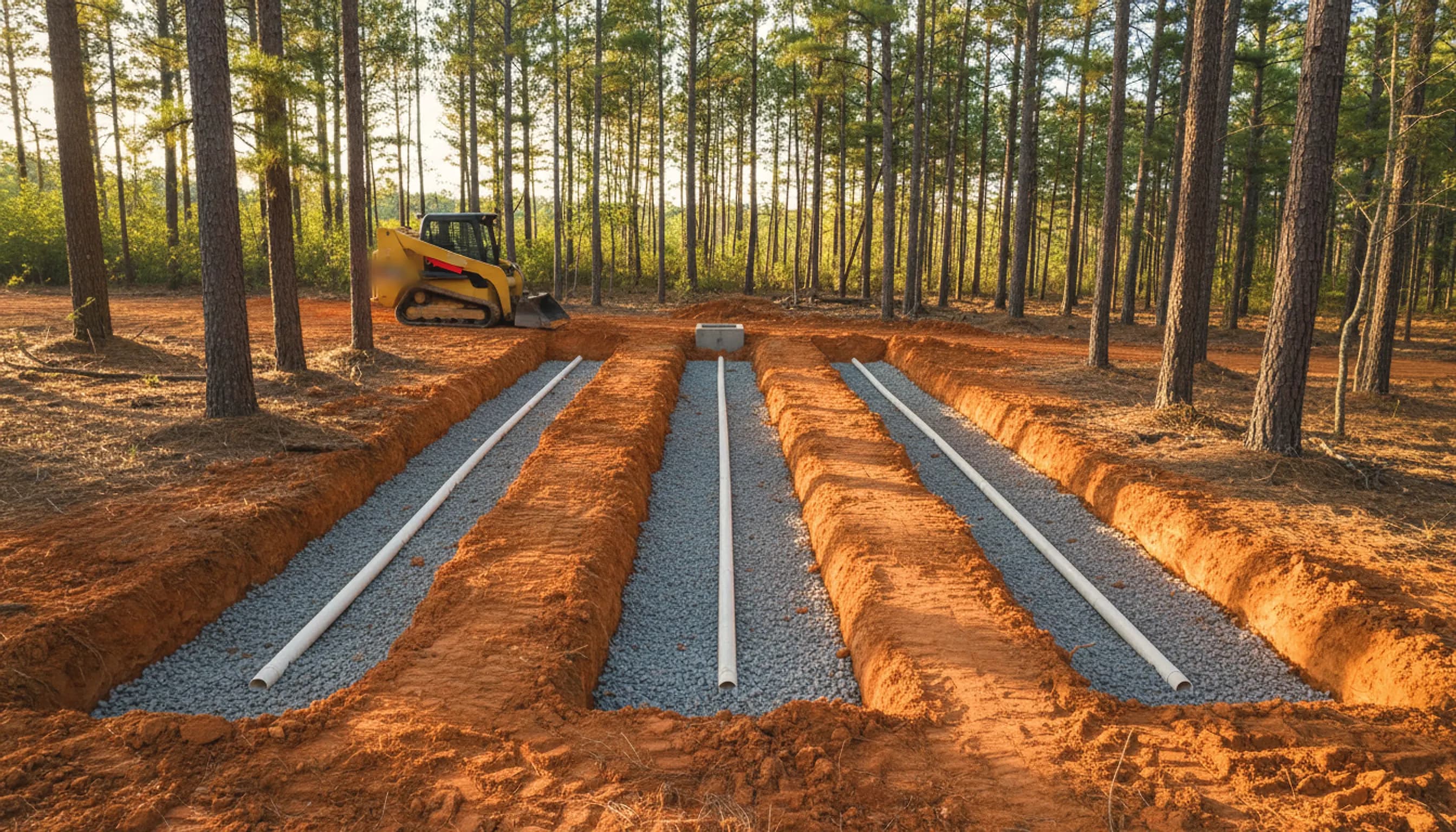
Three parallel drain field trenches of washed gravel and white pipe cut into red clay in a pine woods lot, a compact track loader behind.
Illustrative photo.

FAQ

Land clearing and burning questions

Straight answers, with the rule or record behind them. Still unsure? Call and ask the crew that digs.

(678) 863-5620

How much does it cost to clear one acre in Georgia?

HomeAdvisor's June 2026 figures put one acre at $500 to $2,000 if it is lightly wooded and $3,600 to $5,600 if it is heavily forested, with grading and leveling adding $1,000 to $3,300. Lake lots often cost more per acre because of slope, buffers, erosion controls and the time it takes to haul debris out on narrow roads.

Source: HomeAdvisor: Land Clearing Cost (updated Jun 17, 2026)

Can I burn land-clearing debris in Putnam County in summer?

No. Putnam is one of 54 counties under EPD's annual open-burning ban from May 1 through September 30, 2026, and the ban covers land-clearing debris. Morgan, Jasper and Jones are also on the list. From October through April you still need a Georgia Forestry Commission permit for a land-clearing burn.

Source: GA EPD press release, Apr. 29, 2026: Annual Ban on Open Burning

Is Greene County under the summer burn ban?

Greene, Baldwin and Hancock were not on EPD's 2026 summer ban list. That does not make clearing burns permit-free: the Georgia Forestry Commission still requires a permit for land-clearing, agricultural and forestry burns, obtained through the county GFC office. The list is set each year, so check the current release before burning.

Source: GA EPD press release, Apr. 29, 2026: Annual Ban on Open Burning

Do I need a permit to burn a brush pile I raked by hand?

Outside the ban, GFC no longer requires a permit for hand-piled natural yard debris, but the burn must be at least 25 feet from woods or brush and 50 feet from structures, between sunrise and sunset, and attended the whole time. Machine-pushed clearing piles are a different category and still need a permit.

Source: GA EPD press release, Apr. 29, 2026: Annual Ban on Open Burning

Where do I get a Georgia burn permit, and does it cost anything?

Through the Georgia Forestry Commission, online at GaTrees.org, by calling 1-877-OK2-BURN, or from a local GFC office. The GFC warns that genuine permits are free and that third-party websites charging for them are a scam. Your city or county may add local rules on top of the state permit.

Source: Georgia Forestry Commission: law enforcement warns about fake burn permitting scam (updated Nov. 14, 2024)

Can I clear trees down to the water on Lake Oconee?

Not without permission. Georgia Power prohibits mechanical clearing, such as grubbing or changing the land contour, in the 25-foot vegetative buffer or on its project land without prior written approval, and you need the county's buffer permits first. Unauthorized clearing can lead to a revegetation order, dock removal at your expense and loss of lake permits.

Source: Georgia Power: Lake Oconee Shoreline Guidelines (PDF)

Does clearing a lot affect where the septic system can go?

It can. Compaction from heavy equipment damages clay soils, and Georgia's septic manual says that if grading or cuts will change the depth of a proposed absorption field, the soil evaluation and percolation tests must be done again. Mark the drain field and repair area before clearing and keep traffic off them.

Source: GA DPH Manual for On-Site Sewage Management Systems (March 2026), Section B: General Site Provisions

A small creek with eroded red clay banks and rock ledges in pine and hardwood woods, a weathered wooden shed on the bank.

Ready when you are

Rather have a pro look at it? Call the crew that digs.

Per-acre prices are the easy part. On a lake lot the real questions are what you may cut, how close to the water, and whether the brush pile can be burned in your county this month.

(678) 863-5620

Property type
What do you need?
Rather talk? (678) 863-5620
Where's the property?
Is it a lake lot? (optional)
Who should we call?

By submitting, you agree we may call or text you about this request. Privacy.

Call nowFree Estimate
