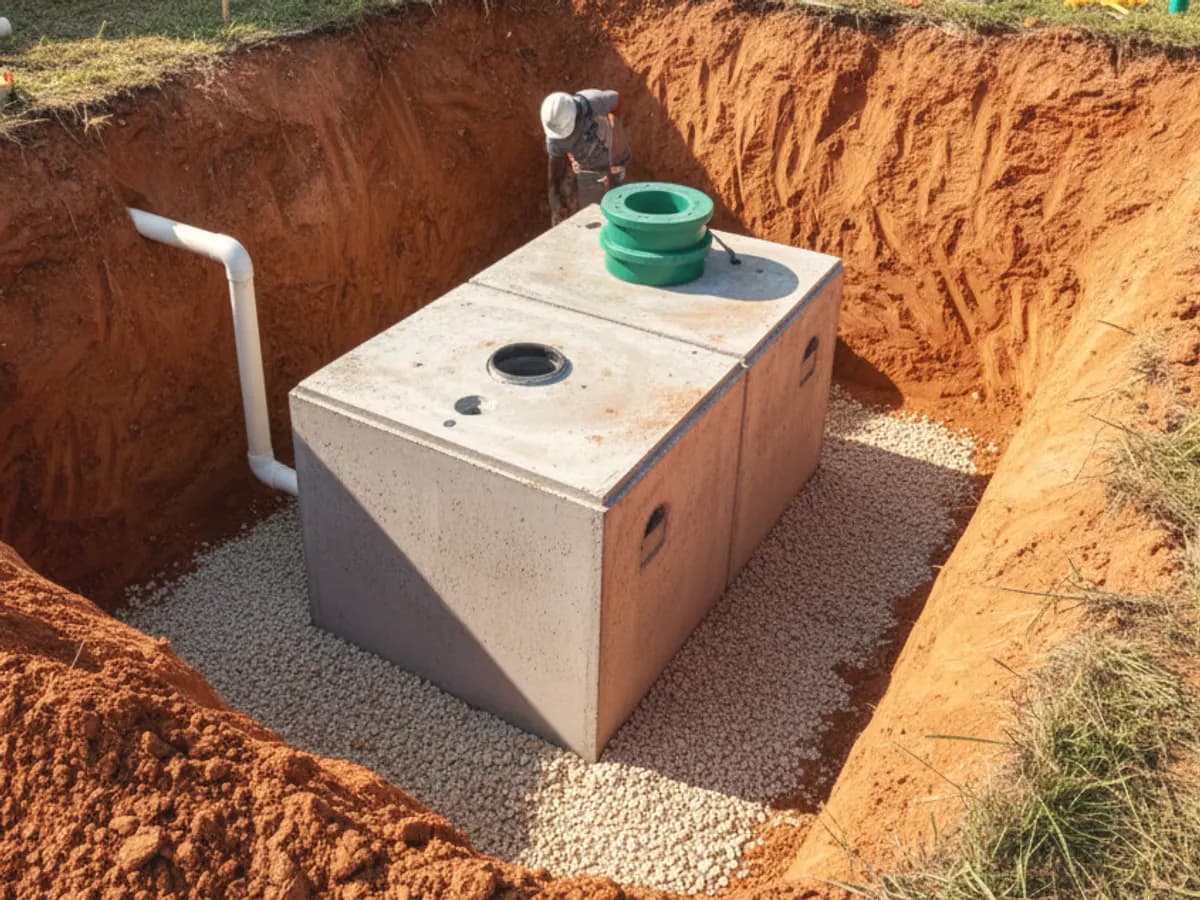
Outside the towns, commercial kitchens in these counties mostly run on septic. Morgan County's plan says most of the unincorporated county has no water or sewer infrastructure, and Jasper's says most of the county is not served by sewer. A lakeside restaurant, a marina grill, a church fellowship hall, a camp or an event venue in the countryside all send their kitchen water to a tank and field. Grease is hard on that system. DPH notes it can clog sewer lines and the inlet and outlet structures of septic tanks, restricting flow and hurting tank performance, and whatever gets past the tank ends up in the trench soil.
Georgia's answer is an outdoor grease trap ahead of the septic tank. DPH's manual explains that placing the trap close to the kitchen, while the water is still hot, lets grease flow in before it congeals; as it cools in the trap, it separates and floats (DPH Manual). Only kitchen wastewater goes through the trap. Toilets bypass it, and DPH says garbage grinder waste shouldn't go into it either, because the extra solids upset performance.
Lake traffic is seasonal, and that matters for sizing. The manual's restaurant formula uses seats, 25 gallons per seat, hours open, and a loading factor that rises with traffic, from 0.75 on minor highways to 1.25 in a recreational area and 2.0 at an interstate. A 75-seat dining room open 12 hours on a main highway works out to 1,875 gallons. Kitchens with variable seating, like nursing homes or camps, use meals per day at 5 gallons a meal, halved without dishwashing. Peak flow, not the slow Tuesday in February, sets the size.
On public sewer, the local utility's code controls. The Eatonton-Putnam Water & Sewer Authority posts a Fats, Oil and Grease ordinance (EPWSA), and Georgia's plumbing code is the 2024 International Plumbing Code with state amendments, effective January 1, 2026 (GA DCA). Before a trap is designed or bought, DPH says to check local plumbing ordinances and codes.
A grease trap is an excavation job as much as a plumbing one. It's usually buried to intercept the building sewer, set level, close to the kitchen, with access to grade for pumping and covers that are gas-tight and rated for the loads above them. In a parking lot, that means cutting pavement and restoring it. Because we do the excavation, trenching and sewer line work too, the trap, its piping and the tie-in to the septic tank or sewer happen in one sequence.