OPTION 01
Conventional gravity trenches
When it fits: Deep soil, gentle slope and plenty of room downhill of the house.
- Lowest cost
- No power or service visits
- Needs 24 inches of separation
- Wide trenches and a large replacement area
DRIP SEPTIC · LAKE OCONEE & LAKE SINCLAIR
Get a free estimate
or call (678) 863-5620The short answer
A drip septic system pumps aerobically treated effluent through emitter tubing buried 8 to 12 inches deep along the ground's contours, timed in small doses. Georgia allows drip fields with just 12 inches of separation to rock or seasonal water, so they fit shallow, sloped Lake Oconee and Lake Sinclair lots where conventional trenches can't be permitted.
Reviewed by A Class Septic Services · Last updated
Who does the work
One crew, raw ground to a working system
Key facts
Each row links to the agency, code or publisher it comes from. Tap a source to check it yourself.
| Topic | What it says | Source |
|---|---|---|
| Pretreatment | Effluent must be aerobically pretreated to no more than 25 mg/L BOD5 and 30 mg/L TSS before it reaches the drip lines. | Georgia DPH Manual for On-Site Sewage Management Systems (June 2026), Section F.6 Pressurized Subsurface Absorption Fields Utilizing Emitters, 2026 |
| Depth | Emitter lines go in the root zone, 8 to 12 inches below the original ground, and at least 8 inches deep. | Same source as above |
| Vertical separation | At least 12 inches between the bottom of the drip field and seasonal groundwater, rock or impervious strata. | Same source as above |
| Line spacing | Typically two feet between laterals; three feet or more required on slopes over 20%. | Same source as above |
| Dosing | Time-dosed from a chamber holding at least one day's flow, with an alarm for high water or power loss. | Same source as above |
| Flow monitoring | New systems must detect a plus or minus 10% change in field flow from clogging, leaks or a failed flush valve. | Same source as above |
| Soil report | A Level 4 soil investigation with each horizon's hydraulic loading rate is required for the permit. | Same source as above |
| Design | Manufacturer design approved by the Department, or a Georgia registered engineer; engineer required over 2,000 gallons per day. | Same source as above |
| Typical market range | Drip system $8,000 to $18,000, average about $13,000 (HomeAdvisor, 2026). Not our prices. | HomeAdvisor: How Much Does a Septic System Cost in 2026? (updated June 20, 2026), 2026 |
Plain definitions
The whole story
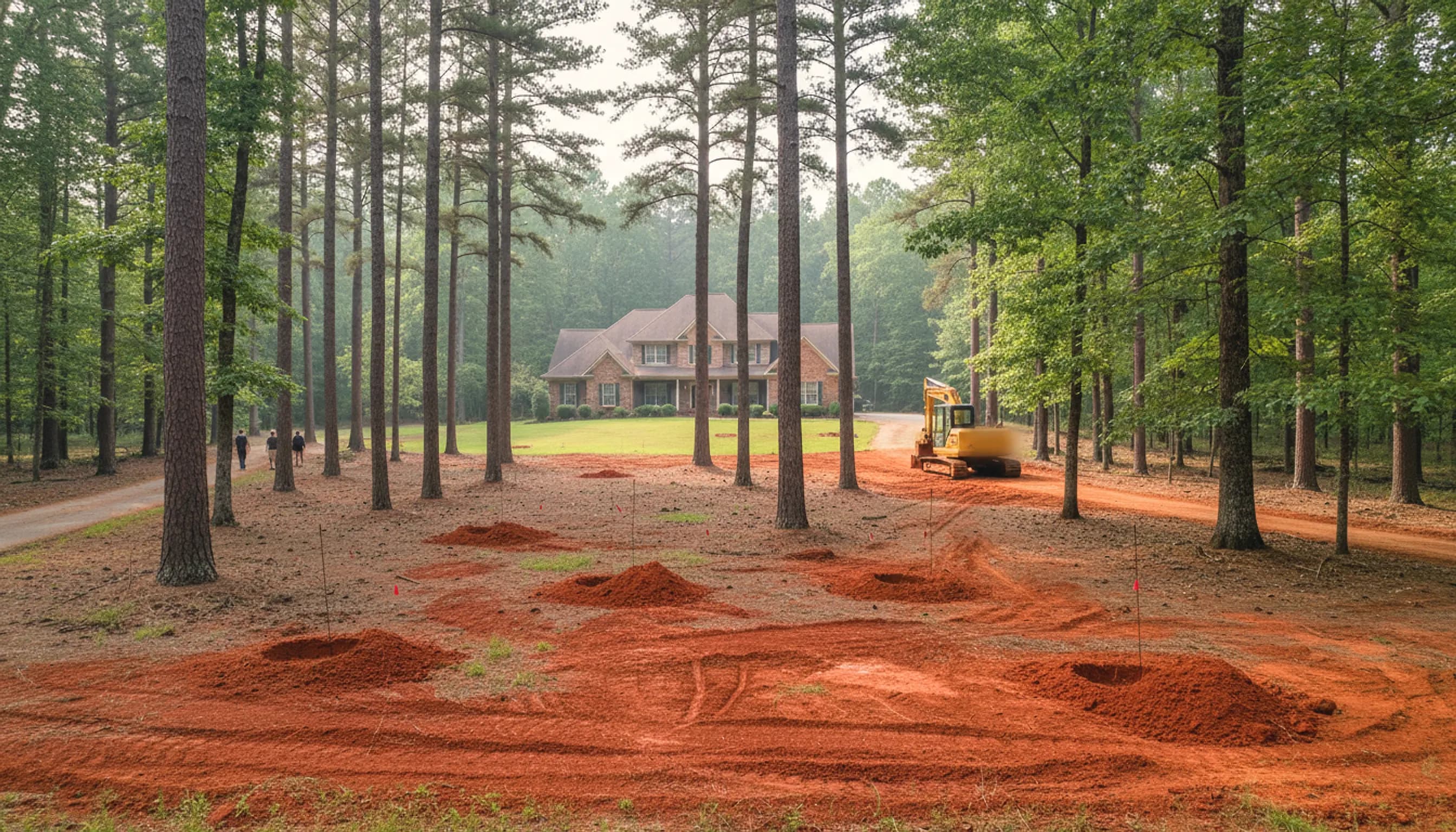
Lake Oconee covers 19,971 acres with 374 miles of shoreline and Lake Sinclair 15,330 acres with about 417 miles (Lake Oconee, Lake Sinclair). Much of that shoreline is hillside. On those lots a conventional field runs into three walls at once: the 25% slope limit, the two-foot separation to rock or seasonal water, and the room needed for wide trenches plus a full replacement area. Drip lines answer all three. They're shallow, they run level along each contour, and the tubing goes in with a vibratory plow, trencher or backhoe in a narrow slot instead of a three-foot-wide trench.
The shallow depth is the key. Georgia measures separation from the bottom of the drip tubing, and requires only 12 inches to a limiting layer. Piedmont lots that show rock or gray-mottled clay at 20 or 30 inches can be turned down for a conventional field and still qualify for drip. In the survey area covering Baldwin, Jones and Putnam, NRCS rates about 381,500 acres of the major soil components very limited for septic absorption fields (NRCS Soil Data Access).
Drip also lets a field wrap around trees. Lake owners want shade, and on Lake Oconee Georgia Power protects a 25-foot vegetative buffer and bars mechanical clearing on project lands without written approval (Georgia Power). Emitter lines can weave between keeper trees on your side of the line where a gravel field would have meant clear-cutting. The field still needs appropriate ground cover, and the final county inspection checks the landscaping after the house is finished.
The tradeoff is equipment. The EPA notes drip needs a large dose tank and electrical power, which add expense and maintenance (EPA). Every Georgia drip system has an aerobic unit in front, a dosing pump, filters, flush valves, check valves on slopes over 5%, and a controller that logs flow. Georgia requires a three-year initial service policy with a visit every six months, and owners are offered a continuing service contract after that. Our aerobic septic systems page covers the treatment side.
Drip fields are easy to damage during construction. A field staked before the house goes up can be crossed by concrete trucks, buried under spoil, or trenched through for an irrigation line. We do the land clearing, grading and erosion control on many of these lots, so the field area stays roped off from the first day and the emitter lines go in when heavy construction is done.
Your options
OPTION 01
When it fits: Deep soil, gentle slope and plenty of room downhill of the house.
OPTION 02
When it fits: Good soil exists but sits uphill or is slow (60 to 90 minutes per inch).
See septic pump systems.
OPTION 03
When it fits: Shallow soil, slopes, tree cover or a small usable area.
Warning signs
Drip alarm sounding? Call (678) 863-5620
How the job runs
Call (678) 863-5620. We review the soil report and lot, and flag the field and its 100% replacement area before any clearing. Military members and first responders get 10% off.
A soil classifier describes each horizon and its loading rate; the design comes from a Department-approved manufacturer design or a Georgia registered engineer and signed by the designer with the compliance statement the manual requires.
The site plan at 1 inch to 40 feet, with two-foot contours, the pretreatment unit, drip lines, force main, return line, manifolds, check valves and air vents, goes to the county.
Georgia 811 gets at least three business days' notice before machines dig.
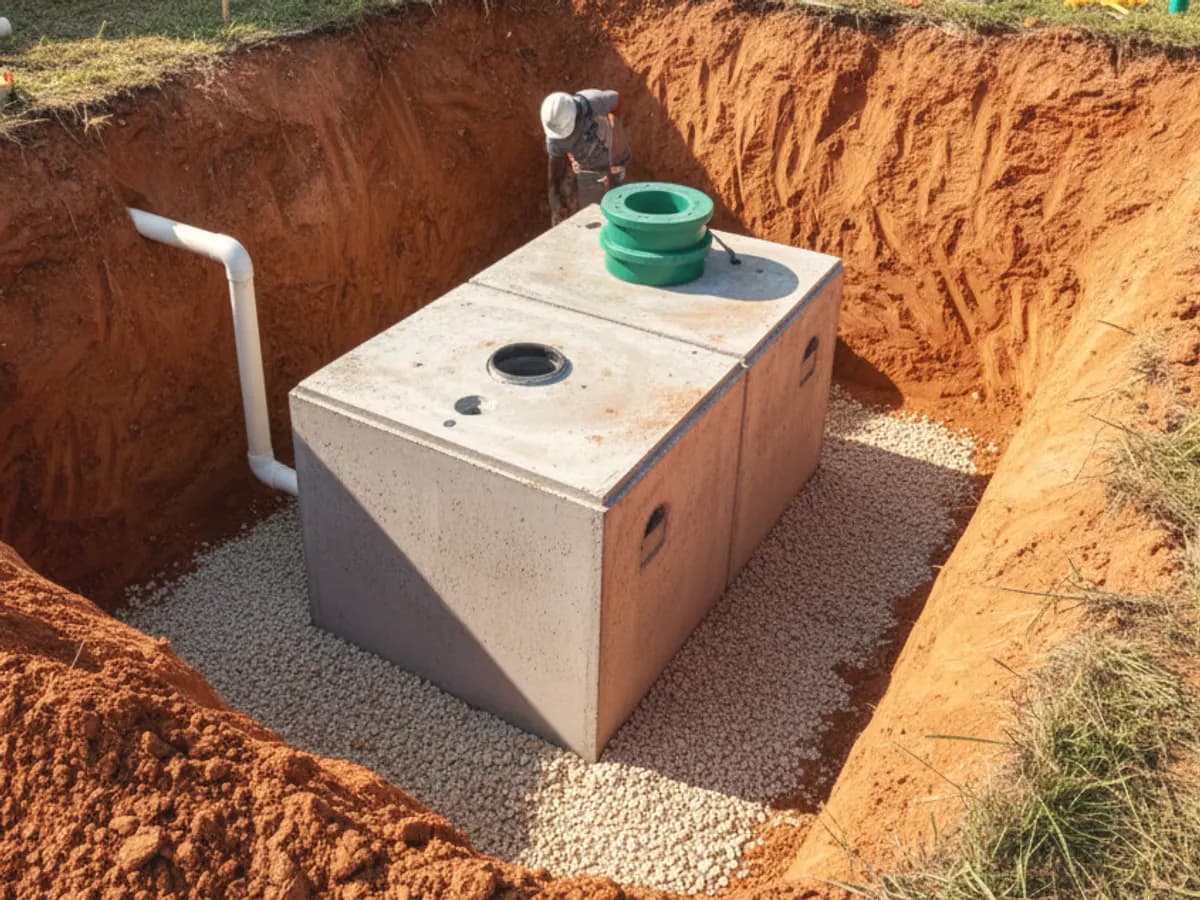
The aerobic unit and dosing chamber are set, then emitter lines are installed level along each contour, within six inches over any 100-foot run.
The county checks the installation against the permit, measures the lines, and watches the system run: timer dosing, emitters, pressure relief and check valves, filter backflush, pumps and alarms.
After landscaping and house construction are done, a final inspection confirms ground cover, drainage and that the owner has the maintenance contract and paperwork.
Permits & the Georgia rules
Commission a Level 4 soil investigation and a drip design.↗
Apply to the county with the site plan, design criteria, pump make and model, and emitter tubing product number.↗
On a Georgia Power lease lot, keep the system and its repair area outside the project boundary.↗
Pass the initial inspection at installation and the final inspection after landscaping.↗
Georgia rule Manual F.6.A.1
“The drip emitter system shall be preceded by a pretreatment process”
Georgia rule Manual F.6.A.3.l
“There must be a totally separate absorption field replacement area”
Georgia rule 511-3-1-.07(3)
“not less than fifty feet (50') from geothermal boreholes and the normal water level of any impoundment”
Land within 75 feet of Lake Oconee's high-water line doesn't count toward the septic lot minimum (0.75 acre on public water, 1.5 acres on a well).↗
Residential septic tank inspection $350, $400 for five or more bedrooms (effective August 1, 2024).↗
Residential inspection $350, site plan review $75 (effective August 1, 2024).↗
Drip packages are reviewed by Putnam Environmental Health (North Central Health District) in Eatonton, (706) 485-8591; no fee schedule is posted online.↗
Baldwin, Hancock, Jasper and Jones
North Central Health District counties; apply at the county health department.↗
What it costs
Drip septic system
$8,000–$18,000
per system
Typical market range per HomeAdvisor, 2026; average about $13,000
Typical market range — HomeAdvisor: How Much Does a Septic System Cost in 2026? (updated June 20, 2026), 2026
Aerobic system (often paired with drip)
$10,000–$20,000
per system
Typical market range per HomeAdvisor, 2026
Typical market range — HomeAdvisor: How Much Does a Septic System Cost in 2026? (updated June 20, 2026), 2026
Percolation and soil testing
$700–$2,000
per test
Typical market range per Today's Homeowner, 2025
Typical market range — Today's Homeowner: Septic Tank Installation Cost (updated April 11, 2025), 2025
These are typical market ranges published by third parties (HomeAdvisor, 2026; Today's Homeowner, 2025), not our prices. We give free on-site estimates.
Free estimate: (678) 863-5620Where we do this
FAQ
Straight answers, with the rule or record behind them. Still unsure? Call and ask the crew that digs.
(678) 863-5620Georgia doesn't name a lot as 'drip required'; the county issues permits for what the soil supports. When the soil report shows too little depth to rock or seasonal water for trenches, slopes too steep, or not enough room, drip with aerobic pretreatment is often the design that can be permitted because it needs only 12 inches of separation.
Georgia's manual puts emitter lines in the root zone of the cover vegetation, 8 to 12 inches below the original undisturbed ground surface, and at least 8 inches deep. That keeps effluent where plants and soil bacteria can use it.
Yes. Georgia's standard calls for aerobic pretreatment to 25 mg/L BOD5 and 30 mg/L TSS before effluent reaches the emitters. Settled effluent from a plain tank would plug emitters and overload the shallow soil.
Yes; it's one of their strengths. Lines run level along each contour, within six inches over 100 feet. On slopes over 20%, laterals must be at least three feet apart, and over 5% check valves keep effluent from draining to the low end after each dose.
HomeAdvisor's 2026 figures put drip at $8,000 to $18,000, averaging about $13,000, against $3,000 to $8,000 for a conventional anaerobic system. Add the aerobic unit's ongoing service. These are third-party ranges, not our prices.
Source: HomeAdvisor: How Much Does a Septic System Cost in 2026? (updated June 20, 2026)
A three-year initial service policy with six visits is included in the purchase, and owners are offered continuing service after that. Lines are flushed automatically at least every two months, filters backwash to the treatment unit, and the aerobic unit's tank still needs periodic pumping.
Yes; drip fields are meant to sit under cover vegetation, and the county's final inspection checks for appropriate ground cover. Avoid tilling, deep-rooted new plantings, driving over the field, or trenching for irrigation through it, which can cut the tubing.
Keep going
Septic Systems
Sources
Rules, costs and local facts on this page link to the agency, code or publisher that states them. Cost figures are third-party market ranges, not our prices — estimates are free.
Reviewed by A Class Septic Services · Last updated

Ready when you are
Drip septic systems spread treated effluent through small tubing a few inches under the surface, laid along the contours of the slope. They're how many shallow, steep and wooded lake lots get a permit at all. We install and repair them, along with the clearing and trenching they need.
(678) 863-5620Free estimate
or call (678) 863-5620By town
Local pages with each town's utility, county permit path and ground conditions.