Drip Septic Systems · Lake Oconee
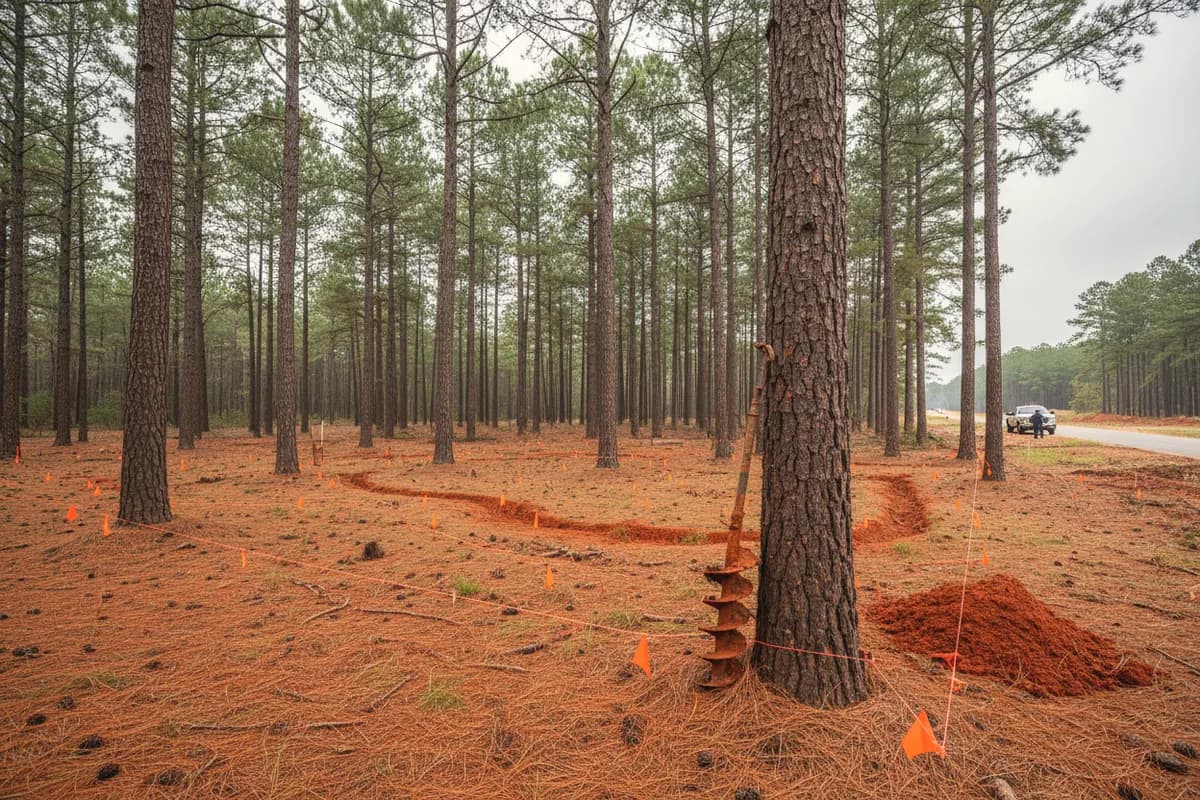
Drip septic systems for Lake Oconee lots too steep, shallow or narrow for conventional trenches, with emitter lines laid on the contour under the trees.
- Lake Oconee & Lake Sinclair
- Residential & commercial
- 10% off: military & first responders
Get a free estimate
or call (678) 863-5620The short answer
What does a drip septic system involve on a Lake Oconee lot?
Drip septic sends aerobically treated effluent through small emitter lines buried 8 to 12 inches deep along the contour, which fits steep, shallow or narrow lake lots. It needs a Level 4 soil study and a permit from the Greene, Putnam or Morgan health office. A Class Septic builds and repairs drip systems around the lake.↗
Reviewed by A Class Septic Services · Last updated
The Lake Oconee story
Why so many new Oconee homes end up on drip
The lots still for sale on Lake Oconee are rarely the flat ones. Cuscowilla's last release of lakefront homesites on Covey Drive was marketed with sewer 'Septic Required,' and lots like that tend to fall off toward the water through hardwoods.↗
Conventional trenches want deep, even ground and lose suitability past 25 percent slope. Drip lines sit in the top foot of soil, where the root zone takes up water and nutrients, and they follow the hillside instead of fighting it.↗↗
Trees are the other reason. A narrow drip field can thread between mature oaks where a trench field would mean clearing a lawn. If any of that clearing reaches Georgia Power land, its guidelines allow tree removal to make room for a septic installation, with 1:1 replanting.↗
On the record
- On drip fields where the slope exceeds 5 percent, DPH requires check valves or another approved method in the supply and return manifolds so effluent doesn't drain into the low end of a zone.↗
- A drip permit application must include a site plan at 1 inch to 40 feet or larger, with two-foot contours and soil types overlaid.↗
Local facts
Georgia's drip rules, applied to a lake hillside
Each row links to the agency, code or publisher it comes from. Tap a source to check it yourself.
| Topic | What it says | Source |
|---|---|---|
| Pretreatment | Aerobic, to 25 mg/L BOD5 and 30 mg/L TSS or better (Class I) | GA DPH Manual for On-Site Sewage Management Systems (March 2026), Section F: Dispersal Systems |
| Line depth | 8 to 12 inches, in the root zone of the cover vegetation | Same source as above |
| Lateral spacing | Usually 2 ft; 3 ft or more on slopes over 20% | Same source as above |
| Separation | At least 12 inches to seasonal water or rock | Same source as above |
| Replacement area | A separate area equal to 100% of the drip field, or a conventional field, whichever is larger | Same source as above |
| Lake setback | Still 50 ft from the lake's normal water level | Ga. Comp. R. & Regs. r. 511-3-1-.07, Absorption Fields (LII) |
| Filtration | Automatic self-cleaning filters, with backwash returned to the treatment unit | GA DPH Manual for On-Site Sewage Management Systems (March 2026), Section F: Dispersal Systems |
More about Lake Oconee
Greene's 75-foot strip and the replacement area
On the Greene County shore, a drip design has to work inside the lot-size rule: 0.75 acre on public water or 1.5 acres on a well, not counting the 75 feet closest to the high-water line. Drip is compact, but the state still wants a full replacement area set aside, so we lay out both before the house footprint is final.↗↗
Drip systems also come with a service obligation: a three-year initial policy with six visits and emergency response within two days, then an offer of continuing service. The lines flush themselves at least every other month, and the controls must flag a 10% change in flow from a clogged filter or a cut line. For a second home that sits empty midweek, that alarm is the early warning; we wire it where someone will actually see or hear it.↗
On the Greene County shore, a drip design has to work inside the lot-size rule: 0.75 acre on public water or 1.5 acres on a well, not counting the 75 feet closest to the high-water line.
Warning signs
When a drip system needs attention
Seeing two or more of these? Call before it gets worse.
- 1. High-flow or low-flow alarm on the control panel
- 2. Wet, spongy spots along one zone of the drip field
- 3. The dosing pump running much longer than normal
- 4. Filter alarm after heavy use over a holiday weekend
- 5. Mower or aerator damage where lines run shallow
What it costs
Drip septic cost range
Drip septic system installed
$8,000-$18,000
Typical market range — HomeAdvisor: Septic System Installation Cost (updated Jun 20, 2026), 2026
Aerobic pretreatment unit (often paired)
$10,000-$20,000
Typical market range — HomeAdvisor: Septic System Installation Cost (updated Jun 20, 2026), 2026
What moves the price
These are third-party typical market ranges, not our prices. Every job is quoted after we see it — estimates are free.
Free estimate: (678) 863-5620- 01Length of emitter line the soil loading rate requires
- 02Number of zones on a long, steep hillside
- 03Controls, filters and the dosing tank
- 04Hand work around trees that must stay
FAQ
Drip septic questions at Lake Oconee
Straight answers, with the rule or record behind them. Still unsure? Call and ask the crew that digs.
(678) 863-5620Is drip septic allowed on Lake Oconee?
Yes, with a county permit, aerobic pretreatment and a design from a DPH-approved manufacturer or a Georgia registered engineer (an engineer is required over 2,000 gallons a day).
Source: GA DPH Manual for On-Site Sewage Management Systems (March 2026), Section F: Dispersal Systems
Can drip lines go closer to the lake than trenches?
No. The 50-foot setback from the normal water level applies to drip fields too.
Source: Ga. Comp. R. & Regs. r. 511-3-1-.07, Absorption Fields (LII)
How steep can a drip field be?
Steeper than a trench field. DPH sets wider spacing, 3 feet or more, on slopes over 20 percent and wants check valves on manifolds above 5 percent.
Source: GA DPH Manual for On-Site Sewage Management Systems (March 2026), Section F: Dispersal Systems
What soil report does a drip permit need?
A Level 4 soil investigation, with horizons identified and hydraulic loading rates for each.
Source: GA DPH Manual for On-Site Sewage Management Systems (March 2026), Section F: Dispersal Systems
Can I plant over the drip field?
Yes, that is the point. The lines go in the root zone of the cover vegetation, 8 to 12 inches down; keep deep-rooted digging and heavy equipment off it.
Source: GA DPH Manual for On-Site Sewage Management Systems (March 2026), Section F: Dispersal Systems
What keeps a drip field from flooding the bottom of the slope?
Time dosing. The controller doses each zone on a timer sized to the soil's loading rate, spreading a full day's flow across 24 hours, and check valves stop the lines from draining downhill between doses.
Source: GA DPH Manual for On-Site Sewage Management Systems (March 2026), Section F: Dispersal Systems
Can I take down trees on Georgia Power land to fit the system?
Only with Georgia Power's approval. It considers removal to facilitate a septic installation and requires replanting at a 1:1 ratio with native species.
Source: Georgia Power: Lake Oconee Shoreline Guidelines (PDF)
Sources
Where these facts come from
Rules, costs and local facts on this page link to the agency, code or publisher that states them. Cost figures are third-party market ranges, not our prices — estimates are free.
Reviewed by A Class Septic Services · Last updated
- 1GA DPH Manual for On-Site Sewage Management Systems (March 2026), Section F: Dispersal Systems
- 2MLS listing: Lot 7 Covey Drive, Eatonton GA (Cuscowilla on Lake Oconee)
- 3GA DPH Manual for On-Site Sewage Management Systems (March 2026), Section B: General Site Provisions
- 4Georgia Power: Lake Oconee Shoreline Guidelines (PDF)
- 5Ga. Comp. R. & Regs. r. 511-3-1-.07, Absorption Fields (LII)
- 6Greene County Board of Health: Lot Size Ordinance (effective Sept 7, 2018)
- 7HomeAdvisor: Septic System Installation Cost (updated Jun 20, 2026)
Ready when you are
Steep lot, great view, no room for trenches? That's a drip lot.
Send the plat and the soil report. We'll sketch where the drip zones and replacement area can go before your architect finalizes the house.
(678) 863-5620- Lake Oconee & Lake Sinclair
- Residential & commercial
- 10% off for military & first responders
Free estimate
or call (678) 863-5620