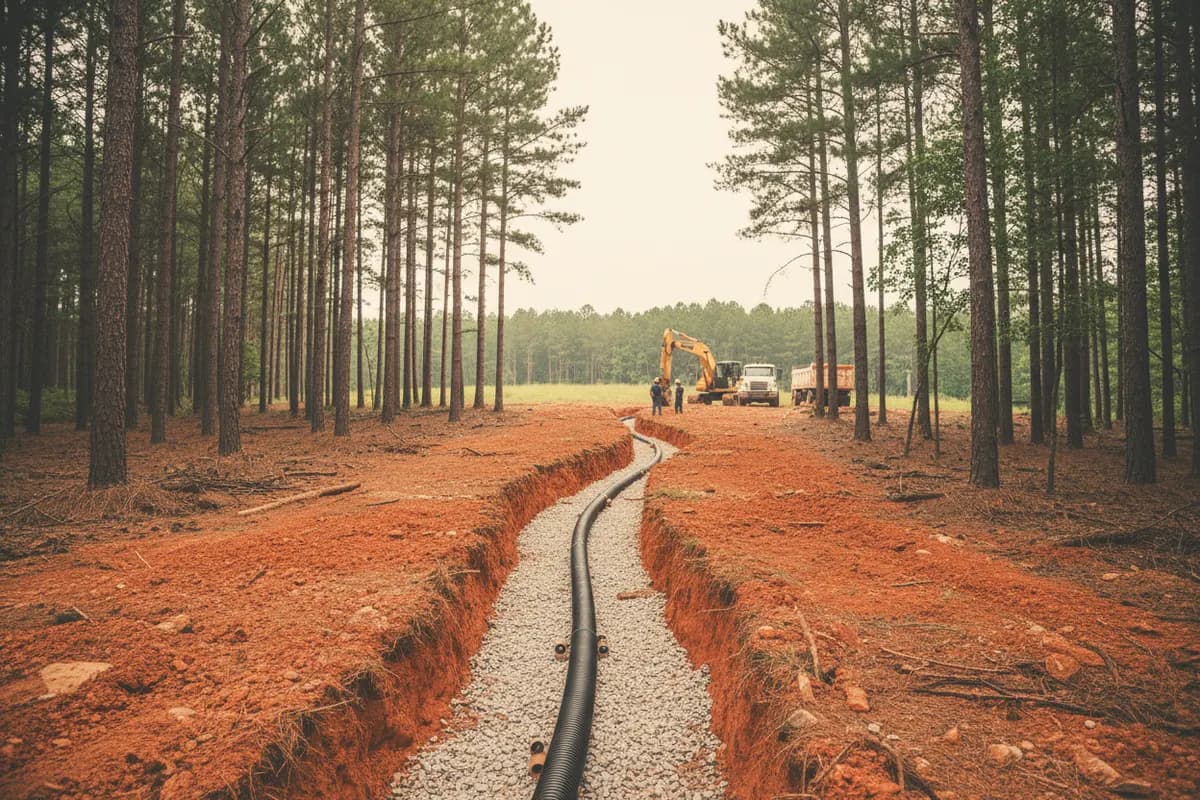
French Drain Installation · Lake Sinclair
French drains for Lake Sinclair homes on red clay, built to dry crawlspaces, yards and septic fields while staying off Georgia Power's land.
- Lake Oconee & Lake Sinclair
- Residential & commercial
- 10% off: military & first responders
Get a free estimate
or call (678) 863-5620The short answer
Can I put a French drain on my Lake Sinclair lot?
Yes, on your side of the line. Georgia Power allows no work on its land or inside its project boundary without its written permit, so outlets usually end on the lot. Near a septic field, drains must sit 10 feet uphill or 30 feet downhill of the trenches, and the county health office may review them.↗↗
Reviewed by A Class Septic Services · Last updated
The Lake Sinclair story
Red clay holds water, and Sinclair lots have little room to shed it
Davidson clay, the dominant soil in the Baldwin-Putnam survey, is dark red and 40 to 75 percent clay in the subsoil. It drains, but slowly, and a summer downpour sits on top of it. On a crowded shore where Baldwin's own plan says houses are packed close together, your runoff and your neighbor's often end up in the same low spot.↗↗
Many Sinclair houses are also decades old; a 1991 Shelton Lane home near Twin Bridges Landing is a fair example. Wherever downspouts dump roof water at the foundation, it soaks the crawlspace, and if the septic tank or field is on that side, it soaks those too.↗
Sinclair's Georgia Power guidelines are worded differently from Oconee's. They don't spell out a drainage-pipe ban, but no work of any kind is allowed on Georgia Power property or inside the project boundary without a written permit. So the practical answer is the same: end the drain on your lot, in a gravel bed, a planted swale or a loose-stone splash area.↗
Septic fields are where drainage pays off most. DPH describes curtain, vertical and under-drains as the usual ways to lower a high water table, but the first job is diagnosing where the water comes from: a perched layer on top of the clay, seepage from uphill, or plain surface runoff. Each one gets a different drain.↗
On the record
- DPH requires subsurface drainage near a septic system to be at least 10 feet uphill or 30 feet downhill of any absorption trench.↗
- A subsurface drainage plan meant to make a septic site usable must be prepared, and its installation approved, by a soil classifier, agricultural engineer or other qualified design professional.↗
- Georgia Power allows loose materials such as pea gravel, slate chips or unmortared fieldstone in natural areas on its Sinclair land with permission; mortared work there is subject to removal.↗
Permits · County Environmental Health (near septic systems) and Georgia Power's Lake Resources Office (anything past the boundary)
Planning a drain on a Sinclair lot
- 01
Watch the yard in a hard rain and mark where water enters, ponds and leaves.
- 02
Locate the septic tank and field, and keep the drain 10 feet above or 30 feet below the trenches.↗
- 03
Pick an outlet on your side of the project boundary; anything beyond it needs Georgia Power's written permit first.↗
- 04
Keep machines out of the 25-foot vegetative buffer; Georgia Power bars mechanical grading or recontouring there without approval.↗
- 05
Plan for upkeep. DPH warns that drainage left to clog with silt and growth can end up as bad as before.↗
Warning signs
Signs a Sinclair lot needs drainage work
Seeing two or more of these? Call before it gets worse.
- 1. Standing water in the crawlspace or a musty smell under the floor
- 2. A soggy strip along the uphill side of the house that never quite dries
- 3. Water settling over the septic tank, or a field that goes wet after storms
- 4. Red silt fanning across the driveway toward the lake
- 5. Downspouts that empty straight onto bare clay
What it costs
Drainage cost ranges
French drain
$500-$18,000 (average $9,250)
Typical market range — HomeAdvisor: French Drain Cost (updated Jun 20, 2026), 2026
Per linear foot
$10-$100
Typical market range — HomeAdvisor: French Drain Cost (updated Jun 20, 2026), 2026
Whole yard drainage system
$2,147-$7,173
Typical market range — HomeAdvisor: Yard Drainage System Cost (updated Jun 20, 2026), 2026
What moves the price
These are third-party typical market ranges, not our prices. Every job is quoted after we see it — estimates are free.
Free estimate: (678) 863-5620- 01Length of run to an outlet that stays on the lot
- 02Depth needed to catch water in Davidson clay
- 03Working around the septic tank and field
- 04Roots, rock and access on a narrow lot
FAQ
French drain questions at Lake Sinclair
Straight answers, with the rule or record behind them. Still unsure? Call and ask the crew that digs.
(678) 863-5620Can my French drain empty into Lake Sinclair?
Not across Georgia Power land without its written permit; no work is allowed on its property or inside the project boundary without one.
Source: Georgia Power: Bartletts Ferry, Jackson & Sinclair Shoreline Guidelines (PDF)
How close can a drain be to my septic field?
DPH requires at least 10 feet if the drain is uphill and 30 feet if it is downhill of the trenches.
Source: GA DPH Manual for On-Site Sewage Management Systems (March 2026), Section H: Site Modifications
Why does my Sinclair yard stay wet for days after rain?
Davidson clay, the main soil around the lake's Baldwin and Putnam shores, has a heavy clay subsoil that takes water in slowly.
Source: USDA NRCS Official Series Description: Davidson series
Can I build a stone drainage feature on the Georgia Power strip?
Only with Georgia Power's permission and plans submitted first, using loose stone; mortared installations are subject to removal.
Source: Georgia Power: Bartletts Ferry, Jackson & Sinclair Shoreline Guidelines (PDF)
Does runoff hurt a septic system?
It can. DPH's troubleshooting guide lists runoff that was never diverted as a cause of hydraulic overloading.
Will a French drain fix a field that's already failing?
Only if excess water is the cause. DPH says subsurface drainage can be an approvable fix when it lowers the water enough to restore separation under the trenches.
Source: GA DPH Manual for On-Site Sewage Management Systems (March 2026), Section H: Site Modifications
Is the shoreline buffer a problem for drainage work?
Work in the 25-foot state-waters buffer is restricted, and Georgia Power separately bars machine grading there without written approval.
Source: Ga. Comp. R. & Regs. r. 391-3-7-.05, state-waters buffer rule (LII)
Sources
Where these facts come from
Rules, costs and local facts on this page link to the agency, code or publisher that states them. Cost figures are third-party market ranges, not our prices — estimates are free.
Reviewed by A Class Septic Services · Last updated
- 1Georgia Power: Bartletts Ferry, Jackson & Sinclair Shoreline Guidelines (PDF)
- 2GA DPH Manual for On-Site Sewage Management Systems (March 2026), Section H: Site Modifications
- 3USDA NRCS Official Series Description: Davidson series
- 42023 Baldwin County Joint Comprehensive Plan (Baldwin County and City of Milledgeville), GA DCA
- 5MLS listing: 109 Shelton Ln, Eatonton GA (near Twin Bridges Landing, Lake Sinclair)
- 6HomeAdvisor: French Drain Cost (updated Jun 20, 2026)
- 7HomeAdvisor: Yard Drainage System Cost (updated Jun 20, 2026)
- 8GA DPH Manual for On-Site Sewage Management Systems (March 2026), Section O: Appendices (troubleshooting failing systems)
- 9Ga. Comp. R. & Regs. r. 391-3-7-.05, state-waters buffer rule (LII)
Ready when you are
Crawlspace wet again? Catch the water uphill and keep it on your lot.
Send a few photos taken during or right after a rain and tell us where the septic is. We'll lay out a drain that clears the field and ends where Georgia Power won't object. Military and first-responder households get 10% off.
(678) 863-5620- Lake Oconee & Lake Sinclair
- Residential & commercial
- 10% off for military & first responders
Free estimate
or call (678) 863-5620