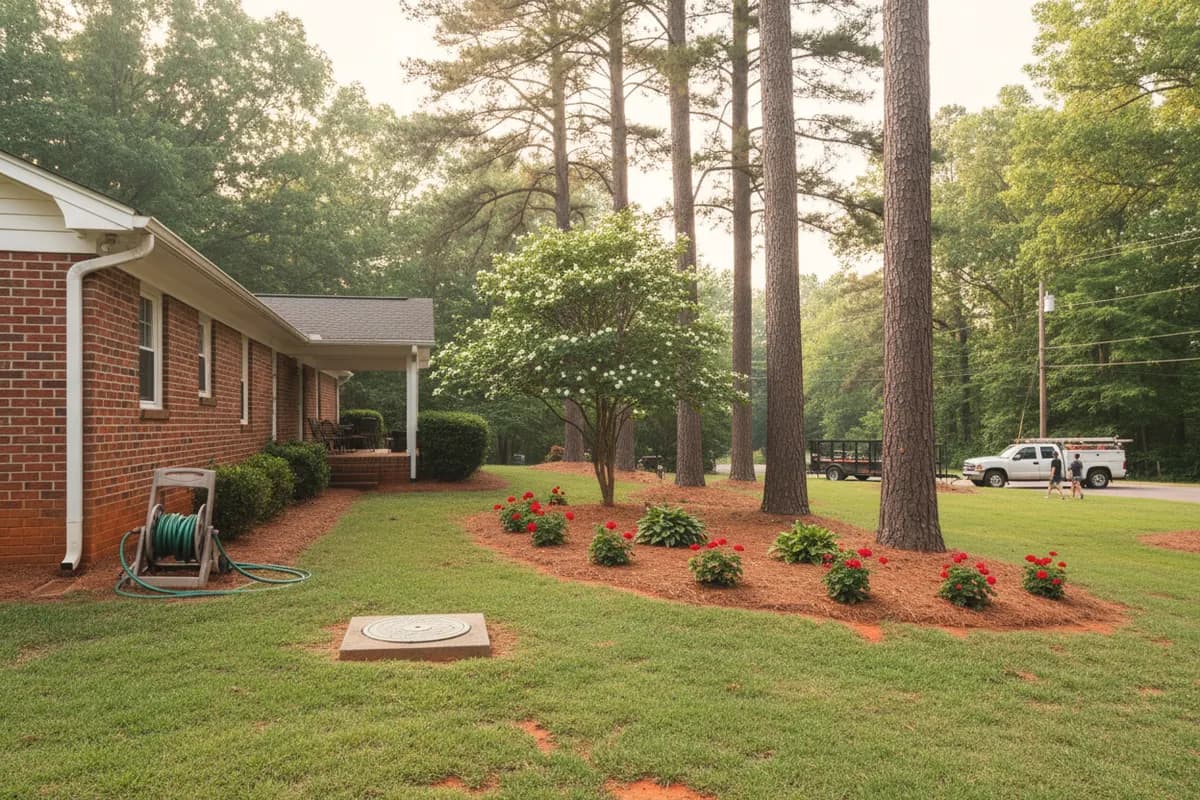
Septic Pump Systems · Lake Sinclair
Septic pump and dosing systems for Lake Sinclair houses that sit downhill of the only usable drain field soil.
- Lake Oconee & Lake Sinclair
- Residential & commercial
- 10% off: military & first responders
Get a free estimate
or call (678) 863-5620The short answer
Why do Lake Sinclair septic systems need pumps?
Many Sinclair houses sit low toward the water, so the only soil that clears the 50-foot lake setback is uphill. A pump or siphon dosing tank moves effluent there. Putnam, Baldwin or Hancock County Environmental Health permits the layout, and A Class Septic installs and repairs the tanks, pumps and lines.↗↗
Reviewed by A Class Septic Services · Last updated
Sewer or septic?
No sewer to fall back on at Sinclair
At Oconee, some golf communities have a utility's low-pressure sewer. Sinclair's shore doesn't work that way. New lots in The Falls are sold with a perc test on file, a new house in gated Lakeside off Twin Bridges Road lists a septic tank, and so does an older home on Dam Road near Rocky Creek Park.↗↗↗
That means the pump in a Sinclair dosing tank pushes treated effluent from your own septic tank to your own field. It's a different machine from the grinder pumps used on pressure sewer systems, and a different job.↗
How to tell which one you have
- No monthly sewer charge on the water bill
- A green or black riser lid in the yard
- An alarm box on a post or the house wall
The Lake Sinclair story
Pump or siphon: what the field length decides
Sinclair's red clay accepts water slowly, so the field the county sizes can run long. Georgia's manual ties dosing to that length. Past 500 feet of trench, a dosing tank is required; past 1,000 feet, the dosing has to alternate between two siphons or two pumps.↗
A siphon needs no electricity, but it only works when the dosing chamber sits above the field and the solids are already settled out. That's rare on a lot that falls toward the lake. When the field is uphill, it takes a pump, with a pump-off float, a pump-on float and a high-water alarm on its own circuit.↗
Seasonal use is the other wrinkle. A pump that sits idle through a Sinclair winter can stick, and a float can hang on a cord or a root. Before a holiday weekend, it pays to open the riser, check the floats move freely and press the alarm test, rather than find out on a Saturday night with a full house.
On the record
- The working volume of a dosing tank must equal 60 to 75 percent of the interior volume of the absorption lines it doses.↗
- No reserve capacity is required when siphons do the dosing, and a pump discharge line should drain after each cycle unless the design calls for a check valve.↗
- Georgia Power's Sinclair guidelines allow no plumbing other than water spigots on docks and boathouses, so no bathroom or pump line can run out to the water.↗
Local facts
Dosing rules at a glance
Each row links to the agency, code or publisher it comes from. Tap a source to check it yourself.
| Topic | What it says | Source |
|---|---|---|
| 500-1,000 ft of trench | One siphon or one pump in a dosing tank | GA DPH Manual for On-Site Sewage Management Systems (March 2026), Section E: Effluent Distribution and Dosing Devices |
| Over 1,000 ft | Alternating siphons or pumps | Same source as above |
| Switch types | Mercury, pressure diaphragm, weighted float, dual or multiple function | Same source as above |
| Valves | Gate, globe and check valves in bronze or PVC | Same source as above |
| Markings | Every distribution device carries its maker's name | Same source as above |
Warning signs
Pump trouble on a Sinclair lot
Seeing two or more of these? Call before it gets worse.
- 1. The high-water alarm sounding after you arrive for the weekend
- 2. A pump that hums but the field never seems to get wet
- 3. Wet ground at the dosing tank lid on the low side of the house
- 4. A breaker on the pump circuit tripped after a thunderstorm
- 5. The alarm going off when the pump runs, pointing to a float problem
What it costs
Pump repair costs
Effluent pump repair
$250-$400
Typical market range — HomeAdvisor: Septic Tank Repair Cost (updated Jun 19, 2026), 2026
Effluent pump replacement
$1,000 and up
Typical market range — HomeAdvisor: Septic Tank Repair Cost (updated Jun 19, 2026), 2026
General septic repair
$627-$3,041
Typical market range — HomeAdvisor: Septic Tank Repair Cost (updated Jun 19, 2026), 2026
What moves the price
These are third-party typical market ranges, not our prices. Every job is quoted after we see it — estimates are free.
Free estimate: (678) 863-5620- 01Lift from the dosing tank up to the field
- 02Length of force main across the lot
- 03One pump or two alternating units
- 04Power run and alarm wiring
FAQ
Sinclair septic pump questions
Straight answers, with the rule or record behind them. Still unsure? Call and ask the crew that digs.
(678) 863-5620Is there public sewer at Lake Sinclair?
Not in the lake neighborhoods we checked. The Falls, Lakeside and Dam Road listings all show septic or perc-tested lots.
Source: MLS listing: 218 Falls Ln, Milledgeville GA (The Falls at Lake Sinclair)
When does a septic system need a dosing tank?
Georgia requires one when the field needs more than 500 linear feet of trench.
Can a siphon replace the pump on my lake lot?
Only when the dosing chamber sits higher than the field and the effluent has had its solids removed.
How big should the dose be?
Sixty to 75 percent of the inside volume of the absorption lines being dosed.
Can I add a bathroom to my Sinclair boathouse and pump it up?
No. Georgia Power allows nothing beyond water spigots for plumbing on Sinclair docks and boathouses.
Source: Georgia Power: Bartletts Ferry, Jackson & Sinclair Shoreline Guidelines (PDF)
Does the alarm share a circuit with the pump?
It shouldn't. Georgia's manual requires the high-water alarm switch to sit on a circuit separate from the pump switches, so a tripped pump breaker still lets it sound.
Why does my field need two pumps?
Fields longer than 1,000 feet of trench must be dosed by alternating pumps or siphons.
Sources
Where these facts come from
Rules, costs and local facts on this page link to the agency, code or publisher that states them. Cost figures are third-party market ranges, not our prices — estimates are free.
Reviewed by A Class Septic Services · Last updated
- 1Ga. Comp. R. & Regs. r. 511-3-1-.07, Absorption Fields (LII)
- 2North Central Health District: Putnam County Environmental Health Department
- 3MLS listing: 218 Falls Ln, Milledgeville GA (The Falls at Lake Sinclair)
- 4MLS listing: 108 Waterside Dr, Eatonton GA (Lakeside at Lake Sinclair)
- 5MLS listing: 159 Dam Rd, Milledgeville GA (near Rocky Creek Park, Lake Sinclair)
- 6GA DPH Manual for On-Site Sewage Management Systems (March 2026), Section E: Effluent Distribution and Dosing Devices
- 7Ga. Comp. R. & Regs. r. 511-3-1-.03, General Requirements for On-Site Sewage Management Systems (LII)
- 8Georgia Power: Bartletts Ferry, Jackson & Sinclair Shoreline Guidelines (PDF)
- 9HomeAdvisor: Septic Tank Repair Cost (updated Jun 19, 2026)
Ready when you are
House below the field? Let the pump do the climbing.
Tell us where the house sits and where the county says the field can go. We'll set the dosing tank, run the force main and wire the alarm, or track down why an existing pump stopped keeping up.
(678) 863-5620- Lake Oconee & Lake Sinclair
- Residential & commercial
- 10% off for military & first responders
Free estimate
or call (678) 863-5620