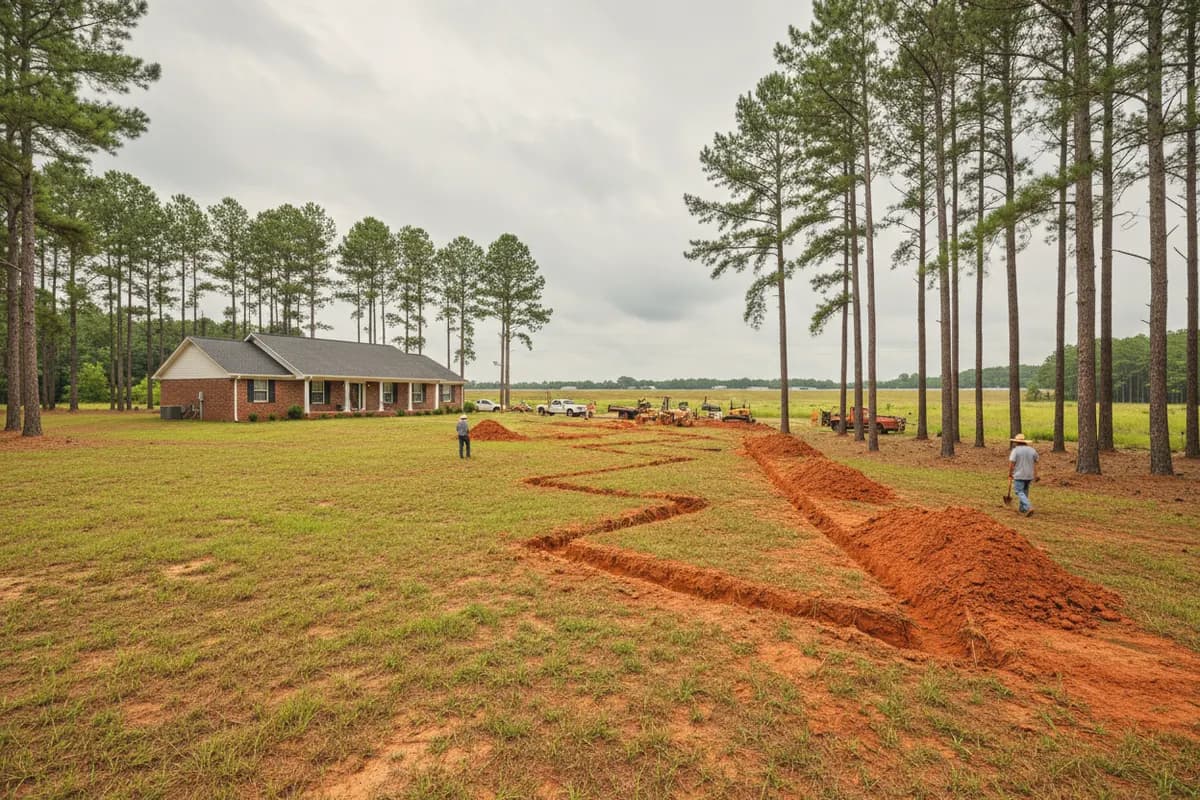
Drain Field Installation & Repair · Club at Lake Sinclair
Drain field installation and replacement for lake homes around The Club at Lake Sinclair, where a new field must meet today's 50-foot lake setback on the same sloped lot as the old one.
- Lake Oconee & Lake Sinclair
- Residential & commercial
- 10% off: military & first responders
Get a free estimate
or call (678) 863-5620The short answer
What does replacing a drain field near The Club at Lake Sinclair involve?
A new or replacement field on Sinclair Dam Road or Dam Road must sit at least 50 feet from the lake's normal water level and 100 feet from any well, on soil Baldwin County Environmental Health approves. On sloped lots that often means new ground uphill. A Class Septic Services digs, builds and backfills after the county inspection.↗↗
Reviewed by A Class Septic Services · Last updated
The Club at Lake Sinclair story
The old field was legal then. The new one has to be legal now.
When a lake house near Rocky Creek Park was built, the field went where the ground and the rules of the day allowed. Replacing it is a fresh decision. Georgia holds absorption trenches 50 feet back from the normal water level of the lake, 100 feet from wells, 10 feet from water lines and basements, and 5 feet from drives and property lines.↗
On a deep lot that is a tape measure exercise. On a sloped 0.77-acre lot like the Dam Road log home, between a driveway, a dock path and a well that listings on this stretch sometimes show, it can leave one patch of qualifying soil, often uphill of the house. That is the point where a gravity field becomes a pumped one.↗
Newer houses in The Preserve, on acre-plus lots overlooking the course, have more room and the same rules. Their questions are usually about a first field done right, or a pool and patio that would cut into the replacement area set aside at permitting.↗
Soil & terrain
Davidson clay and Wilkes slopes on the western shore
Baldwin's lake end sits in the Baldwin-Jones-Putnam soil survey, where Davidson is the largest series: dark red subsoil that is 40 to 75 percent clay but drains well when undisturbed. Steeper banks map as Wilkes on 10 to 25 percent slopes, rated very limited for septic fields. Trenches are dug only when the clay is dry, since wet clay smears shut.↗↗↗
Local facts
Trench rules that shape a Sinclair field
Each row links to the agency, code or publisher it comes from. Tap a source to check it yourself.
| Topic | What it says | Source |
|---|---|---|
| Trench width | No more than 36 inches | GA DPH Manual for On-Site Sewage Management Systems (March 2026), Section F: Dispersal Systems |
| Lateral spacing | At least 7 feet center to center | Same source as above |
| Cover | 6 to 12 inches of earth over at least 12 inches of aggregate | Same source as above |
| Separation | 24 inches from trench bottom to rock or seasonal water | Same source as above |
| Runoff | Field protected from stormwater and gutter discharge | Same source as above |
More about Club at Lake Sinclair
How we rebuild a field on a lake lot
First we prove the old field is the problem and not a crushed pipe or a tipped distribution box feeding one trench; a field replacement is the expensive answer and we do not reach for it first. Then we measure from the normal water line, the well, the drive and the property lines, and mark what is left on the ground with paint so the owner sees the same picture the county will.
Digging waits for dry weather. Trenches go in level along the contour, the stone or chambers get set, and everything stays open until the Baldwin County inspector signs off. After backfill we shape the surface so rain from the roof and the slope above runs around the field instead of across it, and seed it so the clay does not wash toward the cove.↗
First we prove the old field is the problem and not a crushed pipe or a tipped distribution box feeding one trench; a field replacement is the expensive answer and we do not reach for it first.
What it costs
Field costs, for scale
Leach field failure after improper repairs
Up to $20,000
Typical market range — HomeAdvisor: Septic Tank Repair Cost (updated Jun 19, 2026), 2026
Complete conventional system
$3,590-$12,463
Typical market range — HomeAdvisor: Septic System Installation Cost (updated Jun 20, 2026), 2026
What moves the price
These are third-party typical market ranges, not our prices. Every job is quoted after we see it — estimates are free.
Free estimate: (678) 863-5620- 01Distance from tank to the qualifying soil
- 02Whether a pump tank is required
- 03Slope and machine access off Dam Road
- 04Lawn, irrigation and hardscape to restore
FAQ
Drain field questions around The Club
Straight answers, with the rule or record behind them. Still unsure? Call and ask the crew that digs.
(678) 863-5620My field is failing. Can I just dig new trenches next to the old ones?
Sometimes. Fields laid on 16-foot centers leave room between the originals for replacement; tighter layouts need a new area that meets every setback.
Source: GA DPH Manual for On-Site Sewage Management Systems (March 2026), Section F: Dispersal Systems
How far back from Lake Sinclair does the new field have to be?
Fifty feet from the normal water level, measured to the nearest trench, under rule 511-3-1-.07.
Source: Ga. Comp. R. & Regs. r. 511-3-1-.07, Absorption Fields (LII)
I'm on a well. Does that change the layout?
Yes: trenches stay 100 feet from any well, including the neighbor's, which on narrow lake lots can decide the whole design.
Source: Ga. Comp. R. & Regs. r. 511-3-1-.07, Absorption Fields (LII)
Can I build a patio over my old field once it's replaced?
Over an abandoned field, talk to the county. Over the active field or its repair area, no; Georgia bars buildings, paving and parking there.
Source: GA DPH Manual for On-Site Sewage Management Systems (March 2026), Section F: Dispersal Systems
Does the county inspect a replacement field?
Yes. Repairs and replacements are permitted and inspected, and nothing is covered until Baldwin County approves it.
Why did my field fail when the house is barely used?
Downspouts and hillside runoff soaking the trenches are a common cause on sloped lots; Georgia requires fields to be protected from that water.
Source: GA DPH Manual for On-Site Sewage Management Systems (March 2026), Section F: Dispersal Systems
Sources
Where these facts come from
Rules, costs and local facts on this page link to the agency, code or publisher that states them. Cost figures are third-party market ranges, not our prices — estimates are free.
Reviewed by A Class Septic Services · Last updated
- 1Ga. Comp. R. & Regs. r. 511-3-1-.07, Absorption Fields (LII)
- 2North Central Health District: Baldwin County Environmental Health Department
- 3MLS listing: Dam Rd log home, Milledgeville GA (Lake Sinclair)
- 4Listing: Chumley Rd, Milledgeville GA (The Preserve at Lake Sinclair)
- 5USDA NRCS Official Series Description: Davidson series
- 6USDA NRCS Soil Data Access (SSURGO), survey area GA604 Baldwin, Jones, and Putnam Counties
- 7GA DPH Manual for On-Site Sewage Management Systems (March 2026), Section F: Dispersal Systems
- 8HomeAdvisor: Septic Tank Repair Cost (updated Jun 19, 2026)
- 9HomeAdvisor: Septic System Installation Cost (updated Jun 20, 2026)
- 10Ga. Comp. R. & Regs. r. 511-3-1-.03, General Requirements for On-Site Sewage Management Systems (LII)
Ready when you are
Wet yard below the house? Let's find ground that qualifies.
We measure the setbacks, look at the slope and the well, and lay out a field Baldwin County will approve, then build and restore the lawn. Military and first responders save 10%.
(678) 863-5620- Lake Oconee & Lake Sinclair
- Residential & commercial
- 10% off for military & first responders
Free estimate
or call (678) 863-5620