Drain Field Installation & Repair · Lake Oconee
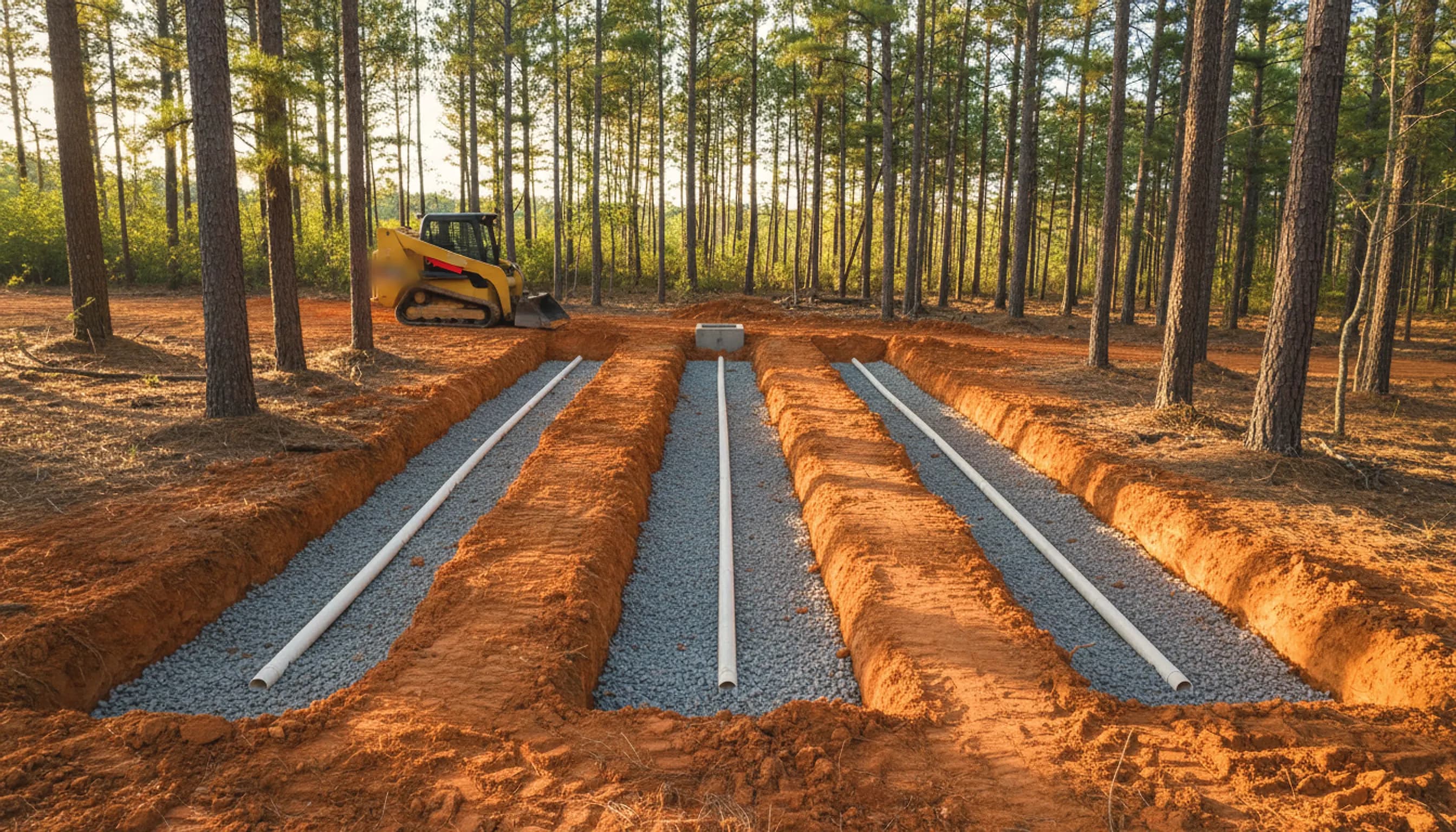
Drain field installation and repair on Lake Oconee lots, laid out around the 50-foot lake setback, steep slopes and Piedmont clay.
- Lake Oconee & Lake Sinclair
- Residential & commercial
- 10% off: military & first responders
Get a free estimate
or call (678) 863-5620The short answer
What does a drain field installation or repair involve on Lake Oconee?
A new or replacement field needs a county repair or construction permit from the Greene, Putnam or Morgan health office, trenches at least 50 feet from the lake's normal water level, and level lines on slopes under 25 percent. A Class Septic digs only in dry soil and keeps runoff off the finished field.↗↗↗
Reviewed by A Class Septic Services · Last updated
The Lake Oconee story
Measuring 50 feet from a lake that moves every day
The field setback on Lake Oconee is easy to state and harder to stake. Georgia measures 50 feet from the normal water level. Oconee is the upper pool of a pumped-storage project, so Wallace Dam draws it down in the day and pumps it back at night.↗↗
On a gentle cove, a foot and a half of lake level can move the edge of the water several feet sideways. We measure from full pond, not from whatever the shoreline shows the afternoon we visit.↗
On the Greene side, the county then sets aside the 75 feet nearest the high-water line when it checks lot size. Between that strip, the 50-foot field rule and the house, a lot that looks spacious from the road can come down to one strip of usable soil on a hillside.↗
On the record
- Lake Oconee normally swings between 435 feet (full pond) and 433.5 feet Plant Datum, an average daily fluctuation of about 1.5 feet, and is pumped back to 435 feet overnight.↗
- DPH excludes gullies, ravines, dry stream beds and natural or man-made drainage ways from consideration for any soil absorption field; wooded lake lots are full of them.↗
More about Lake Oconee
How we lay a field on a lake slope
Slope is the first test. DPH treats ground steeper than 25 percent as unsuitable unless a soil classifier's special investigation shows the limit can be overcome. Below that, trenches run level along the contour so effluent doesn't run to the low end and break out.↗
Trench size is set by rule. Trenches are no more than 36 inches wide, laterals are at least 7 feet apart center to center, and there is 6 to 12 inches of cover over at least 12 inches of aggregate. Placing trenches on 16-foot centers leaves room for a full replacement field between them later.↗
Timing matters in red clay. DPH bars trench excavation in wet soils other than sand, because the bucket smears and compacts the trench walls for good. After a wet spell, we wait.↗
- Where lots are on private wells, DPH wants absorption fields 50 feet from property lines unless the 100-foot well separation can still be held, which matters on well-water lots along the Greene shore.↗
- No part of a field except solid Schedule 40 pipe may sit under a building or pavement, or carry parking or vehicle traffic, so boat-trailer turnarounds stay off it.↗
Slope is the first test.
Warning signs
Signs the field, not the tank, is the problem
Seeing two or more of these? Call before it gets worse.
- 1. Soggy ground or a sewage smell over the trenches when it hasn't rained
- 2. Effluent seeping out of a bank or road cut below the field
- 3. Drains slow again soon after the tank was pumped
- 4. Lush stripes of grass along the trench lines in a dry August
- 5. Gutter downspouts emptying onto or above the field
Permits · Greene, Putnam or Morgan County Environmental Health
Permit path for a new or replacement field
- 01
A replacement field is a repair under Georgia's rules and must be permitted and inspected; a field for a new house rides on the construction permit.↗
- 02
Lay out the new trenches 50 feet from the lake, 100 feet from wells and 10 feet from water lines and basement walls.↗
- 03
Keep machines, spoil and clearing out of the 25-foot buffer and off Georgia Power land unless Georgia Power has approved it in writing.↗
- 04
Divert surface water, including stormwater and gutter discharge, away from the finished field.↗
What it costs
Drain field cost anchors
Leach field failure after improper repair
up to $20,000 to fix
Typical market range — HomeAdvisor: Septic Tank Repair Cost (updated Jun 19, 2026), 2026
Full conventional system, for comparison
$3,590-$12,463
Typical market range — HomeAdvisor: Septic System Installation Cost (updated Jun 20, 2026), 2026
Greene repair permit
$200
Typical market range — Greene County EH Fees (effective August 1, 2024), Northeast Health District, 2024
What moves the price
These are third-party typical market ranges, not our prices. Every job is quoted after we see it — estimates are free.
Free estimate: (678) 863-5620- 01Linear feet of trench the soil's percolation rate demands
- 02Whether the only good soil is uphill and needs a pump
- 03Tree and root removal in a mature hardwood lot
- 04Restoring a manicured lawn inside a gated community
FAQ
Lake Oconee drain field questions
Straight answers, with the rule or record behind them. Still unsure? Call and ask the crew that digs.
(678) 863-5620Where is the 50-foot setback measured from on Lake Oconee?
From the lake's normal water level. Oconee swings between 433.5 and 435 feet in normal operation, so full pond at 435 feet is the safe reference.
Source: Georgia Power: Wallace Dam Operations Brief (relicensing document)
Can a drain field go on a steep lake lot?
Up to 25 percent slope, yes, with level trenches on the contour. Steeper ground needs a soil classifier's special investigation showing the problem can be designed around.
Source: GA DPH Manual for On-Site Sewage Management Systems (March 2026), Section B: General Site Provisions
Can I park the boat trailer on the field?
No. DPH bars parking, vehicle traffic, buildings and pavement over any part of the field other than solid Schedule 40 pipe.
Source: GA DPH Manual for On-Site Sewage Management Systems (March 2026), Section F: Dispersal Systems
Why won't you dig the new field this week?
If the clay is wet, digging it smears and compacts the trench walls, and DPH bars trenching in wet non-sandy soil for that reason.
Source: GA DPH Manual for On-Site Sewage Management Systems (March 2026), Section F: Dispersal Systems
Does the ravine behind my house count as field area?
No. Gullies, ravines, dry stream beds and drainage ways are excluded from soil absorption fields.
Source: GA DPH Manual for On-Site Sewage Management Systems (March 2026), Section B: General Site Provisions
What does a replacement field permit cost in Greene County?
Greene's August 2024 fee sheet lists $200 for a residential repair permit.
Source: Greene County EH Fees (effective August 1, 2024), Northeast Health District
Nearby areas
Drain field work near Lake Oconee
Sources
Where these facts come from
Rules, costs and local facts on this page link to the agency, code or publisher that states them. Cost figures are third-party market ranges, not our prices — estimates are free.
Reviewed by A Class Septic Services · Last updated
- 1Ga. Comp. R. & Regs. r. 511-3-1-.07, Absorption Fields (LII)
- 2GA DPH Manual for On-Site Sewage Management Systems (March 2026), Section B: General Site Provisions
- 3GA DPH Manual for On-Site Sewage Management Systems (March 2026), Section F: Dispersal Systems
- 4Georgia Power: Wallace Dam Operations Brief (relicensing document)
- 5Greene County Board of Health: Lot Size Ordinance (effective Sept 7, 2018)
- 6Ga. Comp. R. & Regs. r. 511-3-1-.03, General Requirements for On-Site Sewage Management Systems (LII)
- 7Georgia Power: Lake Oconee Shoreline Guidelines (PDF)
- 8Greene County EH Fees (effective August 1, 2024), Northeast Health District
- 9HomeAdvisor: Septic Tank Repair Cost (updated Jun 19, 2026)
- 10HomeAdvisor: Septic System Installation Cost (updated Jun 20, 2026)
Ready when you are
Field wet when it shouldn't be? We'll find room for a new one.
We measure the setbacks, check the slope and soil, and give you a plain answer on repair versus replacement before any trench is opened.
(678) 863-5620- Lake Oconee & Lake Sinclair
- Residential & commercial
- 10% off for military & first responders
Free estimate
or call (678) 863-5620