Drain Field Installation & Repair · Greensboro, GA
Drain field repair, replacement and new installation for Greensboro and Greene County properties on difficult Piedmont soils.
- Lake Oconee & Lake Sinclair
- Residential & commercial
- 10% off: military & first responders
Get a free estimate
or call (678) 863-5620The short answer
What does drain field repair or installation in Greensboro, GA involve?
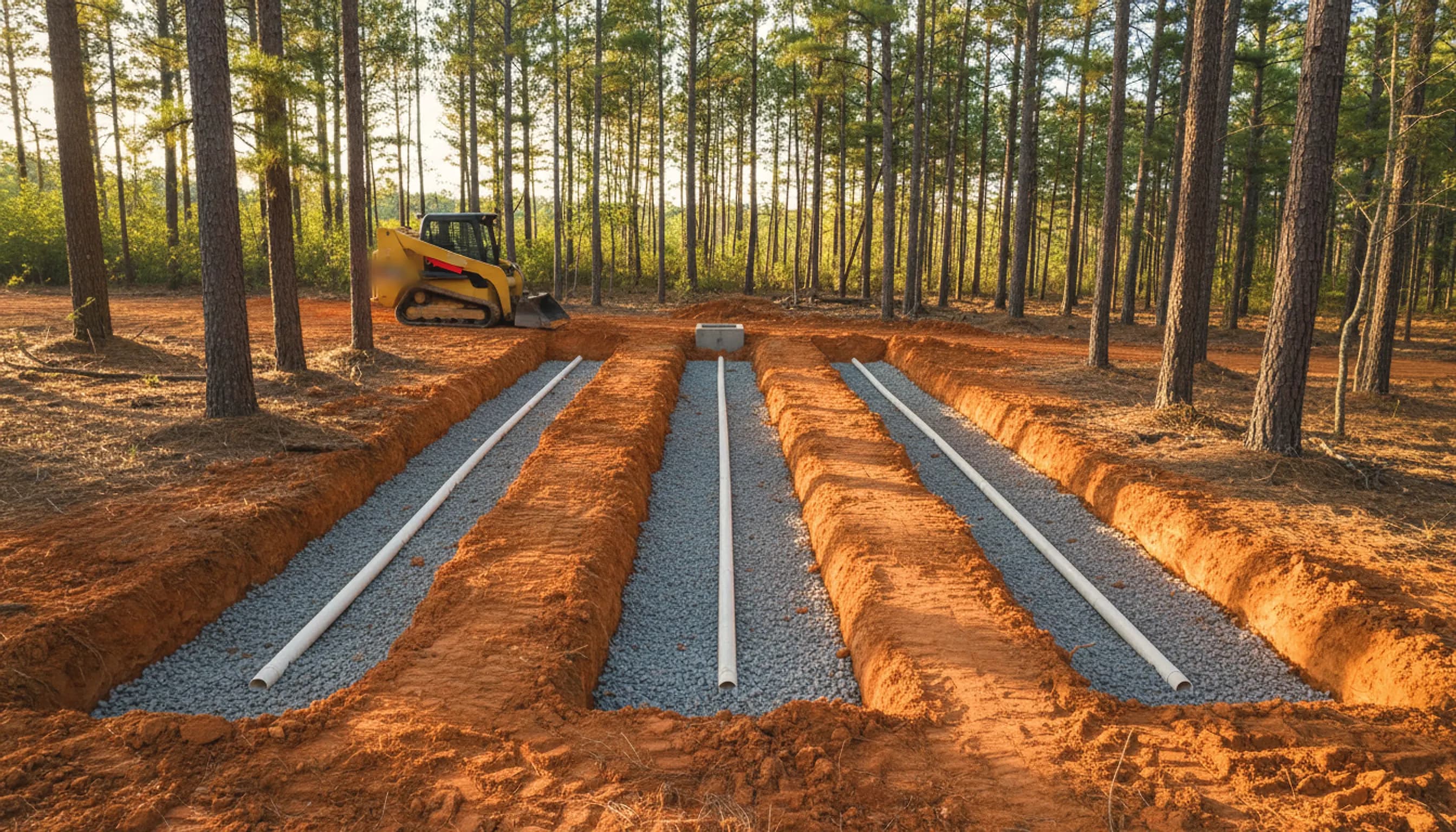
Around Greensboro, fixing a failed drain field usually means new absorption trenches in the lot's replacement area, laid out for Greene County soils that NRCS mostly rates limited for septic. Greene County Environmental Health permits and inspects the work, and new lines stay 50 feet from Lake Oconee, ponds or creeks and 100 feet from any well.↗↗↗
Reviewed by A Class Septic Services · Last updated
Soil & terrain
Greene County soil: very little of it is easy
NRCS rates about 38 percent of Greene County's surveyed acreage very limited for septic absorption fields and another 57 percent somewhat limited. Put plainly, almost every field in the county is a design problem of some degree, and the ones that fail early were often designed for better soil than they got.↗
Cecil, the county's largest soil, covers about a third of the surveyed acreage. The trouble soils are Cataula, Helena and Hard Labor, about 35,000 acres together, with subsoils that slow water down, and Chewacla in the creek bottoms, which is wet floodplain ground. A field on any of them needs more length, more care, or a different system.↗
- Lake Oconee
Warning signs
Field failure, Greene County edition
Seeing two or more of these? Call before it gets worse.
- 1. A wet strip running downhill from the field lines toward the pasture fence
- 2. Sewage odor on still evenings near the field
- 3. Slow drains that come back within weeks of a pump-out
- 4. Field lines surfacing where cattle or a truck rutted the ground
- 5. Ponding over the field after rains that the rest of the yard shrugs off
Local facts
Field numbers for Greensboro and Greene lots
Each row links to the agency, code or publisher it comes from. Tap a source to check it yourself.
| Topic | What it says | Source |
|---|---|---|
| Repair permit | $200 residential, $300 commercial | Greene County EH Fees (effective August 1, 2024) |
| Addition or modification inspection | $175 residential | Same source as above |
| Fields where neighbors use wells | 50 ft from property lines unless the 100-ft well separation can be kept | GA DPH Manual for On-Site Sewage Management Systems (March 2026), Section F: Dispersal Systems |
| Separation to rock or water table | 24 in under a conventional trench; 12 in with Class I aerobic pretreatment | Same source as above |
| Which way it drains | West of a Woodville-Union Point-White Plains line, to the Upper Oconee and Lake Oconee | Wikipedia: Greene County, Georgia |
The Greensboro story
Farm lots on wells: the 100-foot circle
Where a Greene parcel depends on a private well, the county's lot minimum doubles to 1.5 acres. A replacement field has to stay 100 feet from every well, including the neighbor's, and where wells are the norm the state pushes fields 50 feet in from property lines unless the full 100-foot spacing can be held.↗↗
On an old farm parcel off a county road, that circle around the well house can eat the obvious spot for new lines. The fix is often to go the other direction across the yard, which means a longer run of solid pipe or a pump. We map the wells before we price the trench.
Where a Greene parcel depends on a private well, the county's lot minimum doubles to 1.5 acres.
Permits · Greene County Environmental Health, Northeast Health District (1031 Apalachee Avenue, Greensboro)
Replacing a field in Greene County, step by step
- 01
Confirm the field is the failure by checking the tank level, outlet filter and distribution box first.
- 02
Request the repair permit from Greene Environmental Health (706-453-4471).↗
- 03
Build the new trenches only when the soil is dry; wet clay smears and compacts permanently when excavated.↗
- 04
Hold the field for county inspection before cover.↗
What it costs
Drain field costs from outside sources
Leach field failure fix after improper repairs
Up to $20,000
Typical market range — HomeAdvisor: Septic Tank Repair Cost (updated Jun 19, 2026), 2026
Drip dispersal system
$8,000 to $18,000
Typical market range — HomeAdvisor: Septic System Installation Cost (updated Jun 20, 2026), 2026
Aerobic system
$10,000 to $20,000
Typical market range — HomeAdvisor: Septic System Installation Cost (updated Jun 20, 2026), 2026
Greene residential repair permit
$200
Typical market range — Greene County EH Fees (effective August 1, 2024), 2024
What moves the price
These are third-party typical market ranges, not our prices. Every job is quoted after we see it — estimates are free.
Free estimate: (678) 863-5620- 01Trench length needed in slow Cataula or Helena subsoil
- 02Room left after well and property-line setbacks
- 03Whether pretreatment lets the field sit shallower
- 04Distance and lift from the tank to the new area
Services here
Systems we turn to when a standard field won't fit
- 01Aerobic systemsCleaner effluent halves the required separation to rock or water.Aerobic systems details
- 02Drip systemsShallow emitter lines for thin soil and odd-shaped lake lots.Drip systems details
- 03Pump systemsSends effluent to the good ground when it's uphill.Pump systems details
- 04Septic repair in GreensboroIf the tank turns out to be the real problem.Septic repair in Greensboro details
FAQ
Greensboro drain field questions
Straight answers, with the rule or record behind them. Still unsure? Call and ask the crew that digs.
(678) 863-5620Why do so many drain fields fail around Greensboro?
Much of Greene's soil is rated very limited (about 38 percent) or somewhat limited (about 57 percent) for absorption fields by NRCS, so fields designed without enough margin give out early.
Source: USDA NRCS Soil Data Access: ENG Septic Tank Absorption Fields, survey area GA133
What does Greene County charge for a drain field repair permit?
The residential repair permit is $200; a commercial one is $300.
How close to my well can new field lines go?
No closer than 100 feet from any well or spring, and 50 feet from the normal water level of a lake, pond or stream.
Source: Ga. Comp. R. & Regs. r. 511-3-1-.07, Absorption Fields (LII)
Can a failed field be replaced with something smaller?
Sometimes. With aerobic pretreatment to Class I effluent, the required separation to rock or the water table drops from 24 inches to 12, which can open up ground a conventional trench couldn't use.
Source: GA DPH Manual for On-Site Sewage Management Systems (March 2026), Section F: Dispersal Systems
Is it OK to dig the new field right after a week of rain?
No. Georgia's manual bars trench excavation in non-sandy soils while they are wet, because the smearing and compaction can't be undone.
Source: GA DPH Manual for On-Site Sewage Management Systems (March 2026), Section F: Dispersal Systems
Can a replacement field go anywhere on a lot inside Greensboro?
Not near a city water supply well. Greensboro's wellhead protection code prohibits septic tanks and drain fields within 1,500 feet of one, which rules out some in-town lots entirely.
Source: Greensboro Code § 117-5: Wellhead protection zones, prohibited uses
Sources
Where these facts come from
Rules, costs and local facts on this page link to the agency, code or publisher that states them. Cost figures are third-party market ranges, not our prices — estimates are free.
Reviewed by A Class Septic Services · Last updated
- 1USDA NRCS Soil Data Access: ENG Septic Tank Absorption Fields, survey area GA133
- 2Ga. Comp. R. & Regs. r. 511-3-1-.03, General Requirements for On-Site Sewage Management Systems (LII)
- 3Ga. Comp. R. & Regs. r. 511-3-1-.07, Absorption Fields (LII)
- 4Greene County EH Fees (effective August 1, 2024)
- 5GA DPH Manual for On-Site Sewage Management Systems (March 2026), Section F: Dispersal Systems
- 6Wikipedia: Greene County, Georgia
- 7Greene County Board of Health: Lot Size Ordinance (effective Sept 7, 2018)
- 8Northeast Health District: Greene County locations (Environmental Health)
- 9HomeAdvisor: Septic Tank Repair Cost (updated Jun 19, 2026)
- 10HomeAdvisor: Septic System Installation Cost (updated Jun 20, 2026)
- 11Greensboro Code § 117-5: Wellhead protection zones, prohibited uses
Ready when you are
Field lines giving out in Greene? We'll find good ground.
Tell us where the house, the well and the old field are. We'll check what failed and lay out a replacement the county can approve.
(678) 863-5620- Lake Oconee & Lake Sinclair
- Residential & commercial
- 10% off for military & first responders
Free estimate
or call (678) 863-5620