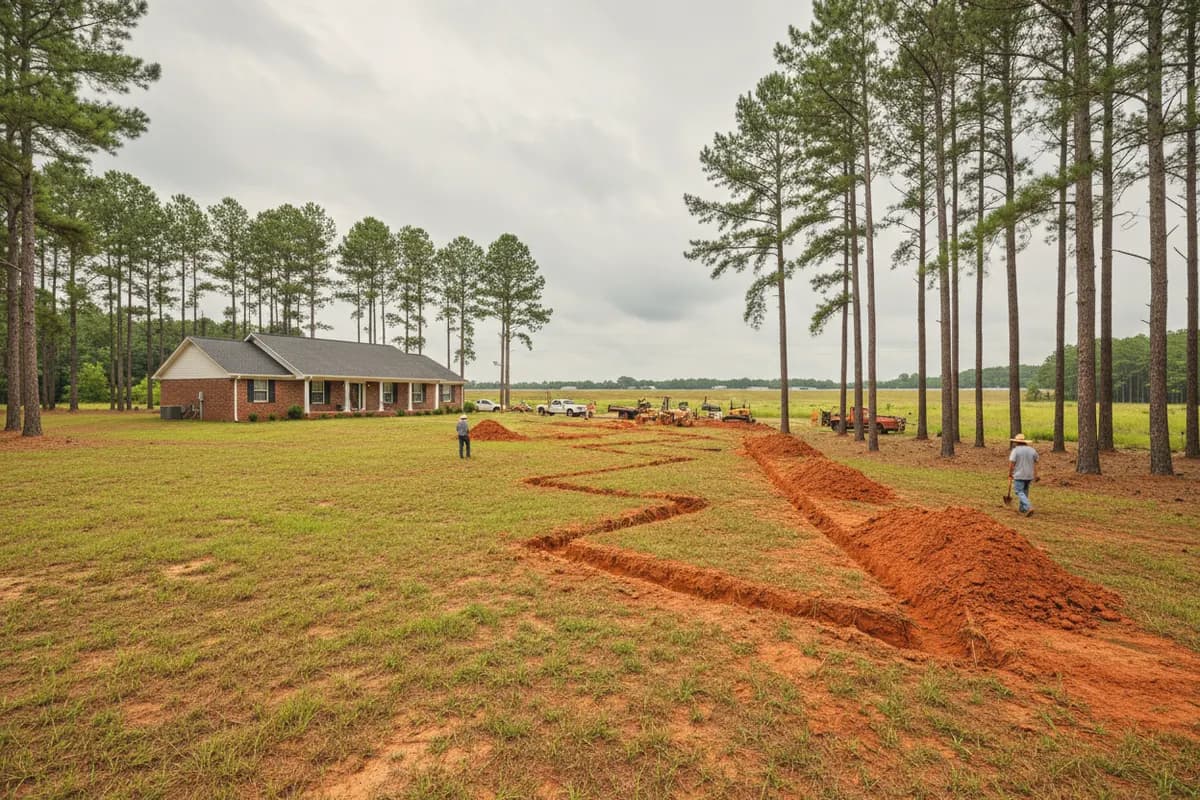
Drain Field Installation & Repair · Gray, GA
Drain field installation, repair and replacement for homes in Gray and Jones County, Georgia.
- Lake Oconee & Lake Sinclair
- Residential & commercial
- 10% off: military & first responders
Get a free estimate
or call (678) 863-5620The short answer
What does drain field installation or repair involve in Gray, GA?
Around Gray, a new or replacement drain field is permitted and inspected by Jones County Environmental Health (North Central Health District). The trenches are sized from a soil evaluation, kept 100 feet from wells, and left open for the county's inspection. A Class Septic Services digs, lays and covers the field after approval.↗↗↗
Reviewed by A Class Septic Services · Last updated
Soil & terrain
What is under a Jones County yard
Jones County shares one soil survey with Baldwin and Putnam, and Davidson is the biggest name in it, about 206,000 acres across the three counties as a major component. It is the soil mapped at the center of Gray, too: Davidson loam on gentle 2 to 6 percent slopes, rated somewhat limited for absorption fields.↗
Davidson is deep and well drained, with a dark red clay subsoil. That clay holds a trench wall well, but it accepts effluent slowly, which is why fields here run longer than people expect. Cecil, the survey's second-largest soil, behaves similarly. Wilkes, also common in the survey, is the troublemaker: it is shallow to weathered rock, so a field laid out on paper can hit rock a foot or two down.↗↗
Local facts
Drain field rules that decide the layout
Each row links to the agency, code or publisher it comes from. Tap a source to check it yourself.
| Topic | What it says | Source |
|---|---|---|
| From a well | 100 feet minimum | Ga. Comp. R. & Regs. R. 511-3-1-.07, Absorption Fields (LII) |
| From a creek, stream or pond | 50 feet from the normal water level | Same source as above |
| From property lines, where neighbors use wells | 50 feet, unless the 100-foot well distance can still be kept | GA DPH Manual for On-Site Sewage Management Systems (March 2026), Section F: Dispersal Systems |
| Trench width and spacing | No wider than 36 inches; laterals at least 7 feet apart, center to center | Same source as above |
| Cover and stone | 6 to 12 inches of earth cover; at least 12 inches of aggregate | Same source as above |
| Slowest allowed perc, lot under 3 acres | 90 minutes per inch (120 on 3 acres or more, conventional) | Same source as above |
| Replacement room | Enough open land for a complete replacement field; 16-foot trench centers leave room between | Same source as above |
Warning signs
Signs the field, not the tank, is the problem
Seeing two or more of these? Call before it gets worse.
- 1. Wet ground or a sheen of water over the lines days after the last rain
- 2. A sewage smell in the yard but not at the tank lid
- 3. Drains that slow down after heavy rain and recover in dry spells
- 4. Grass over the trenches noticeably greener and taller in August
- 5. The tank was pumped recently and the house still drains slowly
The Gray story
Why Gray fields fail in winter and how we rebuild them
Clay fields in this part of Georgia tend to struggle most in late winter, when the ground is already full of water and the trenches have nowhere to send effluent. A gutter or driveway that dumps runoff across the field makes it worse; DPH requires fields to be protected from stormwater and roof drainage for exactly that reason.↗
Timing matters on the repair side too. The DPH manual says trenches in anything other than sand must not be dug while the soil is wet, because the bucket smears and compacts the trench walls and the damage does not reverse. In Davidson clay that means we plan field work for a dry stretch, even when the owner wants it done the same week.↗
A rebuild usually means new trenches in the reserved replacement area, or between the old lines where they were spaced wide enough, with the runoff diverted first. Where the only good soil is uphill of the tank, a pump tank can feed it.
- Georgia's DPH manual forbids digging absorption trenches in non-sandy soil while it is wet, because smearing and compaction are irreversible.↗
Clay fields in this part of Georgia tend to struggle most in late winter, when the ground is already full of water and the trenches have nowhere to send effluent.
What it costs
Drain field cost ranges
New drain field
$5,000 to $12,000
Typical market range — HomeAdvisor: Septic System Installation Cost (updated Jun 20, 2026), 2026
Drain field replacement
around $7,000
Typical market range — HomeAdvisor: Septic System Installation Cost (updated Jun 20, 2026), 2026
Cracked or broken lateral line
$1,500 to $5,000
Typical market range — HomeAdvisor: Septic Tank Repair Cost (updated Jun 19, 2026), 2026
What moves the price
These are third-party typical market ranges, not our prices. Every job is quoted after we see it — estimates are free.
Free estimate: (678) 863-5620- 01Trench length the Davidson or Cecil perc rate calls for
- 02Rock depth where Wilkes soil shows up
- 03Room left after the 100-foot well setback
- 04Whether the new field needs a pump to reach it
Nearby areas
Drain field work around Jones County
FAQ
Drain field questions around Gray
Straight answers, with the rule or record behind them. Still unsure? Call and ask the crew that digs.
(678) 863-5620Can my old field lines in Gray be repaired, or do they need replacing?
A crushed or separated line can often be dug out and replaced. A field that is saturated end to end usually needs new trenches in the replacement area. Either way, the county permits and inspects the work.
Is Jones County soil good for a septic field?
It is workable. Davidson loam, mapped at the center of Gray, is rated somewhat limited for absorption fields, which mostly means longer trenches.
Source: USDA NRCS Soil Data Access: map unit at Gray's Census centroid (33.0020, -83.5409)
How far does a drain field have to be from my well?
At least 100 feet, and 50 feet from the normal water level of any stream or pond.
Source: Ga. Comp. R. & Regs. R. 511-3-1-.07, Absorption Fields (LII)
Can I park or build over part of the field?
No. Only solid schedule 40 pipe may sit under pavement, buildings or vehicle traffic; the trenches themselves stay open ground.
Source: GA DPH Manual for On-Site Sewage Management Systems (March 2026), Section F: Dispersal Systems
Why did my field flood this winter when it was fine all summer?
Saturated clay plus roof or driveway runoff crossing the field. DPH requires fields to be protected from stormwater and gutter discharge; diverting it is often part of the fix.
Source: GA DPH Manual for On-Site Sewage Management Systems (March 2026), Section F: Dispersal Systems
Who inspects a new field in Gray?
Jones County Environmental Health, at the health department on Forest Street, inspects before the trenches are covered.
Source: North Central Health District: Jones County Environmental Health Department
Sources
Where these facts come from
Rules, costs and local facts on this page link to the agency, code or publisher that states them. Cost figures are third-party market ranges, not our prices — estimates are free.
Reviewed by A Class Septic Services · Last updated
- 1North Central Health District: Jones County Environmental Health Department
- 2Ga. Comp. R. & Regs. R. 511-3-1-.07, Absorption Fields (LII)
- 3Ga. Comp. R. & Regs. r. 511-3-1-.03, General Requirements for On-Site Sewage Management Systems (LII)
- 4USDA NRCS Soil Data Access (SSURGO), survey area GA604 Baldwin, Jones, and Putnam Counties
- 5USDA NRCS Official Series Description: Davidson series
- 6USDA NRCS Official Series Description: Wilkes series
- 7GA DPH Manual for On-Site Sewage Management Systems (March 2026), Section F: Dispersal Systems
- 8HomeAdvisor: Septic System Installation Cost (updated Jun 20, 2026)
- 9HomeAdvisor: Septic Tank Repair Cost (updated Jun 19, 2026)
Ready when you are
Wet yard over the field lines? Let's find out why.
We will look at the field, the runoff around it and the soil, and tell you whether it is a line repair or a new field. Jones County permitting is part of the job. 10% off for military and first responders.
(678) 863-5620- Lake Oconee & Lake Sinclair
- Residential & commercial
- 10% off for military & first responders
Free estimate
or call (678) 863-5620